From Frustration to Frontier: How AI-Powered Platforms Are Closing the Insurance Gap
Mar 20, 2026Written by Sabine VanderLinden
-
The $1.8 Trillion Problem: A massive protection gap leaves most SMEs dangerously underinsured, but a new wave of AI-driven insurance is turning the tide, creating significant social currency for the firms that get it right. Seismic shifts in the insurance market, driven by AI and digital transformation, are forcing insurers and startups alike to rethink how they deliver and consume coverage.
-
Speed is the New Scale: Forget 19-day waits. Digital platforms are delivering insurance quotes in minutes, not months, a powerful trigger for startup founders who value velocity above all else. Emerging trends in AI-powered insurance platforms are accelerating this shift, enabling faster, more accurate, and more personalized coverage.
-
Embedded, Invisible, Essential: The future of business insurance is integrated directly into the platforms startups already use, making protection a public, seamless, and intelligent part of their growth story. New technologies such as AI and cloud-based architectures are enabling these embedded, invisible, and essential insurance solutions, reducing reliance on legacy systems and opening new strategic opportunities.
The Silicon Valley Shuffle: A Startup’s Insurance Nightmare
Imagine this: you’re a founder, fresh out of a Y Combinator batch, your startup’s trajectory a steep climb. You’ve secured funding, hired a crack team, and your product is gaining traction. Then comes the email from a potential enterprise client, the one that could change everything. It’s a standard procurement checklist, but one line item stops you in your tracks: “Certificate of Insurance.” Suddenly, your high-flying venture is grounded by a process that feels like it was designed in a different century. Endless forms, opaque pricing, and a 19-day average wait for a commercial policy—a lifetime in the startup world. This isn’t a hypothetical; it’s the frustrating reality for countless entrepreneurs, a story that resonates deeply within the founder community. On top of the logistical hurdles, fear of the unknown and the complexity of insurance requirements can paralyze founders, making them hesitant to move forward with critical deals.
This friction, this chasm between the speed of innovation and the sluggish pace of traditional insurance, is more than an inconvenience. It’s a critical barrier to growth, a key contributor to the staggering $1.8 trillion global protection gap [2]. For small and medium-sized enterprises (SMEs), the backbone of the US economy, this gap is a crisis. A shocking 77% of U.S. small businesses are underinsured, a number that has been climbing [3]. The problem isn’t just a lack of options; it’s a crisis of complexity and comprehension. Startups face the unique challenge of navigating insurance complexity while trying to focus on growth and innovation. A recent study found that a staggering 83% of small business owners couldn’t correctly describe what Professional Liability coverage entails [3]. How can we expect founders to build the future when they’re bogged down by the past, struggling to navigate a system that doesn’t speak their language or determine the right coverage for their needs?
Why This Matters Now: The Age of AI and the Urgency of Adaptation
The landscape is shifting at an unprecedented pace. We are in the age of AI, where digital transformation is not a buzzword but a baseline expectation. Over half of all SMEs are projected to get their insurance through digital-first intermediaries by 2028. The demand for a “wallet-native CX”—a seamless, embedded, and intuitive customer experience—is no longer a preference; it’s a prerequisite. This provides immense Practical Value to time-starved founders. Business leaders are now at the forefront, driving digital transformation in insurance by championing innovation and supporting the adoption of AI-powered platforms. Yet, the insurance industry has been slow to adapt.
Organizations across the sector are rethinking their insurance strategies in response to digital disruption, seeking new ways to deliver value and remain competitive. Data show that while 88% of insurers use AI, only a meager 12% have successfully scaled it, revealing a massive execution gap [5]. The critical role of technology and leadership in bridging this gap is evident, as successful digital transformation depends on both robust technological infrastructure and visionary leadership.
This is where the opportunity lies, creating a powerful emotional driver for change. A new breed of “AI-native” agencies is emerging, not just digitizing old processes but fundamentally redesigning them. As Andrei Craciunescu, CEO of the Y Combinator-backed AI insurance agency RiskCube, explained in a recent interview at ITC Vegas, the goal is to create an “AI insurance agency for startups” where founders can “buy and manage insurance online”. This isn’t just about convenience; it’s about creating a new paradigm where insurance acts as a growth accelerator, not a risk absorber, fostering a positive Emotion around a traditionally dreaded topic.
“We want to have a quote in minutes and not in months anymore,” Craciunescu states, capturing the essence of this new movement. This simple, powerful statement is a rallying cry for a generation of entrepreneurs who refuse to accept the status quo.

The Distribution Intelligence Layer: Building the Future of Insurance
The solution lies in what can be termed the Distribution Intelligence Layer—a technology-first approach that sits between the complexity of the insurance market and the needs of the modern business. This is the core of what companies like RiskCube are building. Building this layer requires a combination of advanced tools—such as AI-driven risk assessment instruments and security solutions—and dedicated resources, including human expertise and capital, to effectively identify, evaluate, and mitigate risks. It’s not about replacing human expertise but augmenting it with AI to automate the automatable and free up humans to do what they do best: build relationships and provide strategic advice. This creates a compelling story of human-machine collaboration.
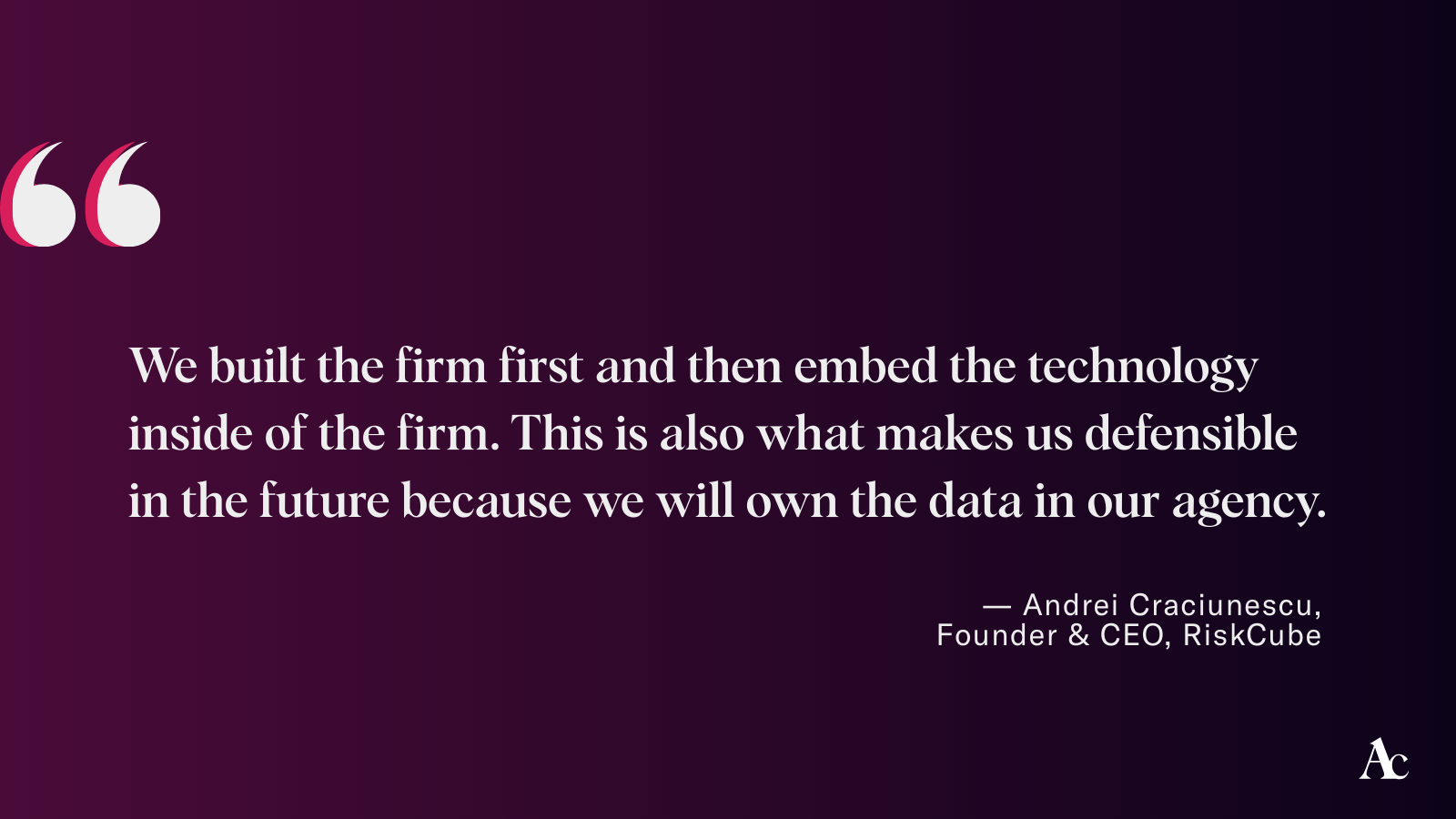
Craciunescu emphasizes this point: “We built the firm first and then embedded the technology inside the firm. This is also what makes us defensible in the future because we will own the data in our agency”. This is a critical distinction. By building a clean, proprietary data foundation, these new players can maintain control over their data and processes, train their own AI models, ensure data privacy, and deliver more accurate, personalized recommendations. This approach directly addresses the trust deficit in the industry, a major concern for founders. In an era of heightened data sensitivity, this commitment to data ownership and security is a powerful form of Social Currency.
Ultimately, the ability of these firms to innovate and adapt in a rapidly changing market is what sets them apart as leaders in closing the insurance gap for startups.
The Three Pillars of the New Insurance Frontier:
-
Embedded Distribution: The future of insurance is invisible. It will be woven into the fabric of the platforms and services that businesses already use. Think of it like Brex for insurance—a seamless experience where coverage is a natural extension of a startup’s financial operations. As Craciunescu notes, “We want to be like Brex but for startup insurance where founders can come to us, and they trust the system”. The embedded insurance market is projected to exceed $70 billion in the U.S. by 2030, underscoring the power of this model. This makes the act of getting insured Public, a visible and effortless part of the startup ecosystem.
-
AI-Powered Risk Intelligence: The traditional, one-size-fits-all Business Owner’s Policy (BOP) is a relic of the past. AI allows for a much more granular and dynamic understanding of risk. By analyzing a company’s digital footprint, these platforms can provide tailored recommendations and pricing, ensuring that startups are not over- or under-insured. This is the shift from static, reactive underwriting to a proactive, real-time service layer. AI also optimizes business processes by automating routine workflows and enhances employee experience by enabling staff to focus on higher-value tasks and engage more effectively with digital tools. This provides immense Practical Value by ensuring founders get the right coverage at the right price.
-
Radical Transparency and Simplicity: The confusion and frustration that founders experience is a direct result of the industry’s opacity. The new frontier is about demystifying insurance. By providing clear comparisons, explaining coverage in plain English, and offering a fully digital experience, these platforms are empowering founders to make informed decisions. This focus on customer experience is paramount, as evidenced by the fact that a good service experience is now a more significant driver of retention than price. This simplicity and transparency create a positive Emotion and build lasting trust. The benefits of this approach include greater clarity, improved decision-making, and significant cost savings for startups seeking coverage.
AI-powered platforms also deliver deeper insights into insurance needs and risk profiles, helping startups and insurers make more informed, data-driven decisions.
The Frontier Firm: A New Breed of Insurer
What we are witnessing is the rise of the Frontier Firm in insurance—agile, tech-forward companies that are not afraid to challenge the status quo. These firms understand that in the age of AI, speed, and intelligence are the keys to unlocking a vast and underserved market. They are not just building better distribution channels; they are building a better insurance product, one that is designed for the unique needs of the modern, digital-native business. The Story of the Frontier Firm is one of disruption and empowerment.
New practices in risk management and risk assessment are shaping the industry, as organizations adopt proactive methods to identify, evaluate, and mitigate emerging risks. These practices are increasingly integrated into digital transformation strategies, ensuring that risk management is embedded in every phase of innovation. Evolving business strategy and business models are necessary for digital transformation, as companies must adapt their operations and offerings to remain competitive. Insurance platforms now support startups during a funding round, aligning coverage with growth milestones and helping them generate revenue. Startups benefit from ongoing support, and AI enables them to handle more work efficiently as they scale. Organizations move through different phases of AI adoption, with changing job titles reflecting new roles and responsibilities in this evolving landscape. Employees play a critical role in driving change and managing supply chain risks, ensuring resilience across interconnected networks.
Protecting confidential information and managing risks across the network of partners is essential for maintaining trust and compliance. The impact of risk on the balance sheet highlights the need to raise awareness of new insurance models and their financial implications. In the new world of digital insurance, transformation is no longer optional for startups seeking relevance and growth. Agentic AI and AI agents are transforming the industry by automating processes and enabling new forms of collaboration. A strong focus on customers is driving innovation, and established companies are adapting by embracing e-commerce and digital channels. One example is the recent 'RockYou2024' data breach, which underscores the importance of robust risk management and data protection. Lessons learned from past digital transformation efforts continue to inform best practices and guide future strategies.

This transformation is not without its challenges. The insurance industry is notoriously resistant to change, and the talent gap is a significant hurdle. However, the momentum is undeniable. The fact that major investors are pouring capital into this space is a clear signal that the industry is on the cusp of a major disruption. The regulatory landscape is also a complex and evolving factor. With 38 states having adopted or enacted AI-related measures in the past year, navigating this patchwork of regulations is a significant challenge for both incumbents and startups. However, it also presents an opportunity for firms that can build governance and compliance into the core of their technology from day one.
As Craciunescu passionately states, the ultimate goal is to change the perception of insurance itself: “People see insurance really positive and not so negative anymore… I would like the people just go to or come to another provider or us and see insurance as a partner and not really the enemy”. This is the promise of the new insurance frontier—a future where insurance is not a necessary evil but a strategic partner in growth and resilience. This vision, when realized, will generate immense Social Currency for the entire industry.
Frequently Asked Questions (FAQ)
Q: What is the biggest mistake startups make when it comes to insurance?
A: The most common mistake is delaying the purchase of insurance until it’s too late. Many founders wait until they have a contract that requires it, leaving them exposed to significant risks in the early stages of their business. Another major issue is not understanding their policy, which often leads to being underinsured.
Q: How is AI changing the insurance industry for SMEs?
A: AI is streamlining the entire insurance value chain, from quoting and underwriting to claims processing. For SMEs, this means faster, more accurate, and more transparent access to insurance. AI-powered platforms can analyze a business’s unique risk profile and recommend the right coverage, eliminating the guesswork and complexity of traditional insurance.
Q: What is embedded insurance, and why is it important for startups?
A: Embedded insurance integrates coverage directly into the products and services that businesses already use. For startups, this means a frictionless experience where insurance is a seamless part of their operations, rather than a separate, cumbersome process. This is crucial for fast-moving companies that need to focus on growth.
Q: What are the key challenges to AI adoption in the insurance industry?
A: The primary barriers are not technological but organizational. They include cultural resistance to change, a shortage of AI talent, the difficulty of integrating new systems with legacy infrastructure, and navigating a complex and fragmented regulatory landscape. Overcoming these requires a holistic, enterprise-wide strategy.
References
[1] Hiscox. (2025). Hiscox Small Business Insurance Report.
[2] Swiss Re. (2025). Natural Catastrophes in 2024.
[3] Insurance Business. (2025). Most US small businesses lack full coverage - Hiscox.
[4] GM Insights. (2024). SME Insurance Market.
[5] Deloitte. (2025). Scaling Gen AI in the Insurance Industry.
[6] Craciunescu, A. (2026, February 2). Redesigning Insurance for the AI-Powered Startup Era
[7] Conning. (2023). Embedded Insurance Distribution.
[8] J.D. Power. (2025). 2025 U.S. Small Commercial Insurance Study.
[9] CB Insights. (2025). State of Insurtech Q3 2025 Report.
[10] QBE North America. (2025). Insuring the emerging AI regulatory landscape.
Editor in Chief

Rebuilding Risk Resilience