AI Horizons 2030: The Readiness Problem. What the room decided...
Oct 30, 2026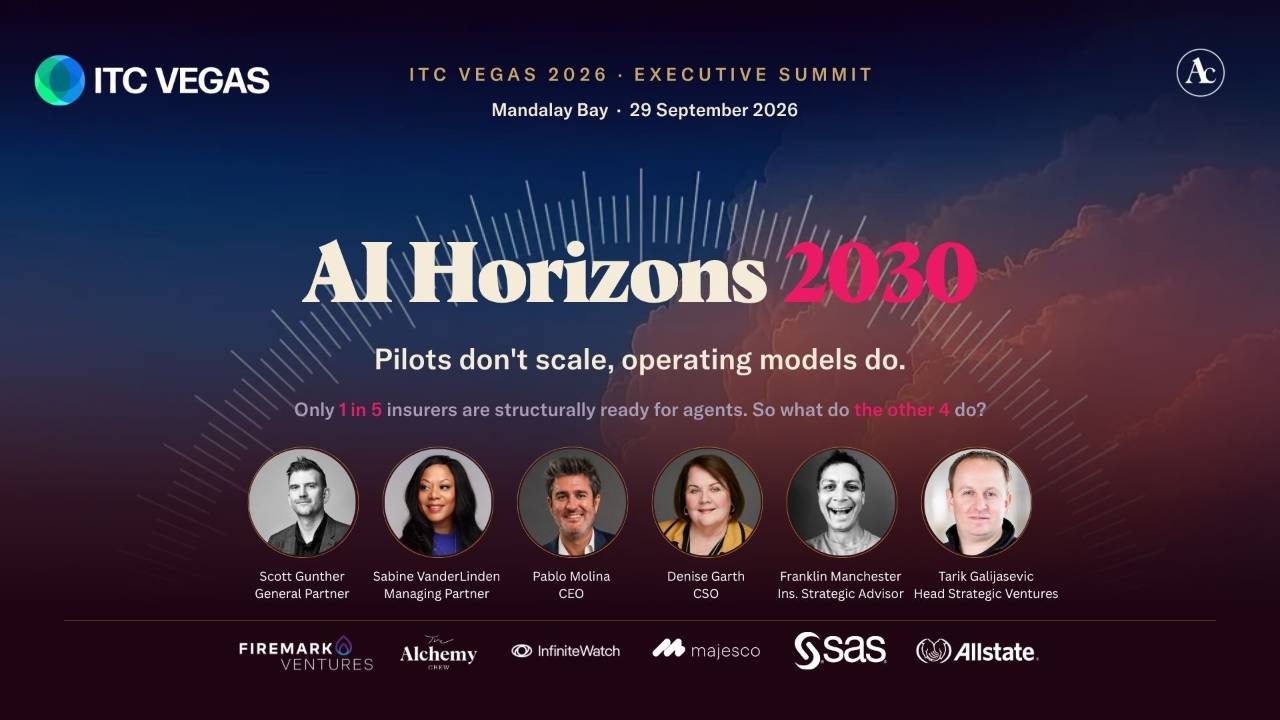
Written by Sabine VanderLinden
ITC Vegas 2026 Executive Summit · Mandalay Bay, Las Vegas · 29 September 2026
The Verdict in Three Lines
- Only one in five insurers is structurally ready to run AI agents at scale. If your organization sits with the other four, you are not doomed; you are undecided. The research we built with Bayes Business School shows 26 of 30 leading P&C carriers have not crossed the halfway mark on both transformation axes. Majesco dives deep into the Frontier Insurer Index.
- Proprietary data and encoded judgment are where operating-model value concentrates by 2030. That was the verdict of 70 of your peers in our room at ITC Vegas: 61% backed the moat, only 6% the model layer, where most of our industry’s spend sits. Your decades of underwriting decisions are the one asset nobody can replicate.
- Trust is a return driver, not compliance overhead. Insurers that build trustworthy AI practices are 15 times more likely to report strong AI outcomes (sources: SAS and IDC). Pilots don’t scale, operating models do, and the Frontier Operating Model starts with a question you can answer today: who owns this?
The afternoon started with one word
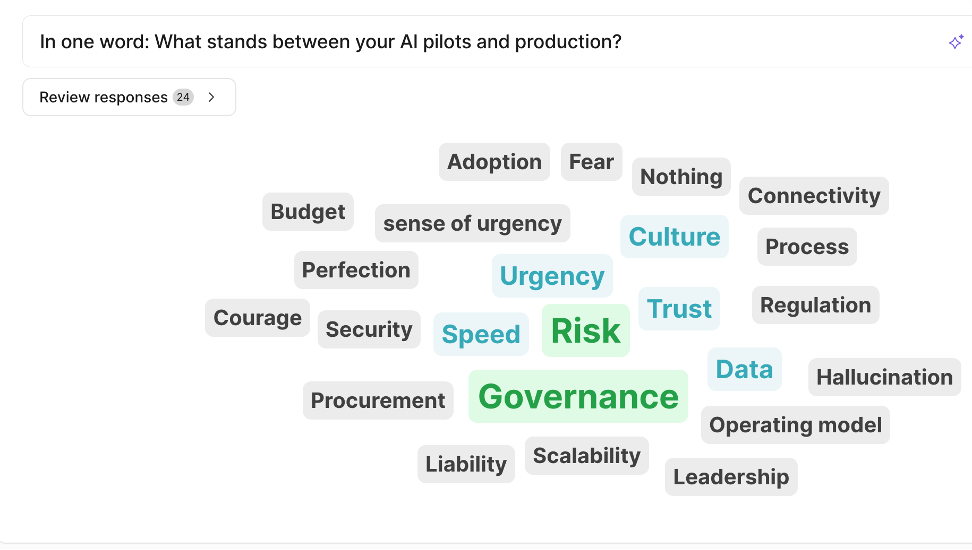
70 executives, one private room at Mandalay Bay, and a single question on the screen before anyone had found their seat: in one word, what stands between your AI plans and your results? The first answer called across the room was "trust." When the word cloud filled the screen, two words sat at its center: governance and risk. Trust, culture, urgency, speed, and data filled the next ring, with budget, procurement, courage, and one defiant "nothing" around the edge. By the end of the afternoon, governance and trust had earned their place at the center of the story.
AI Horizons 2030: The Readiness Problem was not built as a conference. It was built as a working session: fewer speeches, more microphones, one commitment each. Three house rules framed it: what is said in the room stays in the room, the room is the panel, and nobody leaves without one practical commitment for Q1 2027. Insurers, reinsurers, brokers, MGAs, investors and a hand-picked cohort of AI-native providers sat at mixed tables, each with a Frontier Insurer Operating Model Canvas in front of them. The summit ran with the support of Allstate, IAG Firemark Ventures, Majesco, SAS and InfiniteWatch, with guest market lenses from WTW, MAPFRE, FinTLV, Mundi Ventures, Stripe, WaniWani, Adaptive Insurance, EOS Venture Partners and Intact Ventures.
Three hours, six segments: the Investor Lens, the Research Reveal, the Market Lens, the Tech Lens, Trust by Design, and a Working Session that ended in a Verdict.
This is the report I promised the room. Speakers are credited by name. And the room's own voices stay in the room.
From provocations to readiness: how the thesis moved in twelve months
Last year's summit, AI Horizons 2030: Provocations and Possibilities, sat in the same venue on 14 October 2025 and asked open questions. Would AI deliver an efficiency utopia or erode human trust? Could insurance startups compete when OpenAI alone had raised 31 times more than the entire insurtech sector? Would underwriters be eliminated or empowered?
The numbers we leaned on this year were failure rates: 95% of enterprise AI projects failing to scale, 73% of insurtech proofs of concept never reaching production.
Twelve months on, nobody asked whether AI would matter. The agents are at the door, and the capability is a commodity. The next question is readiness: who owns it, what operating model runs it, and what governance runs it in production.
Three shifts stand out.
- From pilots to execution: last year's debate about where to pilot has become a measurement of Frontier transformation, and why it stalls, with 26 of 30 leading carriers short of the halfway mark on both transformation axes.
- From hybrid strategy to the moat: last year the room chose "all three"; this year it chose proprietary data and encoded judgment by a wide margin.
- From trust as risk to trust as return: the 1.6x ROI uplift we cited last year has become a 15-fold likelihood of strong outcomes in the SAS and IDC data. One line aged unexpectedly: "agents won't vanish, they'll evolve" referred to human agents. This year the word meant software.
The number the room walked in with
One in five. That was the provocation the whole discussion before ITC Vegas ran on: by our current assessment, roughly 1 in 5 insurers is structurally ready to operate agents at scale. The other four are not doomed. They are undecided.
What is a Frontier Operating Model?
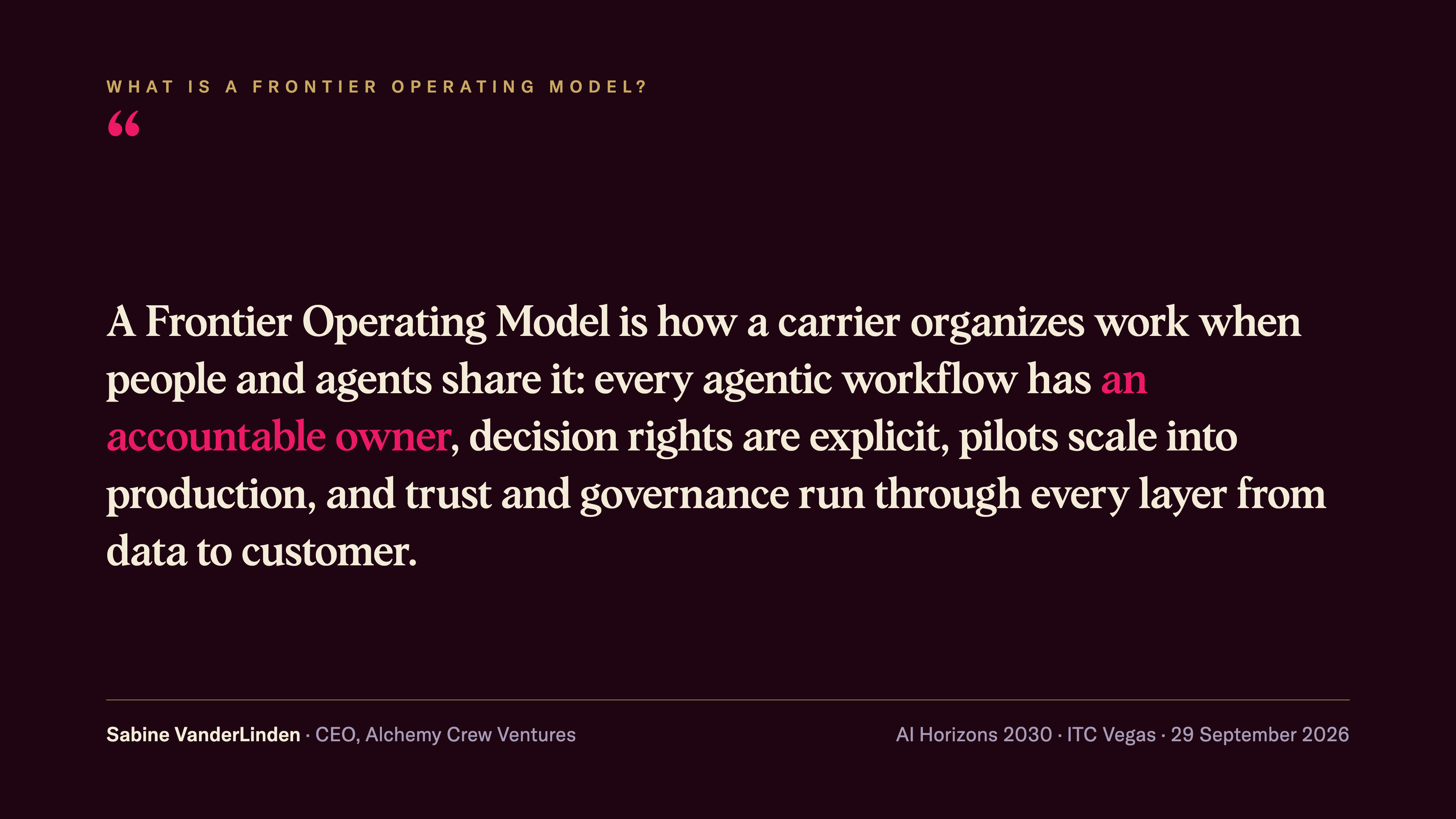
A Frontier Operating Model is how a carrier organizes work when people and agents share it: every agentic workflow has an accountable owner, decision rights are explicit, pilots scale into production, and trust and governance run through every layer from data to customer. Frontier Firms already run on it. The other four are still building toward it.
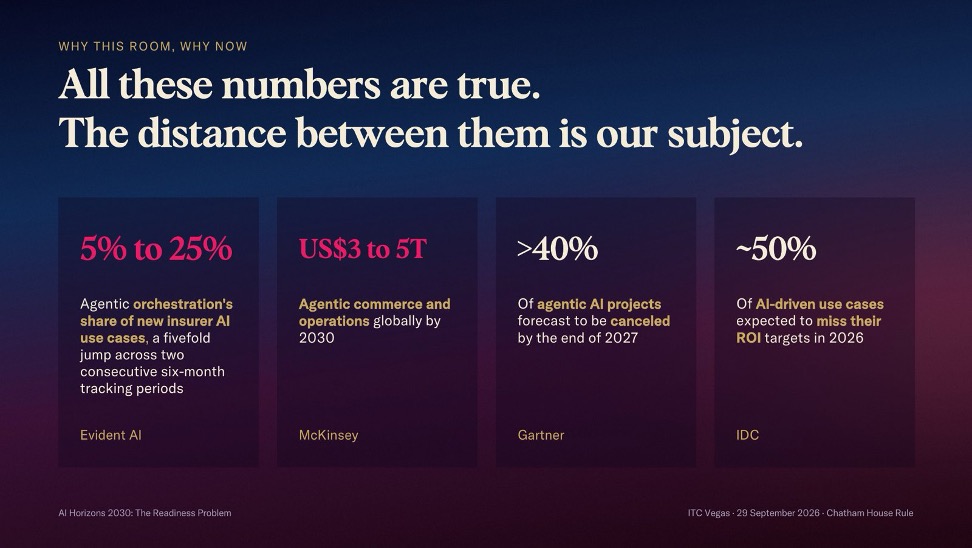
The context numbers are undisputed. Agentic orchestration jumped from 5% to 25% of new insurer AI use cases across Evident's two consecutive six-month tracking periods. You have already seen the numbers: McKinsey puts AI-driven commerce and operations at US$3 to 5 trillion globally. Gartner expects more than 40% of agentic AI projects to be canceled by the end of 2027, and IDC expects roughly half of AI use cases to miss their ROI target this year. The capability is abundant, affordable, and arriving monthly. The results are not.
So we did the work instead of repeating the claims. With my students at Bayes Business School, we built two instruments from public evidence only: the Agentic Maturity Index, which reads 29 global and European P&C insurers through 86 annual reports and 2,984 job postings, and the Transformation Scorecard, which scores 30 carriers across 2022 to 2025 on 2,400 evidence cells, dated by deployment rather than announcement. Alongside it, the Frontier Insurer Index (Majesco & Alchemy Crew Ventures) surveys insurers on twelve questions across two axes: people and operating model.
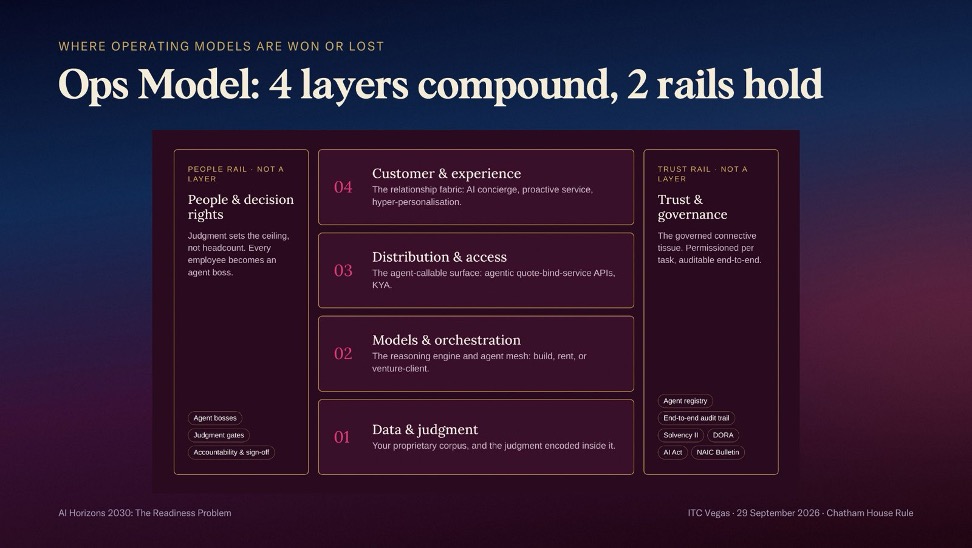
The framework is the enterprise intelligence stack: data and judgment at the base, models and orchestration above, distribution and access above that, and the customer at the top.
Two rails run through every layer: people and judgment, and trust and governance. We tested three frontiers in the room: distribution, product innovation, and what we call the messy middle; core systems, data, integration, and the expertise that makes claims and underwriting work.
Operating model: four layers compound, two rails hold
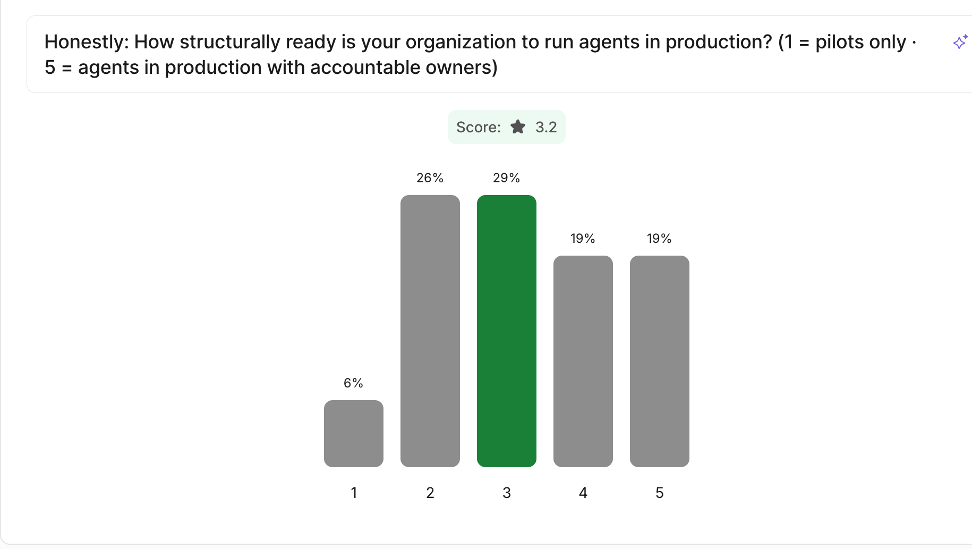
The second Slido asked the room to score its own structural readiness to run agents in production.
The honest average came out at 3.2 out of 5: 6% at pilots only, 26% at 2, 29% at 3, and 19% each at 4 and 5. Read generously, nearly 2 in 5 say they already run agents in production with some accountability. Read against the research, most of the room sits in the middle, and the middle is exactly where the industry is stuck.
Investor Lens: retrofit the incumbent or back the challenger?
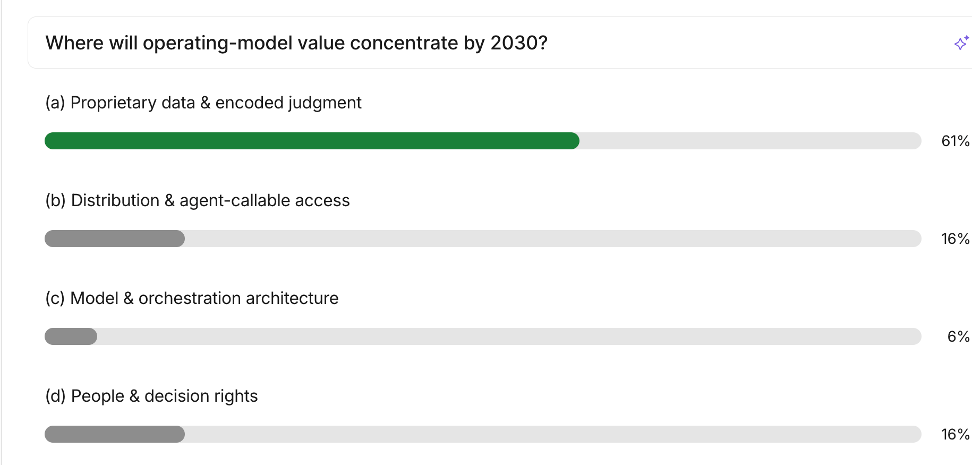
Four investors, four theses, one answer that kept repeating: the moat is proprietary data and encoded judgment, because everything else becomes a commodity in weeks. The room agreed before the panel had finished making the case. Asked where operating-model value will concentrate by 2030, 61% chose proprietary data and encoded judgment, 16% distribution and agent-callable access, 16% people and decision rights, and only 6% model and orchestration architecture. The model layer, where most of the industry's spending and vendor noise sits, is the layer the room trusts least to hold value.
- Gil Arazi of FinTLV opened with the hardest version of the argument: anything built new can be a commodity in three months, three weeks, or three days, so the only durable asset is data and intellectual property nobody else can replicate.
- Tarik Galijasevic of Allstate Strategic Ventures agreed from the incumbent side: models improve every quarter, but they lack the historical record of how decisions were made and what the losses were, and that record lives inside the enterprise.
- Lluís Viñas Fernández of Mundi Ventures, whose funds are backed largely by international insurers, came to the same conclusion: sustainable differentiation depends on unique data and unique intelligence.
- Scott Gunther of IAG Firemark Ventures took the dissenting layer. As a strategic CVC that "signs contracts, not just cheques", he believes value concentrates in distribution by 2030, and this year's news cycle has done his arguing for him.
What the capital will and will not fund
Tarik was blunt that every Allstate deal starts strategic: a CVC must return capital, but what makes a venture arm last is marrying Silicon Valley speed to what is possible inside a very large ship.
Scott gave the room the afternoon's most practical rule. IAG Firemark Ventures' primary fund has raised the bar: it requires a business owner ready to drive the transformation within 12 months after investment. No owner, no deal. His closing observation across the global startup and insurer landscape is consistent: many senior leaders at insurers want to do insurance better; the real leaders are bold and doing insurance differently.
Asked what an incumbent cannot retrofit even with an unlimited budget, Gil named the cost of a mistake: a startup's error is small on its books; an incumbent's takes 5 to 7 years to clean out of the underwriting book. On why so many insurtechs have died, he was equally direct: a venture on the insurance value chain will never be a SaaS company, margins will be 15% rather than 85%, and growing by dropping price is easy right up until the clean-up. The exits that worked, Next Insurance and Corvus to Travelers, grew from underwriting discipline outward.
Lluís called the incumbent-backed model both a benefit and a trap: of Mundi's 40+ insurtech investments, the truly transformational startup-insurer collaborations could be counted on one hand.
What separates an agent from a chatbot with a budget line? Scott's stress test: a decision or capability that a human and an agent transform together, measurably; otherwise it is theatre.
Tarik's view: let the agent coordinate and execute the commodity steps and bring the human in only where the critical path demands it. Gil's newest company, Segmantic, targets a narrow niche of complex property claims precisely because the team knows which steps will commoditize and which will not.
From the floor, Magda Ramada of WTW added the diligence question: is the harness proprietary, where is the expertise stored and protected, and what does the evaluation layer look like?
On valuations, Tarik offered the line many investors repeated afterward: there are tons of great companies and very few great investments, because today's prices assume a perfect scenario.
The room's money
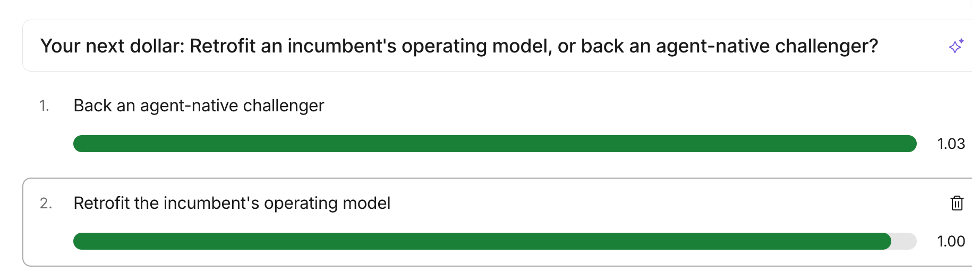
The mid-panel Slido asked where the room would put its next dollar: retrofit the incumbent or back the AI-native challenger. The ranking came back a dead heat, 1.03 to 1.00 in favor of the challenger. A room full of carriers, brokers, and their investors couldn't pick a side.
Tarik argued incumbents still hold the harder-to-replicate assets: customers, trust, regulatory relationships, and history, with challengers winning in pockets where total redesign makes sense.
Scott refused the binary: retrofit the operating model with an AI-native distribution or claims capability.
Gil pointed at the bigger prize outside the current market: more than half of catastrophe losses are uninsured because carriers cannot underwrite them, and AI liability, data centers, and new perils are a larger opportunity than everything already written. In a softening market, now is the time.
Two floor voices closed the lens.
James Tootell of EOS Venture Partners observed that many challengers are in fact enablers helping insurers retrofit, that carriers are building inside the core while spinning up AI-native businesses outside it, and that the diligence signal that matters is recurring production revenue and retention, not pilot fees.
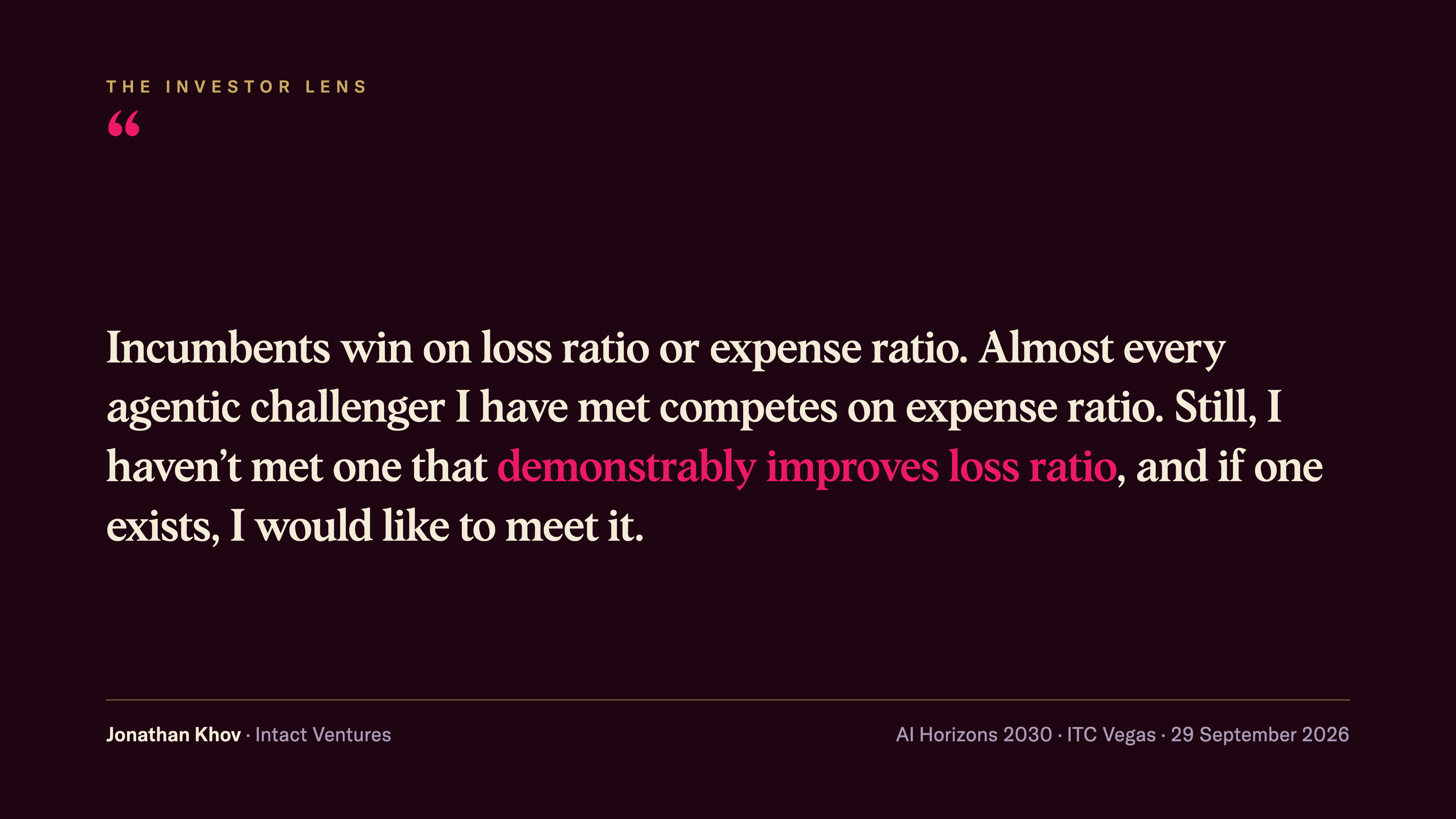
Jonathan Khov of Intact Ventures drew the segment's sharpest line. Incumbents win on loss ratio or expense ratio. Almost every agentic challenger he has met competes on expense ratio. He has yet to meet one that demonstrably improves loss ratio, and if one exists, he would like to meet it.
Research Reveal: frontier moves, no Frontier Firms
26 of the 30 leading P&C carriers we analyzed have not crossed the halfway mark on both transformation axes. That is the headline from Denise Garth of Majesco, and it is the number that turns 1 in 5 from a provocation into a measurement.
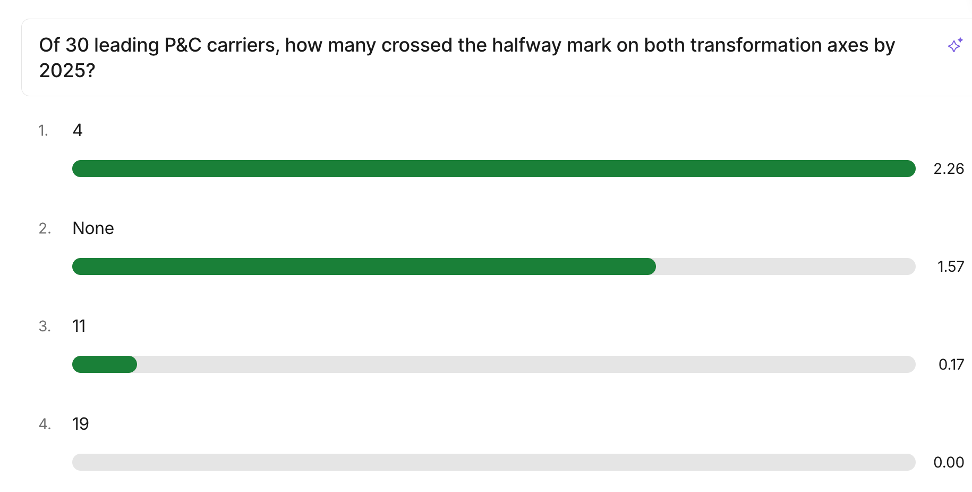
Before the reveal, the room played the research back as a quiz, and its instincts were good. I asked how many of the 30 carriers had crossed the halfway mark by 2025; the top pick was four, with "none" close behind. This was right.
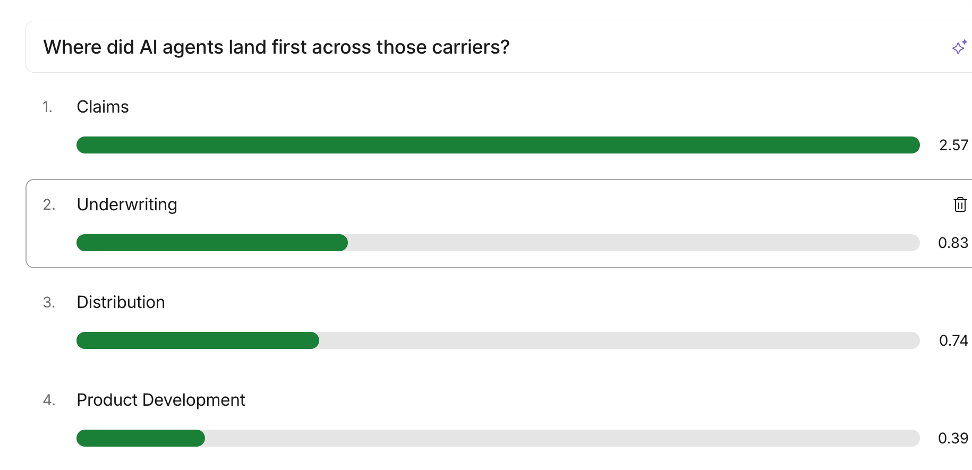
I then asked where agents landed first; claims won by a mile. This was right again. On the Agentic Maturity Index, claims score 0.467 on a 0-to-1 scale, the most agentic function by far, because agents went where the cost was. Product development, where new value would be created, scores 0.083.
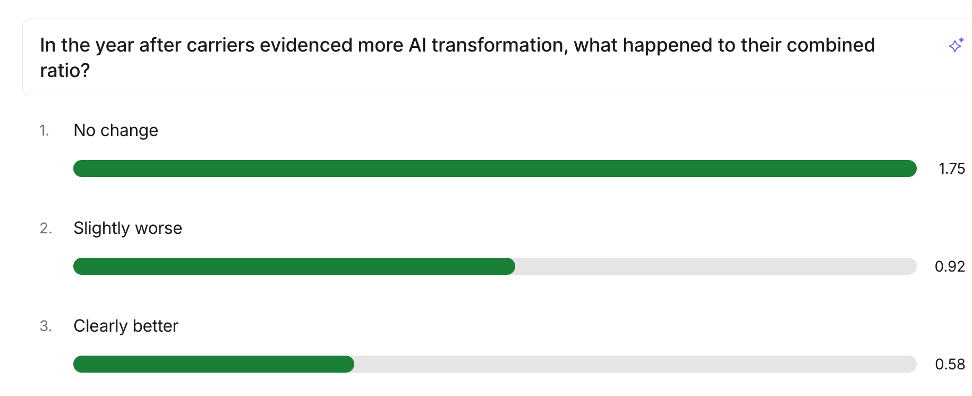
When asked what happened to the combined ratio the year after carriers showed more AI transformation, the room's verdict was no change. Here the room was too kind. In the Transformation Scorecard, a 0.1 rise in business-model transformation is associated with a combined ratio about 0.31 points worse the following year. Association, not cause, but the direction is clear: tools went live faster than the work was rebuilt around them, so the cost landed before the leverage.
The direction of travel is real: the lowest transformation group shrank from 29 carriers to 11 in four years. Denise's reading of what carriers publish was the uncomfortable part. Public statements focus on cost cuts and headcount, not on the people who will manage agents or the insurance-literate talent who will redesign the work.
Most of what is reported as transformation is modernization: ripping and replacing technology, or laying AI on top of existing systems. Rebuilding the business model is harder still, because the industry has layered process on process for 20 or 30 years without asking why. The result is what she calls spaghetti code and spaghetti operations.
The Frontier Insurer Index
The index scores two things.
On the people axis: do employees use agents in their daily work, how many do they manage, and are they the reviewers and guardrails for what the agents do?
On the operating-model axis: do pilots scale into production, or stall and get replaced by the next pilot? Scale, not proof of concept, is the test.
The model places insurers in 16 positions across 5 zones:
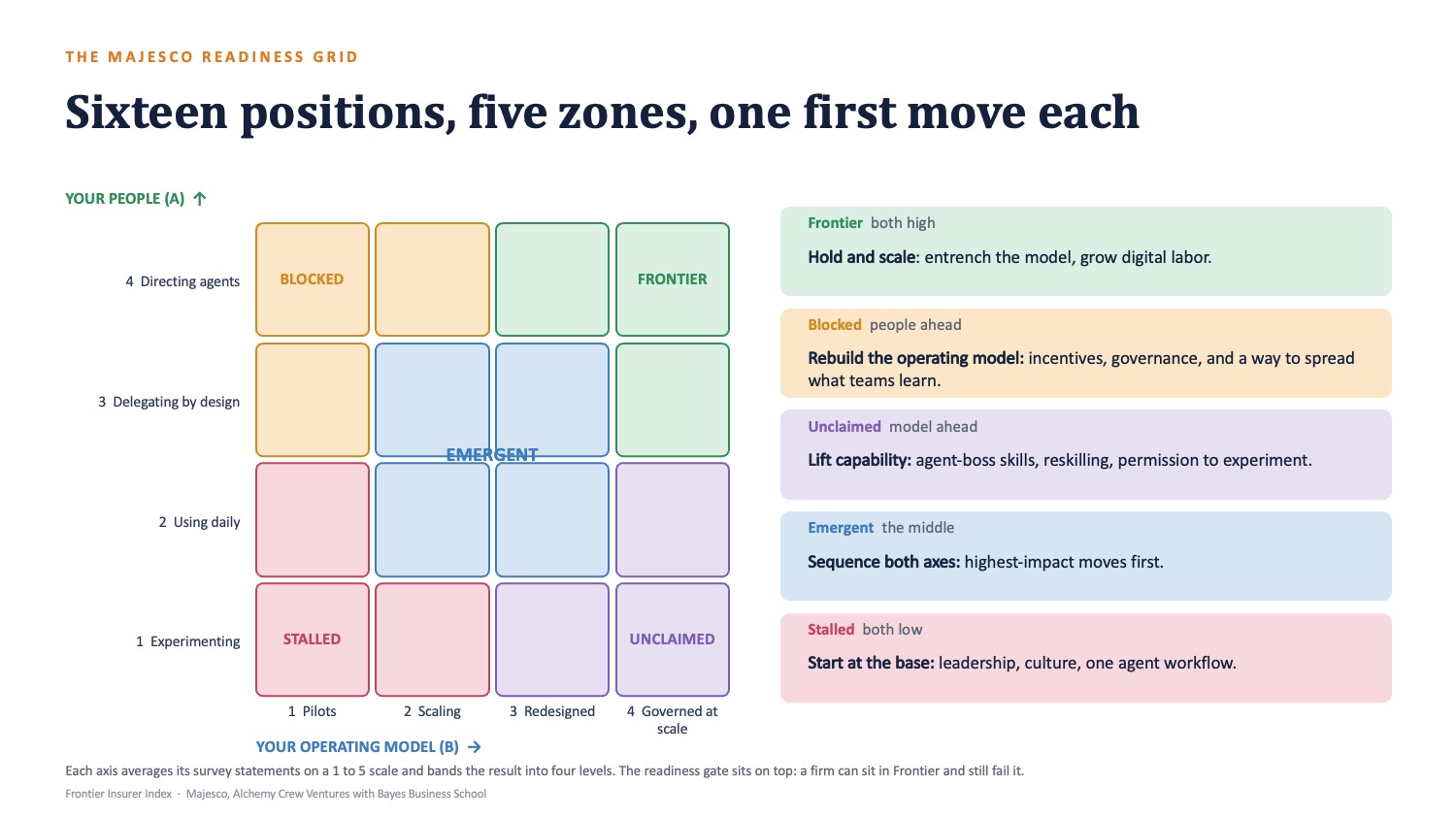
- Rebuilders have redesigned the operating model, incentives, and governance but haven't brought people along.
- Stalled organizations lack culture, top-down leadership, and any agentic workflow. Without a CEO willing to say "we will do business differently", they stay there, and Denise believes much of the industry sits here.
- Unplanned organizations hired the agent-boss talent first, with no operating model or technology to use them. Those people will get frustrated and leave.
- Emergent organizations float between the others, not yet committed to a path.
- Frontier organizations align people, technology, leadership, and operating model.
Denise Garth's warning: most executives are more optimistic about their organization than the reality warrants. An agentic First-Notice-Of-Loss workflow is a silo. How does it work with the rest of claims, with service, with policy?
Rethink the process. Don't layer technology on top of today's steps.
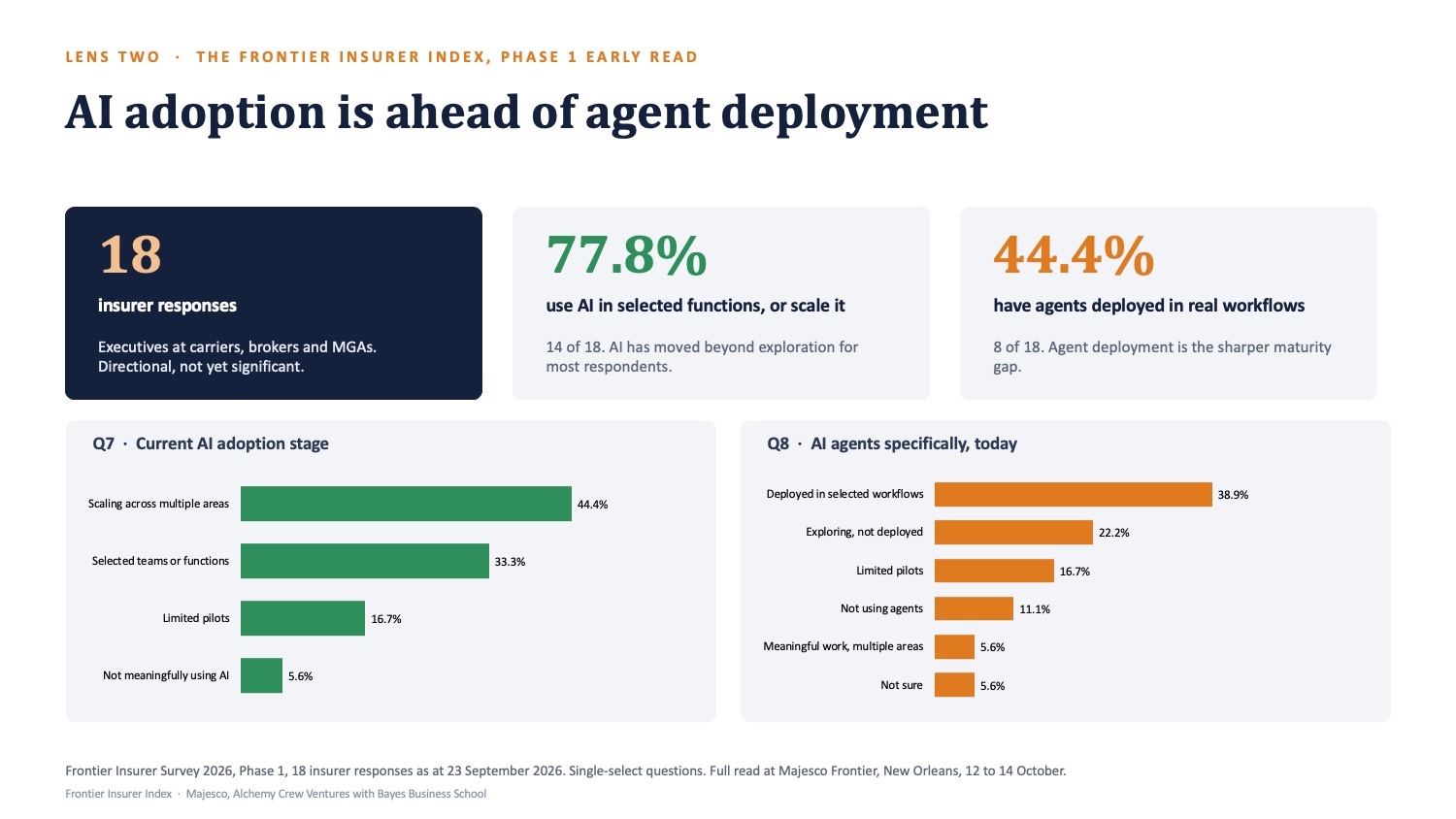
The early survey responses are directional, and the pattern is already clear. 78% use AI in selected functions or are scaling it. 44% have agents deployed in real workflows, and only 6% have agents doing meaningful work across multiple areas.
The barriers named most are limited AI skills (44%), integration complexity (39%), and data quality or access (33%); legacy core systems come last at 11%. The most helpful capability is agents embedded in core workflows (50%). That is the messy middle, and it is not a metaphor. Execution, not strategy or technology, is the bottleneck; Denise quoted Majesco CEO Adam Elster: execution is strategy.
McKinsey's coordination tax names the prize: 5 decades of technology automated the work inside functions and never automated the integration between them. Agents can.
AI adoption is ahead of agent deployment: 78% use AI, 44% have agents in real workflows
The bottleneck is execution capability, not the core alone: barriers and accelerators
Frontier moves without frontier firms
The industry is moving. Zurich has enrolled more than 11,000 colleagues in AI upskilling since 2023. Generali runs an academy reaching around 90,000 people. MAPFRE uses virtual assistants to handle more than 40% of operations, while pledging no AI job cuts. Allianz automates almost half of its German pet claims with a rule that payouts stay human. ERGO negotiated its workforce changes with its union before moving the work.
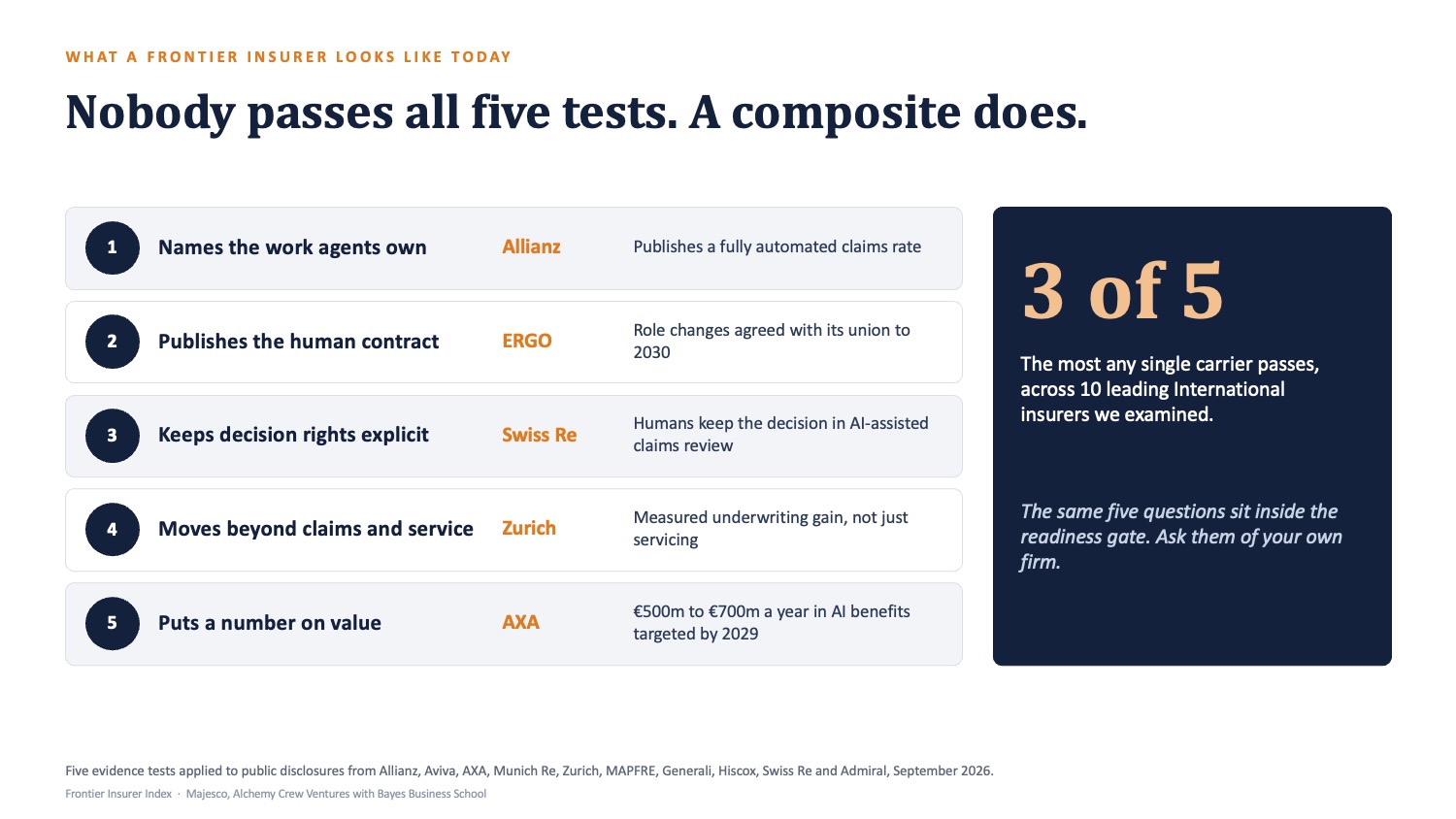
Then the test. We put 10 of these carriers through 5 frontier criteria: (1) names the work agents own, (2) publishes the human contract, (3) keeps decision rights explicit, (4) moves beyond claims and service, (5) puts a number on the value.
No single carrier met all five. The strongest met three. Frontier moves everywhere. Frontier Firms nowhere yet.
Denise's last word on the research returned to a prediction she made on the same stage a year ago:
In 2025 I predicted that by 2030 an insurer would decrease their expense ratio by 20 points. There was disbelief. In 2026, I can see the path there, and it focuses on becoming a Frontier Insurer, where a redesigned business operating model and an intelligent core platform are bringing that prediction to reality. The stats and business outcomes are beginning to emerge as our customers continue this journey. Reduced operating expenses. Significantly reduced delay in new business underwriting and issuance. Improved growth. Improved customer satisfaction. Product innovation. And that is just the start. This is the Frontier Insurer. This is creating real business value. This is where the promise of AI becomes reality and a gamechanger.
The messy middle, by Manish Shah
Manish Shah of Majesco closed the segment with the two ways insurers get stuck.
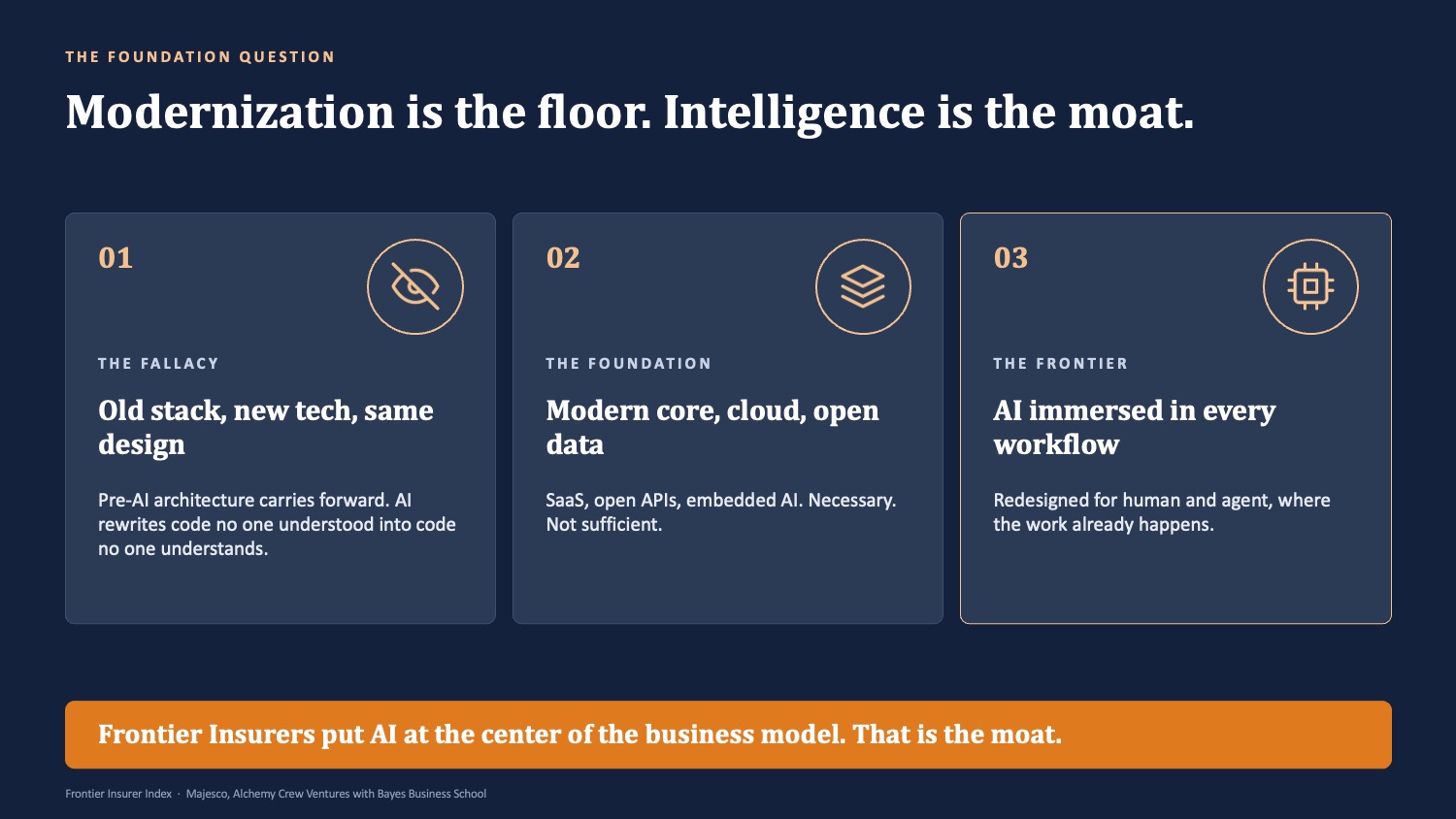
The first is building agent after agent on a foundation too weak to distribute them: legacy systems, locked data, weak APIs. Without data access, there is no context, and without context, the agent cannot be relied upon.
The second is modernizing the technology without rethinking the operating model, keeping the functional hand-offs the industry perfected from Henry Ford's assembly line, and ending up using very expensive token-based AI to read an RPA script. His sharpest line: AI agents do not forgive legacy debt. Asking a model to rewrite millions of lines of legacy code produces a new black box you still cannot operate inside.
He also reframed what counts as an AI strategy. Choosing an LLM, a framework, or an agent-building tool is table stakes. Immersive AI brings generative and agentic capability together inside a redefined business process, running on a governance spine of identity, entitlements, auditability and telemetry, with agents reaching data only through governed tools. Software designed for human-only users won't support human-agent collaboration; the workflow and UX need redesign.
His one diagnostic question for any executive: is your AI strategy to run AI inside the core workflow, or on top of it and beside it? The answer tells you everything.
Market Lens: when the agent becomes the channel
Ask a consumer AI assistant to sell you insurance and it will. It will also get it wrong, and the customer will not know. That was the live experiment Magda Ramada of WTW brought to the room. She asked the assistants to find her a better motor policy. The first answer assumed she lived in Virginia. Corrected to Chicago (she lives in Madrid), it recommended the lowest-price option without asking what she drove, how much she drove, what coverage she cared about, or her credit score. Anyone in insurance can spot the missing questions. Most buyers cannot. The result is a stream of recommendations that don't match the risk profile and that consumers perceive as coming from the insurer.
What auto insurance should I buy? The assistant answers for Virginia before asking where the buyer lives. WTW, reproduced subject to permission.
Her historical parallel was the aggregator wave of the 2000s. Comparison sites won on convenience and marketing budgets that dwarfed any insurer's; in the UK and Spain, direct players were commoditized. Today's five large AI platforms make the aggregators look modest, and this time the channel does not behave consistently: every agent asks different questions, and agents can reverse-engineer pricing and underwriting logic the way analysts once did. Some carriers have said yes to being present, then refused platform access to their systems. Yes, but not like this.
Magda gave the room four boxes to think in.
- Insurer-owned question sets: carriers need control over which questions get asked and how answers are validated, which means building agents that negotiate with other agents.
- Data validation: heterogeneous information will flow in, and carriers must know its source before it reaches pricing.
- Dynamic products: different answers produce different risk profiles, and a carrier that cannot decide in real time loses the risk.
- The core issue: monolithic policy administration cannot hold loss data at the component level, so modular products stay out of reach.
This is not an API problem. It hits the target operating model and determines which risks a carrier can even see. AI distribution, she argued, will finally force the dynamic-product conversation the industry has procrastinated on for a decade. Extracting claims data to module level once took her six months per policy. With agents, it takes a couple of weeks.
The floor exposed the US constraint. An admitted carrier files rates and waits months; how do you file for every dynamic scenario? Magda conceded this is far harder in the US than in Europe, where regulators will work with carriers on dynamic definitions of price and product. Denise Garth noted that some carriers start on the specialty and non-admitted side precisely to test without filing. Mike Gulla of Adaptive Insurance raised the risk nobody has litigated: 50 years of contract language is built on questions asked by human agents, and the first bad-faith claim arising because an AI did or did not ask a question will test whether a carrier can deny coverage on that basis. Denise added the regulatory clock: the NAIC's AI operating-model regulation is expected in November, applies to every software vendor an insurer uses, and Majesco is one of the parties giving input. She urged them to join the committee and shape it. Gil Arazi's rejoinder was that AI advances faster than any regulator did. This drew a big laugh, but left the tension unresolved.
The Slido that bridged into the Tech Lens asked the question the afternoon kept circling: when an agent distributes your product, who owns the customer? The broker or MGA came first by a wide margin (2.11), followed by whoever holds the data (1.07), the carrier (0.68), and the platform the agent runs on last (0.46).
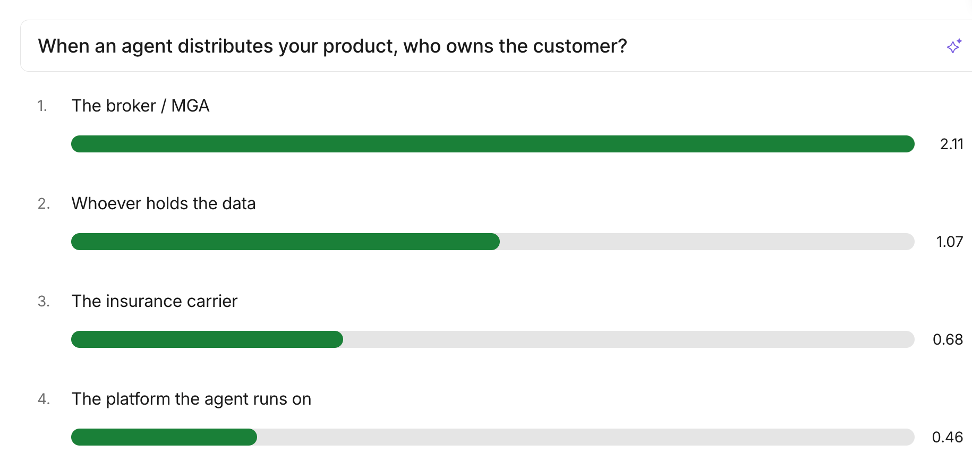
A room full of carriers voted that the carrier does not own the customer, and barely anyone believes the platform will. Whether that reflects today's reality or complacency about 2028 remains the industry's unanswered question.
Tech Lens: proof, not pilots
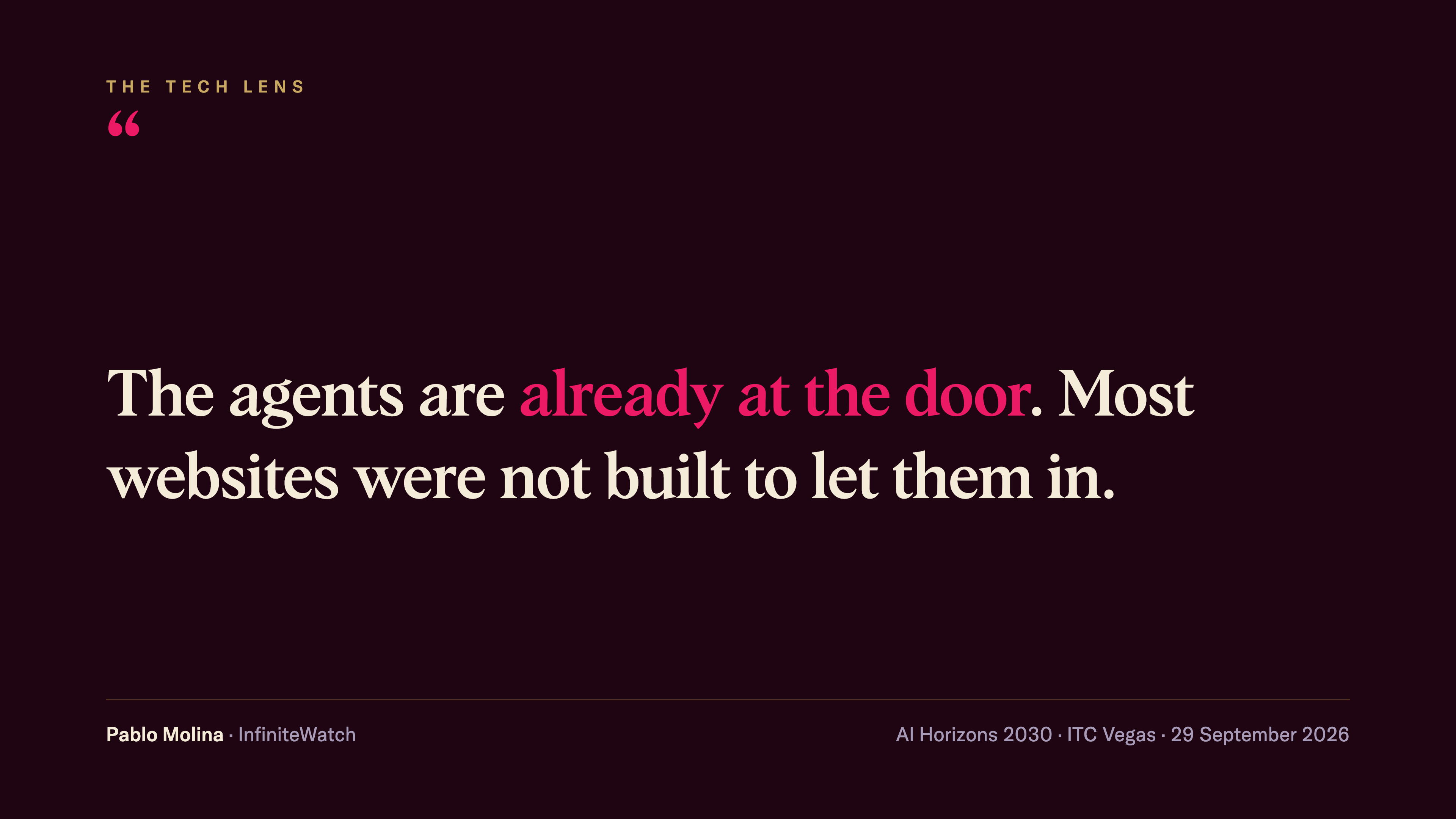
Agent traffic on insurer and broker websites tripled in three months, from 4% to 12% of visits. That number, from Pablo Molina of InfiniteWatch, whose observability layer sits across roughly 30 large carriers and brokers, was the proof point of the afternoon. The agents are already at the door. Most websites were not built to let them in.
Four AI-native providers took one frontier each: discover and quote, transact and pay, product innovation, and the messy middle. All discussed the problem in depth.
Discover and quote
Raphaël Vullierme of WaniWani, who built and sold Luko, France's largest online home insurer, to Allianz, explained why he left the carrier side: a large share of value in insurance rests on information asymmetry between buyer, carrier, and intermediary, and AI collapses it.
WaniWani's insurance app was approved on a platform built for productivity tools the same week the major assistants began suggesting apps inside conversations. WaniWani now works with around 30 insurers, from AXA and Allianz to small insurtechs. Raphaël predicts premium originated through AI assistants will cross its first seven-figure milestone by year-end.
His point on where the operating model breaks: agents aren't asking permission. They reach the website and tell the customer whether the carrier is ready or not. Infrastructure that controls what the agent sees turns an innovation conversation into a compliance conversation, and compliance teams become allies once they see this as a way to take back distribution control.
Transact and pay
Leanna Zillner of Stripe corrected my number: Stripe processed US$1.9 trillion last year. Stripe helped OpenAI create agentic commerce protocols, and its consumer wallet, Link, now serves as Muse's AI wallet, which reached 2.8 million downloads in its first two weeks. That is the shift from agents advising to agents transacting.
From retail: AI-referred traffic converts around 30% higher, and 62% of use cases are comparing brands and products. For insurance, she separated two kinds of agents. Web-browsing agents are the near-term headache because merchants cannot tell good bots from bad bots.
MCP-connected agents are only as good as the capabilities underneath: many carriers have a quote API, but no bind API, and some still ask what an API is. Context must carry across hand-offs, and insurance is only as good as how fast it moves the money.
I added one piece from my own interviews with European carriers: ghost brokers already use agents to pull quotes from insurer websites, repackage them on social media for distribution, and sell to business owners who discover at claim time that they hold no cover. Good bot versus bad bot is not a future problem.
Product innovation
Mike Gulla of Adaptive Insurance described Grid Protect, a parametric power-outage product live across 18 US states that runs end to end with almost no humans in the transaction.
Adaptive is a technology company first and an insurer second, and the product is an if-then statement: the customer buys a coverage amount against an outage that hits a defined trigger, the platform monitors the grid through utility data, and the restaurant owner is never asked whether they serve alcohol or close at 4 am.
When an outage qualifies, the policy system notifies the insured, who confirms, triggering the claim and payment. No moral hazard, so no adjuster. Owning the stack let Adaptive launch 7 new products in 9 months on the rails built for Grid Protect.
Mike remains skeptical of AI in underwriting decisions and uses it aggressively on expense: an agent monitors weather events around the clock and drafts the agency outreach, so a team of 10 focuses its day where the data says to.
The messy middle
Pablo Molina, who took CoverWallet past US$1 billion in premium before its sale to Aon, now watches what agents actually do on insurer websites. They route around CAPTCHAs. They don't read disclaimers, promotions, or upsells because they have tunnel vision on the task. A quote through a WhatsApp agent can take 15 minutes to return. The agent experience is broken, and the demand is real.
His framing: 2015 was the year Google told the world to make websites mobile-ready. This is the agent-ready moment.
On industrializing agents, he described the unit of work: the minimum procedure, comprehensive enough to automate end-to-end, tested by running an emulator over thousands of historical interactions before go-live, so the AI surfaces tacit know-how that lives in people's heads and never on paper.
Monetization and the 2027 call
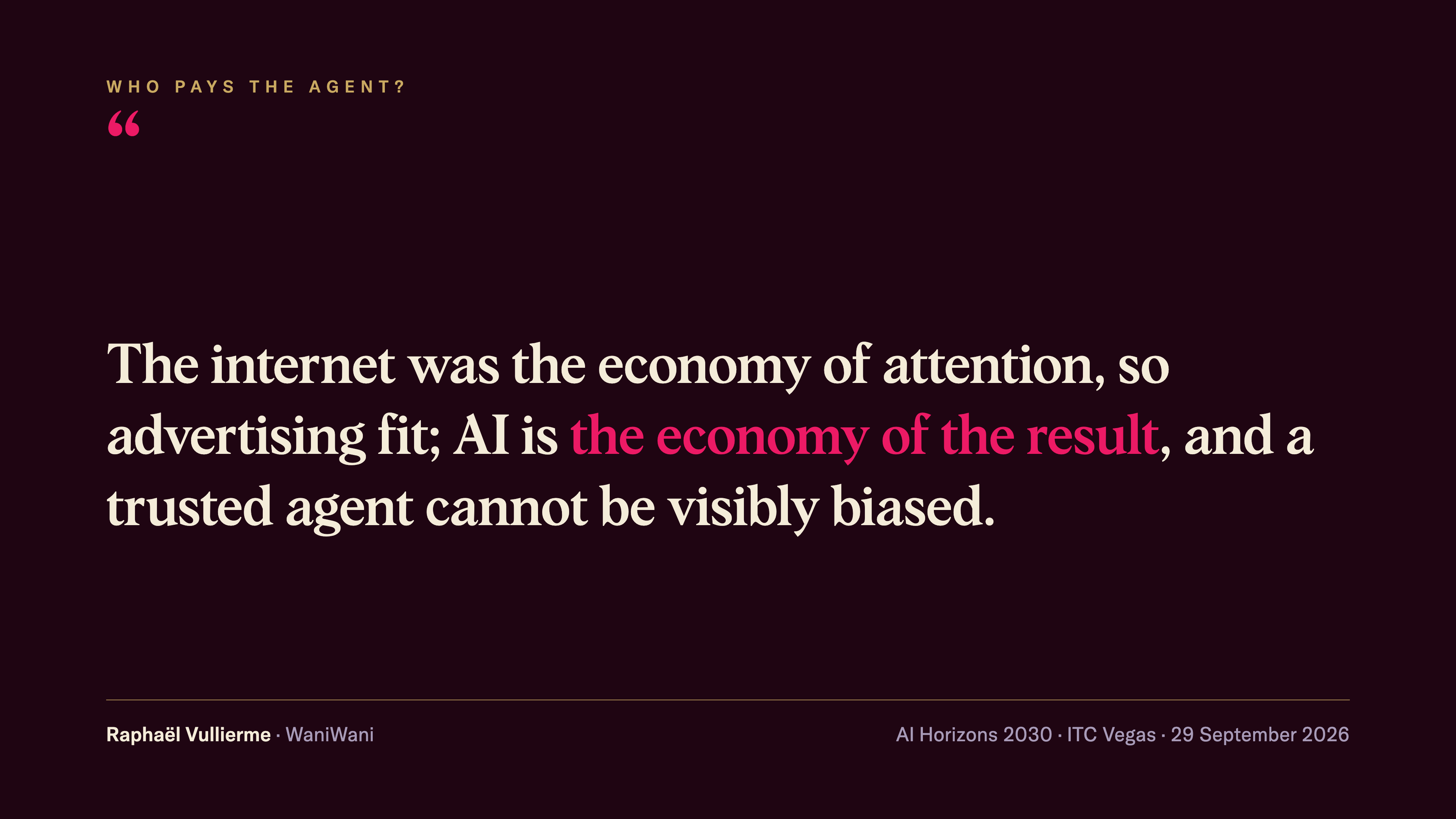
Asked how agent distribution gets paid for, Raphaël was firm: the internet was the economy of attention, so advertising fit; AI is the economy of the result, and a trusted agent cannot be visibly biased. Expect payment for compute plus a small affiliation fee, and large platforms won't take broker licenses.
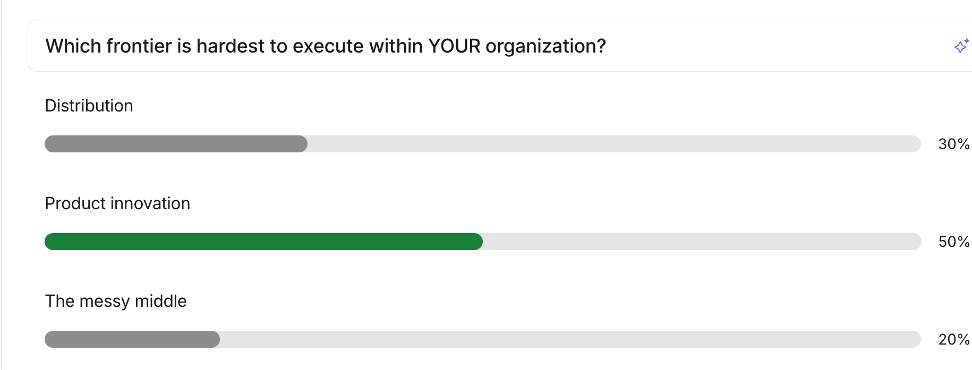
The Slido asked which frontier is hardest to execute inside your organization today. Half the room said product innovation, 30% distribution, and only 20% the messy middle.
The Frontier Insurer Index says the opposite: the frontier the room rated easiest is where carriers are actually most stuck. The panel's calls before Q1 2027: Pablo, prepare for agent-to-agent transactions now; Raphaël, three years of insurance AI has been claims AI, which touches around 5% of the combined ratio, while distribution changes the whole business model; Mike, work with partners who understand insurance; Leanna, get the infrastructure in order, money movement included. Carlos Cendra Falcón of MAPFRE gave the incumbent's response and chose product innovation: people who buy insurance through an agent already buy insurance, so the frontier that opens new business is product.
Trust by Design: trust is an offensive capability
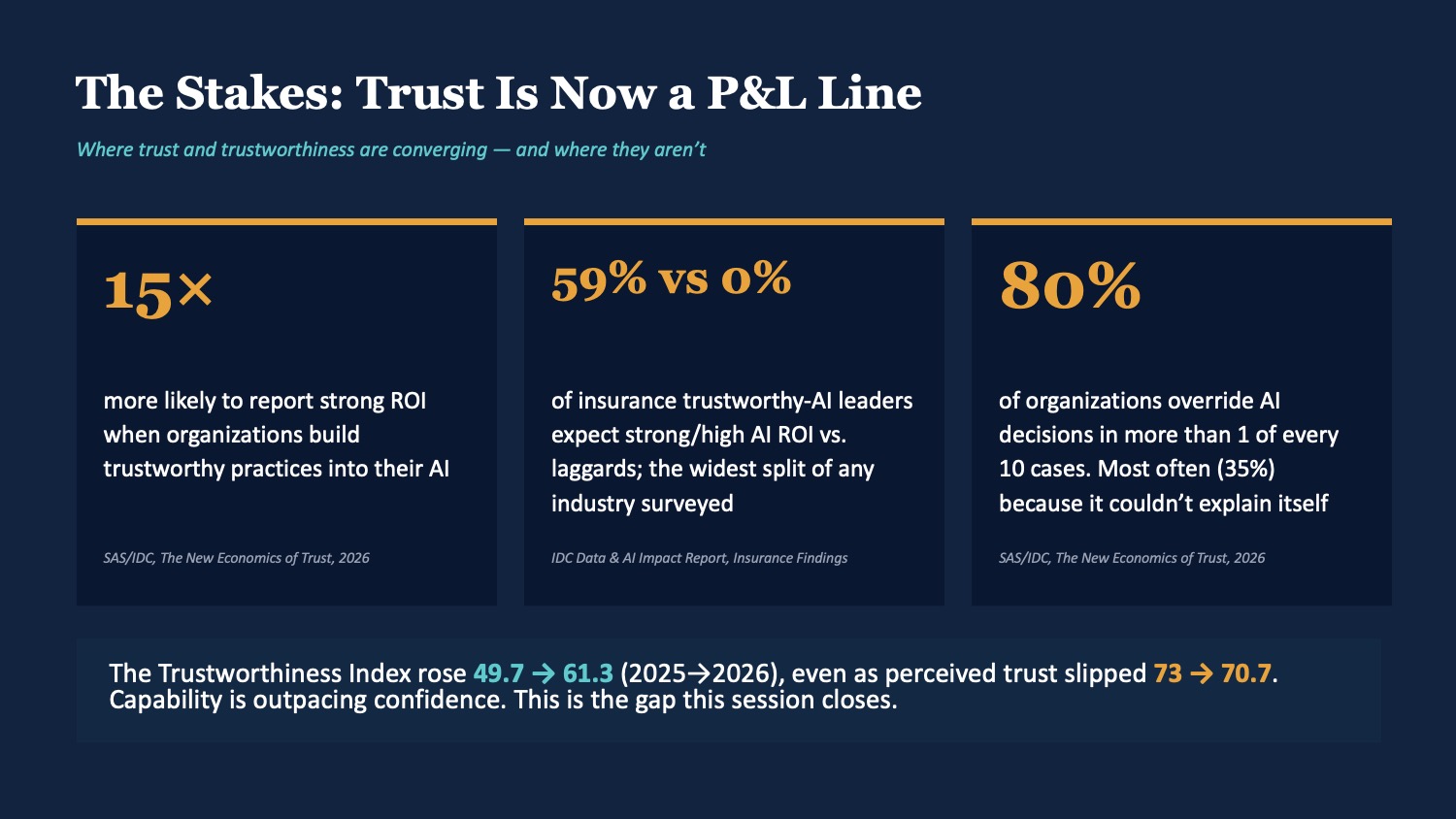
Organizations that build trustworthy practices into their AI are 15 times more likely to report strong AI outcomes. That is the finding Franklin Manchester of SAS brought from SAS's research with IDC, and it flips how most boards think about governance. Trust is not the brake. It is where the return comes from.
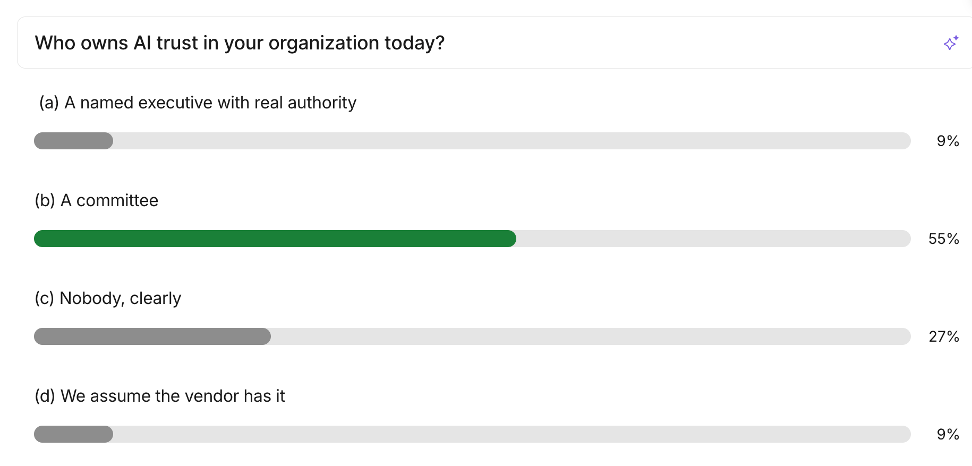
The segment opened with a Slido asking who owns AI trust in each organization today. 55% said a committee, 27% said nobody, clearly, 9% a named executive with real authority, and 9% assume the vendor has it. Fewer than 1 in 10 frontier-minded leaders in a room can name the executive who owns AI trust.
Insurance shows the starkest gap between leaders and laggards of any industry in the study. 59% of insurer leaders report stronger ROI, roughly $2 for every dollar invested; laggards report none and are burning cash on pilots that never reach scale.
80% of organizations override AI decisions in more than 1 in every 10 cases, most often because the system could not explain itself. The Trustworthiness Index rose from 50 to 61 between 2025 and 2026 while perceived trust slipped from 73 to 71: capability is outpacing confidence.
Only around 1 insurer in 11 sits in the quadrant where trust and trustworthiness are both high.
Franklin, an underwriter by training, framed it around market conduct: insurers will examine every AI-assisted decision to accept a risk, price a policy, or settle a claim years after it was made. Auditability, transparency, and explainability are not compliance overhead. They are defensible space.
What leaders do differently: they cascade responsible AI policy to every employee, address the data layer (80% of enterprise data is unstructured), treat model auditability as foundational, and invest in governance as a differentiator rather than buying more AI.
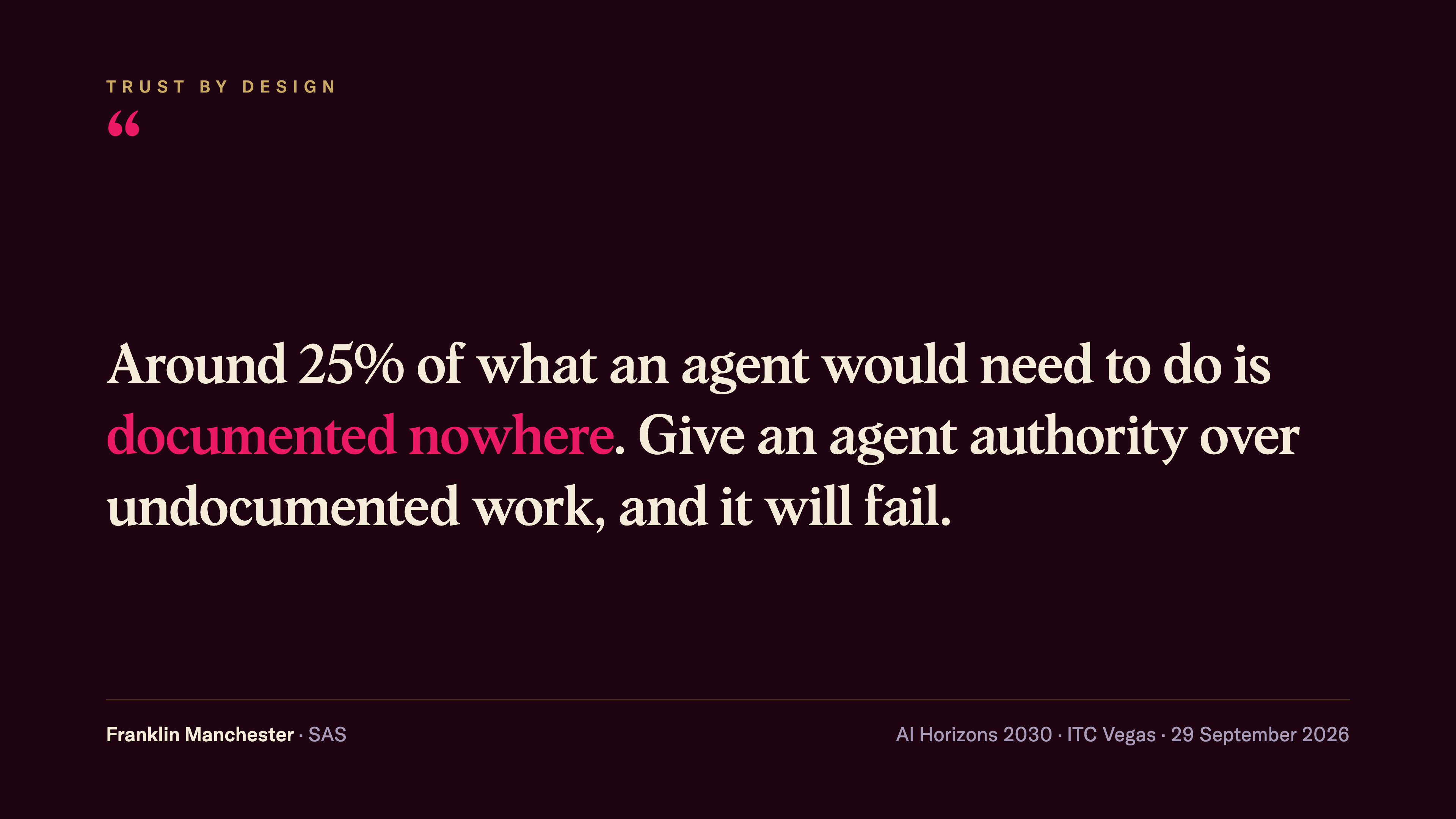
They also map their processes. Franklin quoted the head of one of the world's largest financial institutions: around 25% of what an agent would need to do is documented nowhere. Give an agent authority over undocumented work, and it will fail.
His operating principle is human in the lead, not human in the loop.
The moment of truth comes when a carrier can answer four questions about any agent action: who authorized it, was it permissible, what data and model produced the decision, and which human signed off. In a trust industry, the blast radius of a wrong autonomous decision is reputational before it is regulatory.
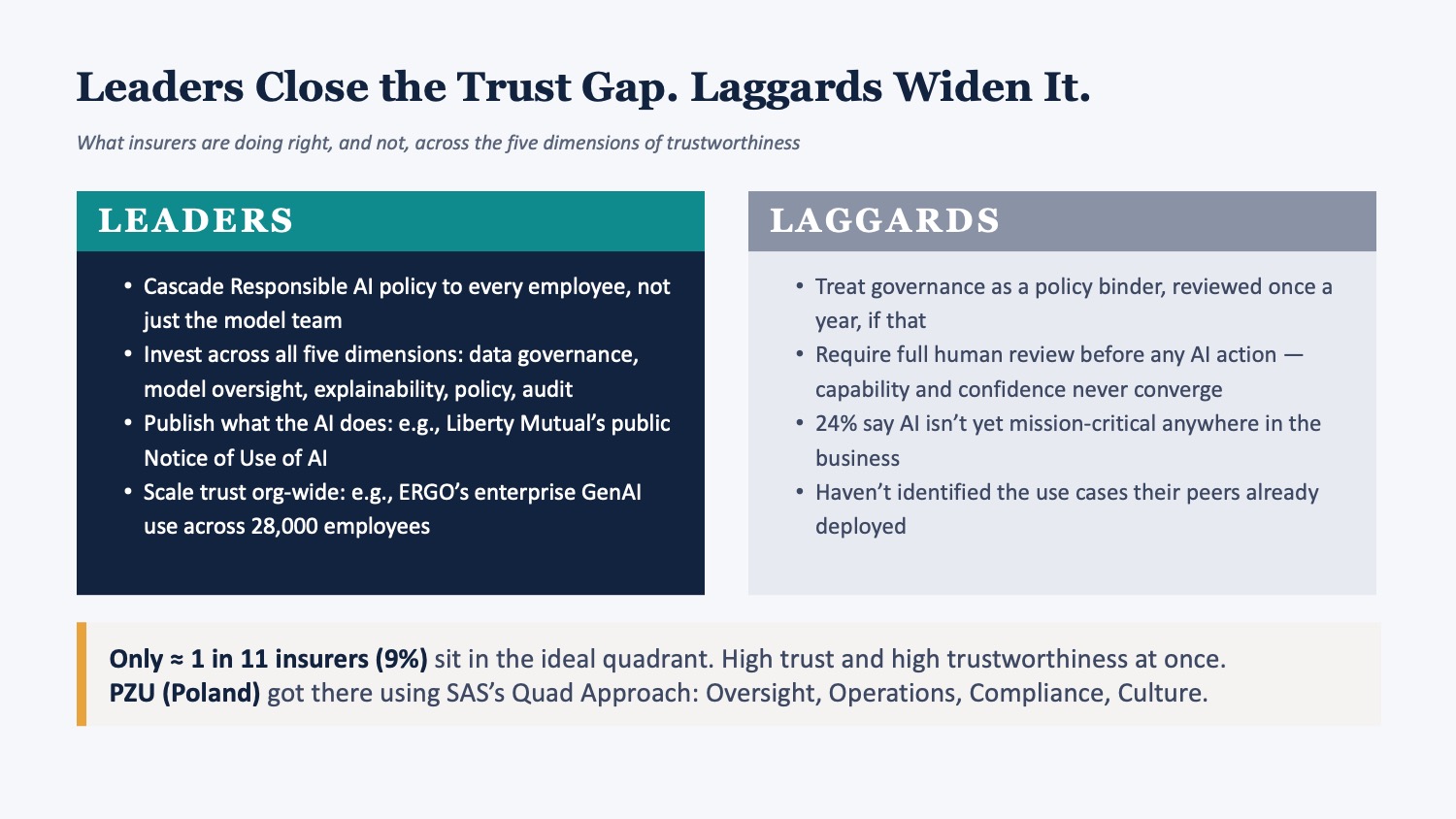
The moment of truth: who authorized it, what produced it, which named human signed
What it takes to keep trust, by Willem Paling
Willem Paling, who leads AI for IAG, made the stakes concrete. IAG's brands, former motoring clubs and mutuals, are among the most trusted in Australia, and one serious failure is enough to lose that.
Willem brought a UK Financial Ombudsman case: a woman who had left an abusive marriage told her insurer about her new address and asked that all correspondence go there. The insurer sent the documents to the old address, exposing her new one to her former partner. Imagine the same mistake made by an AI system, and what it would do to the pace of AI transformation across the industry.
Trust means different things to different stakeholders, and a frontier insurer has to earn all of them.
- Consumer advocates want a vulnerable customer to always be able to reach a human and want catastrophic outcomes to be impossible.
- Regulators want every decision explainable and traceable; IAG expects a request within a year or two to produce the traces of every AI decision made over the preceding years.
- Frontline teams want AI that removes admin and improves customer outcomes, or they will quietly resist it.
- Customers, especially when a decision goes against them. They want to understand it, contest it, and know who is accountable.
His reframe: most insurer decisions favor the customer, so AI should make the everyday materially better and consequential decisions more consistent than people.
Supervision should be proportional: a motor liability decision referencing 10 rules can be fully managed by AI; long-context medical reasoning still cannot.
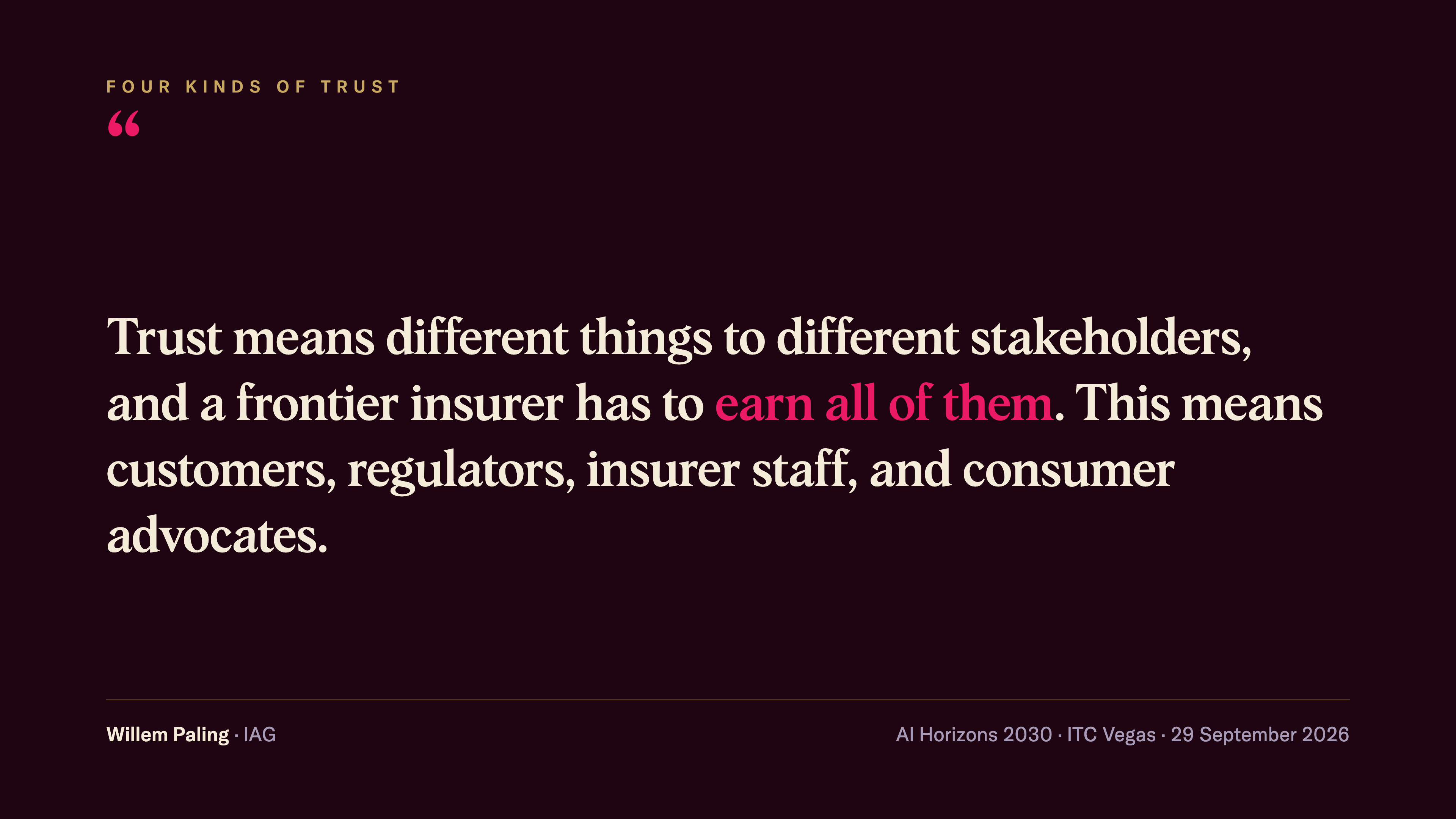
Magda added the measurement layer. Trust in a system shows up in honest signals: override rates rising or falling, edge cases becoming more consistent, how people talk about the system, how many decisions are taken outside it. Counting users tells you nothing about a technology people don't use; you must track interactions continuously, across every function.
Denise brought it back to business outcomes: growth, expense ratio, loss ratio, combined ratio, retention, and net promoter score are the metrics that prove transformation. A voice from the room closed the segment with two lines worth sharing. Governance needs an enforcement layer, because the audit trail that proves you were right is also the evidence a claimant will use against you. And human-in-the-loop only works when the human knows what wrong looks like.
The Working Session and the Verdict
The tables did not agree, and that was the point. Three frontiers, mixed tables working the canvas, and the first report-back was that everybody at the table had a different answer.
- On distribution, the first thing to break is the customer relationship; tables flagged bias in how agents recommend and landed on a control the industry does not yet have: know your agent, alongside know your customer. Who owns the customer stayed open at every table.
- On product, travel insurance came up as the simple, embedded place to start, AI liability as the new coverage the market lacks, and excess and surplus lines as the practical US starting zone because they escape rate filing. One table drew the line that matters for strategy: AI won't serve a customer because the relationship with a human agent or broker is too strong, and carriers should know which customers those are.
- On the messy middle, Denise Garth noted that the market is insurance-illiterate, so AI's task isn't to replace agents and brokers but to make them far more effective, and workflow redesign has to start with the customer journey rather than inside one function.
My closing provocation to the room: we are still tweaking around the edges, taking a safety-net product and making it faster and slicker without changing what the customer will want. AI makes it possible to move from safety net to guardian angel, a service that acts before loss rather than after. If you put 70 of the industry's most innovative people in a room, they shouldn't optimize an existing product. They should be redesigning the category.
Scott Gunther's report-back named the practical outcome: everyone disagreed, which is what the format was for, and the job now is to stay connected so the insights keep compounding. That is what this report, the survey, and the follow-up are for.
Five moves toward a Frontier Operating Model before Q1 2027
Every participant left with one commitment on a card. These are the five the afternoon argues for most strongly, drawn from what the investors fund, what the research measures, and what the providers see breaking.
- Name the accountable owner, then the agent. IAG Firemark Ventures will not invest without a business owner committed to starting the transformation within 12 months; apply the same rule internally. No agentic initiative proceeds without a named executive who owns the outcome, the decision rights, and the human contract.
- Choose your target operating model before your model. Answer Manish Shah's question in writing: does AI run inside the core workflow or beside it? Pick one end-to-end process and redesign it for human-agent collaboration, working backward from the customer journey. Fund the data access, APIs, and governance spine it needs. Do not fund another isolated pilot.
- Test the agent-ready channel now. Measure the share of agent traffic on your own sites this month. By 2028, decide which question sets, validation rules, and product data you will expose to agents, and which you never will. Confirm you have quote and bind APIs that carry context across hand-offs. Build know-your-agent alongside know-your-customer before the first bad-faith claim does it for you.
- Re-architect one product, not one workflow. Pick the product you would rebuild as dynamic, modular, or parametric: travel, a parametric commercial cover, an E&S line, an AI liability wording. Use it to force the policy administration, filing, and loss-data conversations the core needs anyway.
- Instrument trust as a return driver. Cascade a responsible AI policy to every employee. Map the undocumented quarter of your process before granting any agent authority. Put four questions on every agent action and track override rates continuously. Report combined ratio, retention and NPS against the programme, not pilot counts.
Two more that the capital in the room asked for:
- Challengers should prove recurring production revenue and loss-ratio impact, not only expense-ratio impact, if they want an incumbent's balance sheet.
- Incumbents should look hard at the perils outside the current market, because the opportunity there is larger than the business we already write.
What the room could not close, and what happens next
Three questions stayed open after three hours.
- Who owns the customer when an agent originates the transaction? The vote favored the broker or MGA, and the answer will determine whether AI distribution is a channel or disintermediation.
- How does a dynamic product survive US regulation? Specialty and non-admitted lines are the workaround, the NAIC's November regulation is the next test, and the first bad-faith claim involving an AI-asked question will set the precedent nobody has yet.
- Who pays the agent? Compute fees and small affiliation fees seem most likely; advertising conflicts with the trust an agent needs, and the channel's economics remain undecided.
One in five held up. The research says 26 of 30 leading carriers have not crossed both transformation axes, that frontier moves are everywhere and Frontier Firms nowhere, and that the barrier is execution in the messy middle. Investors say money follows proprietary data, encoded judgment, and an owner willing to change. The providers say the agents are already at the door. The trust research says carriers that govern well earn twice the return of those that don't. The other four are not doomed. They are undecided, and they have the next 6 months to decide.
AI Horizons 2030: The Readiness Problem was convened by Alchemy Crew Ventures at ITC Vegas on 29 September 2026 with the support of Allstate, IAG Firemark Ventures, Majesco, SAS and InfiniteWatch. The Frontier Insurer Index is a research collaboration between Majesco, Alchemy Crew Ventures and Bayes Business School.
Editor in Chief

Rebuilding Risk Resilience