MAPFRE's Carlos Cendra Measures Frontier Transformation in the P&L
Aug 24, 2026Written by Sabine VanderLinden
Carriers now sell insurance inside ChatGPT, and that is why Carlos Cendra Falcón measures frontier transformation in the P&L: as Scouting & Investment Lead at MAPFRE, he tests every partnership by asking whether it attacks a line in the profit and loss statement, because transformation that does not move financial outcomes is not transformation.
Key takeaways
- The market priced the machine channel in a single day. Insurance distribution stocks fell 9% in February 2026 when Insurify and Spanish insurer Tuio launched ChatGPT apps. BofA Global Research puts at least $15 billion of the $100 billion US agency commission pool at risk of AI disintermediation.
- Machine readability now moves revenue. JD Power finds 37% of customers who researched coverage with AI changed their policy, and 42% who shopped with AI bought one. Its advice to insurers is to monitor how large language models interpret your product content.
- Cendra's filter retires the decorative pilot. Gartner expects over 40% of agentic AI projects to be canceled by the end of 2027 on cost, unclear value, and weak risk controls. Frontier transformation appears on the income statement.
JD Power finds that 29% of auto and home customers use AI at some point in their journey, making this a live operating issue for insurance leaders, innovation executives, and corporate strategists deciding where AI belongs in distribution, operations, and growth. Through Carlos's lens, this piece looks at frontier transformation in insurance, from ChatGPT-driven distribution and machine-readable products to partnership selection, changing customer behavior, agentic AI execution risk, and the road to 2035 operating models.
The Machine Channel Went Live in Seven Months
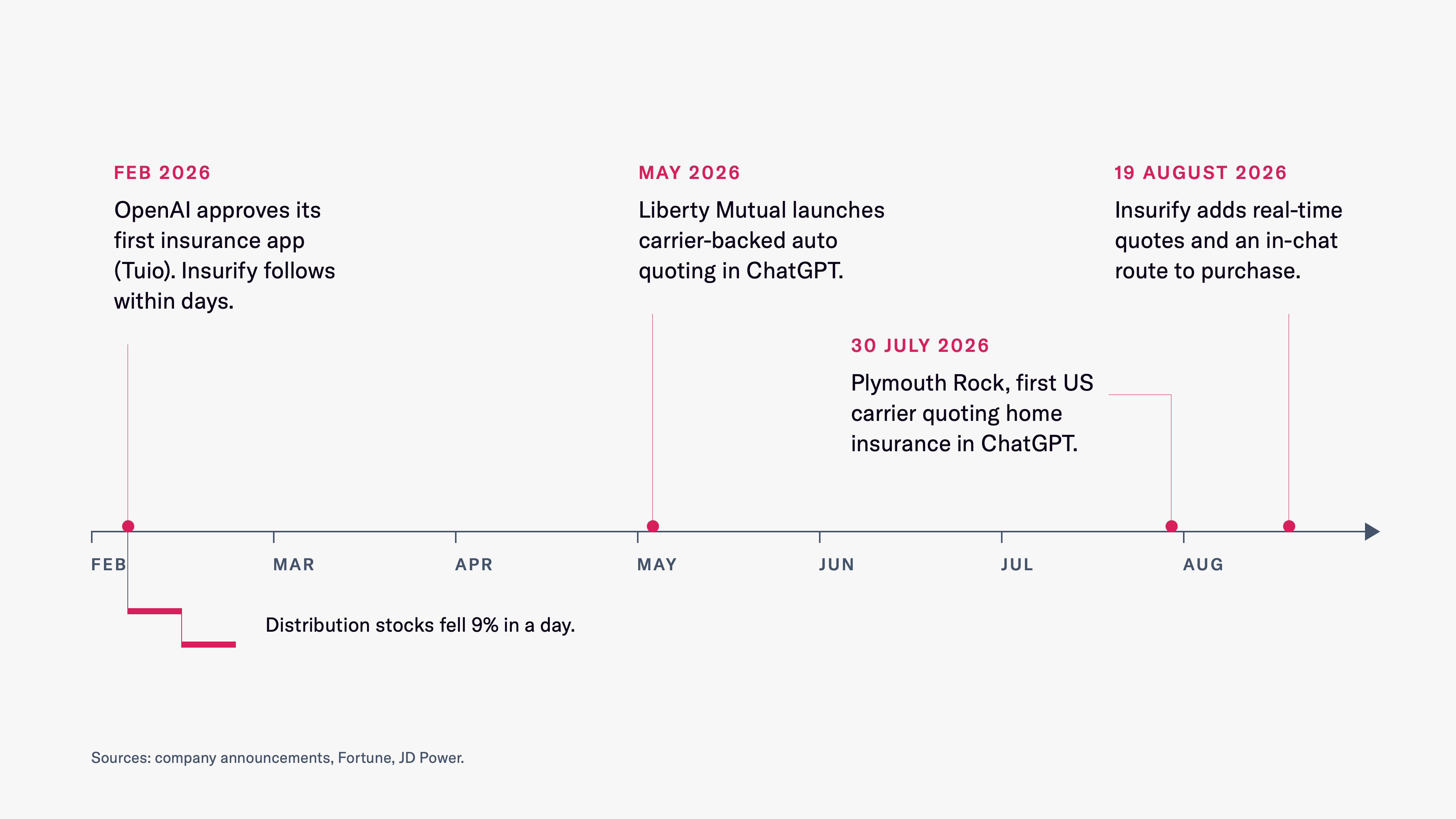
In February 2026, OpenAI approved its first insurance provider app, built by the Spanish home insurer Tuio, and Insurify's car insurance comparison app followed within days. Distribution stocks fell 9% before recovering. Liberty Mutual launched carrier-backed conversational AI quoting for auto in May. On 30 July, Plymouth Rock became the first US carrier quoting home insurance inside ChatGPT, live in six Northeastern states. On 19 August, Insurify moved from estimates to real-time quotes and an in-chat route to purchase. In the UK, MoneySuperMarket's ChatGPT app now covers car, home and pet cover across more than 150 providers. Seven months moved Frontier transformation from a strategy slide to a live channel.
When Carlos and I recorded, he put the systems problem on the same line as everything else.
"Our systems are not prepared for machines talking to them and the way they're going to be operating."
He named the actor he expected to force the issue: a small broker in Pennsylvania building an agent to hunt the best offer for clients. A carrier got there first. Plymouth Rock's plugin is live in Pennsylvania.
Customers are slower than the launches. JD Power surveyed 8,352 of them in June and July 2026 and found most still avoid AI for insurance, held back by unfamiliarity, habit, and thin trust in the results. That hesitation is the runway incumbents are standing on, and I would not plan past next year on it. I have sat in enough innovation reviews to know the failure mode. A channel shift is logged as a marketing problem and lands with a team that has no mandate over product data. On the agentic frontier, your channel arrives as a buyer with no patience for your interface.
A Partnership That Does Not Attack the P&L Is Decoration for Business Strategy
Carlos explains why cosmetic innovation keeps getting funded, and his explanation is behavioral. There is a lot of FOMO, he says, so you stay close to what is happening without ever finding the mechanism to bring it home. FOMO funds exploration. Exploration photographs well. Nothing lands in the accounts. His word for the result is cosmetic.
"I'm going to use the word attack to one of the lines in your P and L or your balance sheet, because otherwise you are just there to look nice in the picture.
He is Venezuelan, and blunt about geography. Embedding insurance in Latin America works differently than in Spain, and Brazil differs again from Argentina, so one use case needs a different partner in each market. Because: "Sometimes the best in class is not the best fit for you."
The market will run that filter for everyone soon enough. Gartner expects over 40% of agentic AI projects to be canceled by the end of 2027 due to escalating costs, unclear value, and inadequate risk controls. MAPFRE's own scouting data shows the discipline arriving in Latin America, where technology enablers now make up 52% of the insurtech ecosystem against 48% for distribution plays. Frontier Firms count their transformation where it touches the income statement.
Machines Do Not Care How Pretty Your Website Is
Shiny, in Carlos's vocabulary, is the enemy of deep. Interfaces rebuilt for human browsing mean nothing to an agent parsing product data.
"Machines don't care. How pretty is your website? It was important a few years ago. Now you need to have the information available, well structured, and you need to be able to talk to the machine and make it understand that your offering is the best one."
I framed the readiness test at a session I ran with Stripe on agentic commerce. Can a machine discover your product, quote it for the right segment, and bind the contract without a human rescuing the flow? Discoverability, quotability, bindability.
JD Power issues the same instruction on the customer side, telling insurers to monitor how major large language models read and interpret their content. Saharsh Agarwal of the Indian School of Business and Ananya Sen of Carnegie Mellon ran a randomized field experiment and found Google AI Overviews cut outbound organic clicks by 39.8%. Carlos sees the same pattern inside MAPFRE, where in some geographies more than half of website traffic from Google searches has fallen away. Your structured product data has become the Intelligence Layer a machine walks into, and persuasion turns into architecture.
Customer Engagement: Owning the Customer Stopped Being the Point
Carlos remembers when everyone in this industry agreed the client had to be ours. Embedded insurance ended that agreement. A passenger riding in an Uber often has no idea that a policy is in place for the journey. You will never own that customer. The decision is yours: whether you want the business.
"If you decide to play that, you know that the rules have changed and what was absolutely critical for you five years ago, today it is not."
What stays in the house, in his view, is risk management knowledge, the business rules, and control of how the tech stack connects to others. Hybrid distribution has become the operating condition for every insurer I work with.
You Cannot Tear Down a 30,000-Person House
The day before we spoke, Carlos had argued this with a colleague. A small, badly built house is sometimes worth tearing down. With more than 30,000 employees across dozens of countries, that option is gone. Asked what he would do as CEO, he turns it into a design brief. With his own people and outsiders in the room, define what an insurance company is in 2035, then build the roadmap backward.
"What we've done until today may not be enough for the next 10, 15, 20 years."
MAPFRE is answering the scale question in capital letters. On 23 July 2026, it agreed to buy Safety Insurance Group for $ 1.54 billion in cash, a deal that would create the second-largest private passenger auto insurer in New England. Scale and machine readability are two separate bets, and the Northeast is where both are landing at once. A Frontier Operating Model gets built backwards from 2035. Today's roadmap runs the other way.
What Frontier Transformation Asks of You This Quarter
-
Run a machine-readability audit in two weeks, and read the failures as lost revenue. Ask ChatGPT, Perplexity, and one custom agent to find, price, and bind your flagship product, scoring discoverability, quotability, and bindability. Whatever it cannot complete, revenue from a better-structured competitor collects instead.
-
Name the P&L line for every live pilot before the next quarterly review. The line, the movement expected, the date. Anything you cannot name is what Gartner's 2027 cull retires for you, at the cost of the budget already spent.
-
Rebuild scouting briefs around business pain, not technology categories. One session per business line, asking what is bothering the business, where it wants to grow, where it must be more effective. Then scout for the right fit per market, because the best-in-class vendor in Madrid can cost you money in São Paulo.
-
Draft the 2035 blueprint before the next board cycle, then use it to say no. One page covering what your company is in 2035, which capabilities survive, and the first three steps backward. Its value is as a filter on the pilots you approve.
The Institution Question
I opened the conversation asking whether our industry suffers a shortage of innovation or a failure to rebuild the institution underneath. Carlos spent an hour answering the latter. The gap is institutional, and no volume of pilots closes it.
What the next decade rewards is unglamorous. Product data a machine can read. Partnerships that move a named line. A destination designed before the roadmap. The firms treating Frontier transformation as institutional redesign are the ones that keep the promise Carlos returns to, "helping people navigate the risk they are facing in their lives, with their properties, with their health, with their way of life."
Listen to the full conversation with Carlos Cendra Falcón on Scouting for Growth.
When a machine shops for insurance on your customer's behalf, will it find you, price you, and bind you, or will it never know you were there?
Want to talk about it? Just set up a call with me here.
Frequently Asked Questions (FAQs)
What is Frontier transformation in insurance?
Frontier transformation redesigns an insurer's operating model for a market where agentic AI participates in distribution, underwriting, and service, using AI to transform business processes. MAPFRE's Carlos Cendra applies one test to separate it from digitization, noting that becoming a frontier firm requires redesigning the organization around AI, not just digitizing the interface. Does the change attack a line in the P&L, or does it only make the interface look modern?
Are AI agents and the role of the AI agent really buying insurance yet?
Quoting is live, and binding is close behind. AI agents are moving from quoting to autonomously applying intelligence on users' behalf. Tuio and Insurify launched ChatGPT apps in February 2026, Liberty Mutual added carrier-backed auto quoting in May, and in July Plymouth Rock became the first US carrier quoting home insurance inside ChatGPT. Insurify added real-time quotes in August, and by 2026 these agents are expected to execute insurance purchases autonomously, not just surface quotes.
How many customers already use AI to shop for auto insurance?
JD Power's AI Insurance Experience Study, fielded across 8,352 customer evaluations in June and July 2026, found that 29% of auto and home insurance customers use AI to research, service accounts, or shop. Of those researching with AI, 37% changed their policy. Of those shopping, 42% made a purchase.
What does machine readability mean for an insurance product?
An agent can complete the journey without a human rescuing the flow. It discovers the product, quotes it for the right segment, and binds the contract. That rests on structured, labeled product data, and most carriers still lack the modernized systems needed for autonomous transactions. It also depends on trust infrastructure, with AI agents using cryptographically verifiable credentials and trust registries, which are essential for agent-to-agent transactions; Europe’s eIDAS 2.0 requires digital identity infrastructure by 2027.
What would Carlos Cendra do first as an insurance CEO?
Design the destination before the roadmap. With help from his own people and outsiders, he would define what an insurance company is in 2035, then work backward from today. The comparison he reaches for is the Wizard of Oz. Set the road, follow it, adjust.
References
MAPFRE: more than 30,000 employees
MAPFRE agrees to buy Safety Insurance Group for 1.54 billion dollars
MAPFRE on Latam insurtech, 1H 2026
JD Power AI Insurance Experience Study 2026
Fortune on the February 2026 selloff and the BofA estimate
Plymouth Rock quotes home insurance inside ChatGPT
Insurify adds real-time quotes in ChatGPT
Gartner on agentic AI cancellations by 2027
AI Overviews cut outbound organic clicks by 39.8%
Editor in Chief

Rebuilding Risk Resilience