Is Your Intelligence Layer a Stack or a Shopping List?
Sep 17, 2026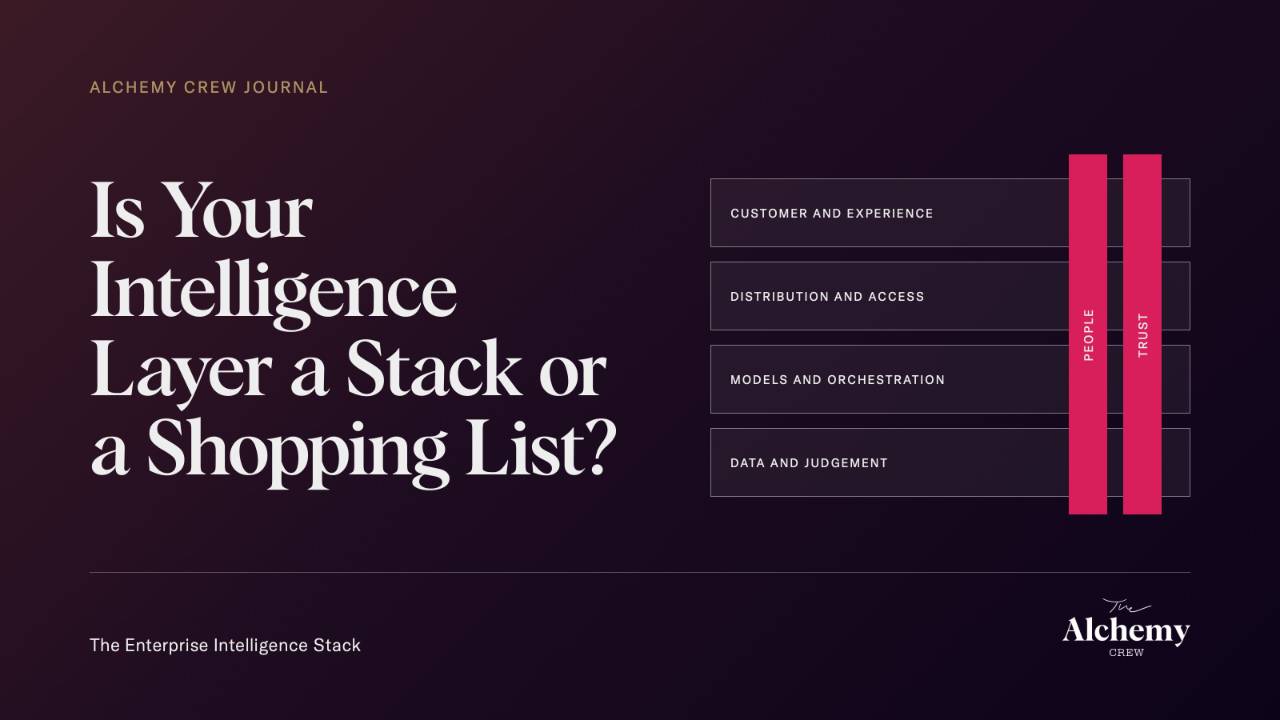
Written by Sabine VanderLinden
Your Intelligence Layer is a stack, not a shopping list, only when data, models, platforms, governance, and people operate as one connected system with a shared registry, audit trail, and clear human accountability.
Key points
- Most stalled agentic AI pilots fail on composition. An enterprise can own strong data, models, platforms, and governance and still get nothing back when those parts run on different data, different logs, and different assumptions about the customer. Gartner links the expected cancellation of more than 40% of agentic AI projects by 2027 to escalating costs, unclear business value, and inadequate risk controls.
- The Enterprise Intelligence Stack has four layers you can buy and two rails you must build. You can procure Data and Judgment, Models and Orchestration, Distribution and Access, and Customer and Experience. The People and Trust rails run through all four layers, and only the organization itself can design and govern them.
- AI assistants are becoming the front door for insurance distribution. Aviva launched home insurance quoting inside ChatGPT in March 2026, and Plymouth Rock followed on 30 July 2026 as the first US carrier to do the same. The Distribution Intelligence Layer decides whether that first introduction turns into a customer relationship the insurer can keep through service and renewal.
Why Agentic AI Systems Pilots Stall When the Intelligence Layer Is Fragmented
Agentic AI pilots stall when an enterprise's existing capabilities fail to operate as one system.
The symptoms are familiar to anyone who runs operations at a carrier. A promising pilot works beautifully in isolation and then struggles to scale; modular capabilities add local flexibility, but loose coupling in the shopping list model makes it easy to swap components without redesign, leaving the wider Intelligence Layer fragmented. Two AI agents hold completely different views of the same customer. Infrastructure gets duplicated across teams, accountability blurs, and the third pilot ends up costing as much as the first.
Market data points to the same conclusion. Gartner predicts that more than 40% of agentic AI projects will be canceled by the end of 2027, and estimates that only about 130 of the thousands of vendors marketing agentic AI offer genuine agentic capability. Gartner's analyst Anushree Verma describes most current projects as early experiments and proofs of concept that underestimate the real cost and complexity of running AI agents at scale. Agentic AI also requires substantial computational resources to operate effectively, and much of the implementation burden is mundane integration work, with roughly 80% tied to data engineering tasks.
Four excellent tools can still produce nothing if each one works from its own data, its own log, and its own governance model. In a real stack, data flows predictably from raw collection to consumption; without that, enterprises face significant challenges, including rising costs, unclear business value, and weak risk controls. In the episode, I put it this way:
"The real failure is that the capabilities we already own don't work together."
Before any new purchase, the better question is how the new tool will connect to what the firm already owns. That question applies equally to an enterprise buyer and to an AI venture selling into one.
This is the Intelligence Layer problem in its plainest form. The parts usually exist already, and the work left is composition.
What Is the Enterprise Intelligence Stack for Generative AI?
The Enterprise Intelligence Stack is a four-layer, two-rail framework that shows how enterprise AI capabilities must connect to create value. The four layers are Data and Judgment, Models and Orchestration, Distribution and Access, and Customer and Experience. The People and Trust rails run through every layer and hold the Intelligence Layer together. Its technical foundation enables autonomous operation and decision-making to work coherently across those layers.
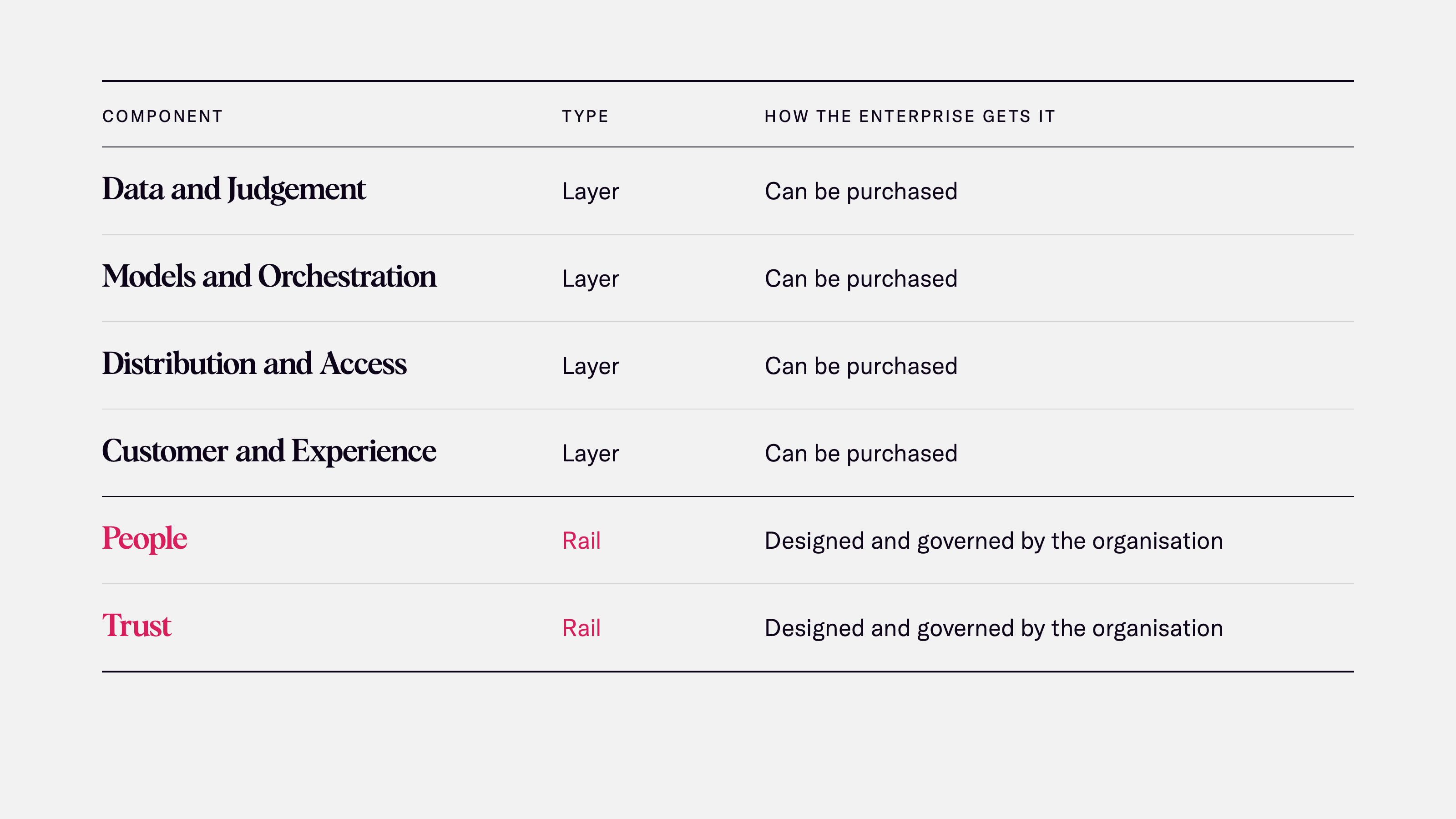
The distinction between layers and rails matters for budget. The bottom layers of the stack focus first on automation, while the higher layers coordinate judgment, access, and experience. Layers can be bought from suppliers. The organization must design and govern rails internally because they carry the accountability, permissions, and oversight that make agentic AI safe to scale.
Supplier count is a poor guide to whether a firm has a working Intelligence Layer. A shopping-list model emphasizes modular autonomy among components, which is useful only if the rails still hold them together. As I said in the episode:
"A firm can use four suppliers and still have one shared spine. It can also use one supplier and end up with four disconnected systems."
For AI ventures selling into insurers, the implication is direct. The value proposition now depends on how well the product joins the buyer's existing stack and its rails.
This is the Intelligence Layer as an architecture decision. Rails that run through every layer are the clearest predictor of scale.
The Composition Test: Four Questions for Every Agentic AI Initiative
The Composition Test checks any new agentic AI initiative against four requirements: one shared source of truth, one registry, one audit trail, and one accountable human. An initiative that fails any of the four adds cost to the Intelligence Layer without adding capability.
-
One shared source of truth. Every agent, team, and tool works from the same customer and product data, so two agents never act on two versions of the same policyholder.
-
One registry. Record every model, agent, and integration in one place, so the firm knows exactly what it owns before it buys more.
-
One audit trail. One log traces actions taken by agents and people, which a regulator, auditor, or claims dispute will eventually ask to see.
-
One accountable human. A named person owns the initiative's outcome, from the pilot through to production.
Run the test on the live portfolio, and the result is usually uncomfortable. The question I left listeners with captures it:
"Do you have a stack or do you have a shopping list?"
This is how an Intelligence Layer earns the right to scale. Each passed test makes the next initiative cheaper because it plugs into existing rails.
Inside the Distribution Intelligence Layer: Be Found, Be Buyable, Be Remembered
The Distribution Intelligence Layer governs how customers discover, buy from, and stay with a business when an AI assistant starts the journey.
Customers can increasingly discover products, compare options, generate quotes, and decide what to do next before they ever reach a company website. Walmart announced a partnership with OpenAI in October 2025 that lets customers shop Walmart through ChatGPT using Instant Checkout, with Walmart CEO Doug McMillon describing the search bar and long list of results as an experience about to change.
Insurance is following the same path. Aviva's ChatGPT app gives customers a Signature home insurance quote after a few questions, and they complete the purchase on Aviva's website. Plymouth Rock Home Assurance launched home insurance quoting in ChatGPT on 30 July 2026, with a continue-to-purchase step that moves the customer into the carrier's journey. Insurance Journal also reports that Insurify launched a ChatGPT app for car insurance shopping and that Liberty Mutual announced a conversational auto quoting app on ChatGPT for May 2026.
AI removes the search box first. As search, comparison, form-filling, and routine administration become cheaper, the broker's value moves downstream toward advice, trust, complex judgment, service, and renewal.
The Distribution Intelligence Layer has three jobs:
-
Be found. Product information must be accurate enough for an assistant to understand and represent correctly.
-
Be buyable. Secure connections must allow quotation, purchase, and service to happen without breaking the journey.
-
Be remembered. When the customer moves into the enterprise journey, their details, permissions, context, and choices move with them.
The hand-off is where customer ownership is decided. In the episode, I described it as a relay:
"Think of a relay race. The assistant runs the first leg. Your firm runs the second. The customer data and trust are the baton."
How the journey is designed and who controls what happens after the introduction shape customer ownership. For founders building in this space, an enterprise contract depends on the product connecting securely to real systems, respecting permissions, and leaving an audit trail.
This is the Intelligence Layer at the customer's front door. The Trust rail decides whether the baton is carried or dropped.
What Should Insurance Leaders Do With Their Intelligence Layer and Data Quality This Quarter?
Five moves, in order: draw the stack, run the Composition Test, fund the rails, buy your own product through an AI assistant, and map one hand-off from first question to renewal.
-
Draw the stack in the next two weeks. Map every data source, model, platform, team, and governance process against the four layers and two rails. Mark every place where two agents hold different views of the same customer. Most leadership teams discover they own more than they thought.
-
Run the Composition Test on every live pilot before the next budget cycle. Score each pilot on one shared source of truth, one registry, one audit trail, and one accountable human. A pilot that fails two or more tests goes back for redesign before it gets more funding.
-
Fund the rails before funding the next layer. Put budget into the People and Trust rails first: named owners, permissions, oversight, and a single audit trail. Every layer bought afterwards becomes cheaper to connect.
-
Try to buy your own product through an AI assistant this month. Ask ChatGPT, Claude, and Gemini to find, compare, and quote your product. Record where the answer is wrong, where the journey breaks, and where the customer is handed to a competitor.
-
Make one product AI-ready and map its hand-off within 90 days. Pick a single product and make it findable, buyable, and serviceable through an assistant. Then draw who owns the data, identity, payment, service, renewal, and next conversation at every stage.
For AI ventures selling into insurers, the same five moves work as a sales discipline. Show the buyer exactly how your product connects to their source of truth, their registry, their audit trail, and their accountable owner.
The Uncomfortable Question for Insurance Leaders
The gap most enterprises face in agentic AI is a composition gap. Capability is abundant, and the hard work is making it connect. Buying isolated components can be fast, but an Intelligence Layer is what supports repeatable decision-making across the business.
In the age of agents, the winners will be the firms whose intelligence connects, compounds, and scales. That rewards leaders who draw before they buy, govern before they automate, and design the hand-off before they chase the next channel. On distribution specifically, I closed the second episode with this:
"Being found is useful. Keeping the customer in the end is the business model."
Listen to both episodes on Scouting for Growth
Which of your live pilots would pass the Composition Test today?
Want to talk about it? Just set up a call with me here.
Frequently Asked Questions (FAQs)
What is the Enterprise Intelligence Stack?
The Enterprise Intelligence Stack is a framework I created to explain why enterprise AI succeeds or stalls. It has four layers (Data and Judgment, Models and Orchestration, Distribution and Access, Customer and Experience) and two rails (People and Trust). Layers can be purchased. The organization must design and govern the rails that connect the Intelligence Layer into a single system.
What is the Composition Test for agentic AI initiatives?
The Composition Test checks whether a new agentic AI initiative will connect to what an enterprise already owns. It asks four questions: is there one shared source of truth, one registry, one audit trail, and one accountable human? Sabine VanderLinden recommends running it on every pilot before funding, because an initiative that fails these tests adds cost to the Intelligence Layer without adding capability.
What is the Distribution Intelligence Layer in insurance?
The Distribution Intelligence Layer is the part of an insurer's Intelligence Layer that handles discovery, purchase, and retention when an AI assistant such as ChatGPT starts the customer journey. It has three jobs: be found, be buyable, and be remembered. Its success depends on the hand-off, where customer data, identity, permissions, consent, and context move from the assistant into the insurer's own systems.
Will AI assistants replace insurance brokers?
AI assistants are reshaping what insurance brokers are paid for. As AI makes search, comparison, form-filling, and routine administration cheaper, Sabine VanderLinden argues that broker value moves downstream toward advice, trust, complex judgement, ongoing service, and renewal. Brokers who build their offer around those strengths stay relevant as the first customer interaction moves into AI interfaces.
Can you get an insurance quote through ChatGPT?
Yes. Aviva launched a ChatGPT app in March 2026 that gives UK customers a Signature home insurance quote after a few questions, with purchase completed on Aviva's website. Plymouth Rock Home Assurance became the first US carrier to offer home insurance quoting through ChatGPT on 30 July 2026. Insurify and Liberty Mutual have also launched or announced auto insurance apps on ChatGPT.
References
Walmart and OpenAI partnership brings Instant Checkout to ChatGPT (Consumer Goods Technology)
How Aviva customers get a home insurance quote inside ChatGPT (Aviva)
Aviva pilots a ChatGPT app for home insurance quotes (FinTech Global)
Insurers race to deploy ChatGPT apps, including Insurify and Liberty Mutual (Insurance Journal)
Editor in Chief

Rebuilding Risk Resilience