Responsible AI Governance Is a Growth Lever: Make It Irresistible, Says Townsend
Aug 17, 2026Written by Alchemy Crew Ventures Team
This article draws on a conversation with Reggie Townsend, Vice President of AI Ethics, Governance and Social Impact at SAS, and answers the core question directly: responsible AI governance should govern at the use-case level, because that is where risk, value, and potential harm actually live. For corporate innovation and risk-resilience leaders: insurers, reinsurers, brokers, boards, C-suite executives, AI ethics and governance teams, and growth-venture founders, the practical payoff is clear: use-case governance helps reduce operational and reputational risk, strengthen trust, improve cash flow decisions, and turn responsible AI into a competitive advantage rather than a brake on adoption.
From there, the conversation moves through the operating details that matter now: how to embed governance into workflows instead of adding it after deployment, how to handle human accountability as AI agents take on more work, how to prepare for EU AI Act deadlines, and how Alchemy Crew’s DIVAAA framework supports AI deployment inventory, validation, adoption, and scale. Townsend calls the wider goal making responsible AI irresistible—the path of least resistance inside the enterprise, so leaders can move faster without losing control.
The line from the SAS Innovate stage
On stage at SAS Innovate 2026, in front of roughly 3,000 people, Townsend said governance has to be the path of least resistance, and that he wanted to make being responsible irresistible. The clip traveled.
Townsend is a poet by his own description, and he uses irresistible as both an aspiration and a brief to the team that built SAS AI Navigator, the company's governance product.
Making being responsible irresistible is as much of an aspiration as it is really an instruction to my team.
That instruction changed the design questions. Governance usually arrives at the tail end of something already built, which turns it into a roadblock nobody wants to clear. Townsend asked his team to lower the barrier instead, to the point where Navigator opens with a single question in the upper-left corner: How are we doing? A smiling face and nothing to action means an executive can close the tab in five minutes and move on. The question this article takes up is what has to change in a large enterprise for that to be true.
Why this matters now
The gap between AI ambition and accountability is widening, and boards sit on the wrong side of it. Grant Thornton's 2026 AI Impact Survey found that three in four boards have approved major AI investments, while fewer than half have set governance expectations or made AI risk a standing agenda item. Another 40% of directors say overseeing ai is challenging. Money is moving faster than oversight.
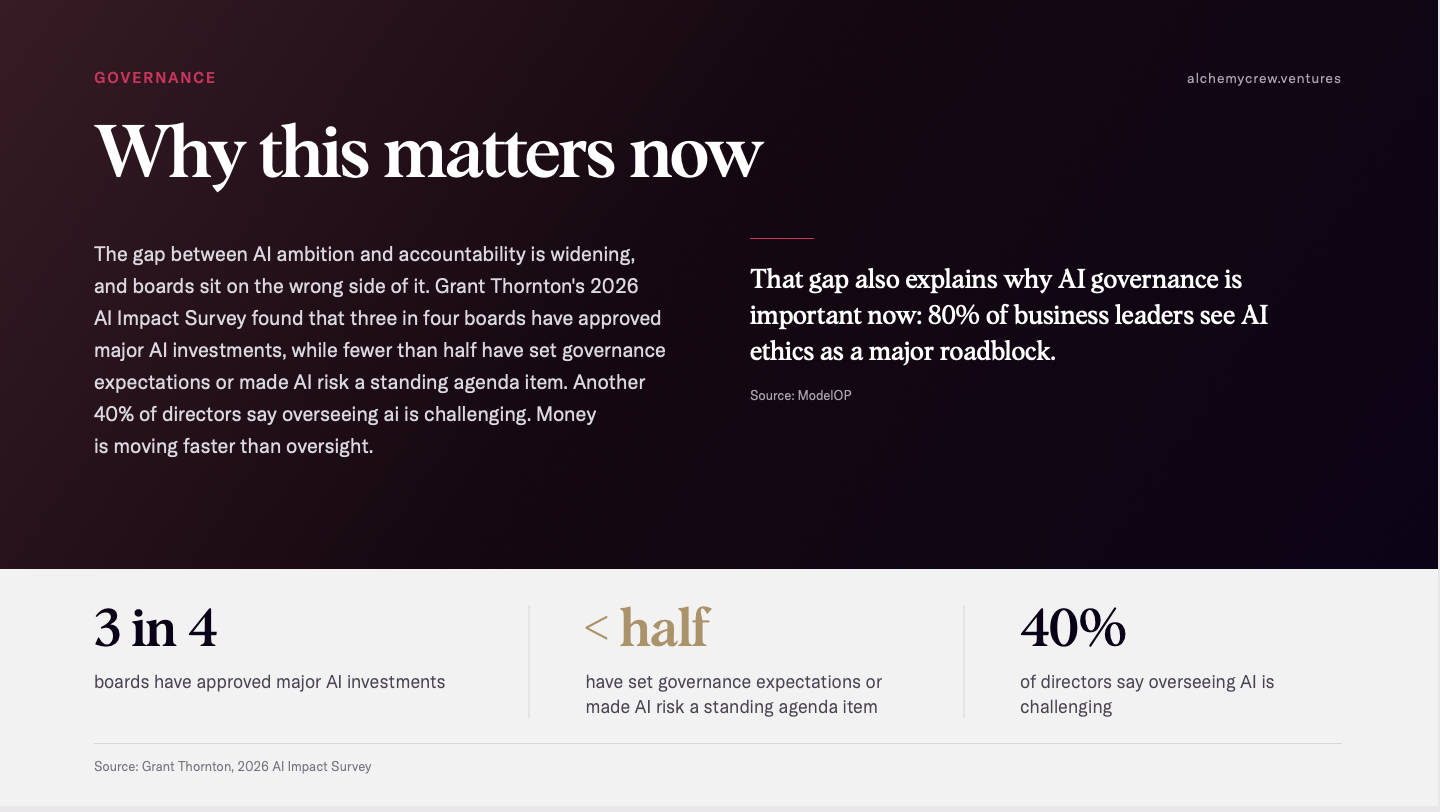
That gap also explains why AI governance is important now: 80% of business leaders see AI ethics as a major roadblock. The cost of that gap is measurable. MIT's NANDA study, The GenAI Divide: State of AI in Business 2025, found that 95% of enterprise generative AI pilots delivered no measurable impact on the profit and loss statement, tracing the failure to weak integration into real workflows well upstream of model quality. The same study named the shadow AI economy, where staff reach for personal tools when the sanctioned ones are too clumsy to use.
Sabine VanderLinden frames the moment as a frontier transformation, where humans and agents work together and intelligence flows through the operating model the way electricity once moved underground. Townsend shares the analogy and pushes it further. If intelligence is now on tap, the risk sits in how each drop gets used, and that is where most responsible AI governance programs are not looking, because responsible AI governance ensures AI systems are ethical, transparent, secure, and compliant with the law, not just that ai usage expands.
Value and risk live in the use case, so governance has to start there
Auditing models is necessary work that answers the wrong question. Townsend's sharpest architectural point is that companies govern at the wrong unit. Models carry broad abilities, yet people apply them in narrow, specific ways, and the impact lands on the application.
Use cases are where value and risk actually live inside of the enterprise.
Consider one model dropped into an insurer. It can run loan adjudication, claims triage, and resume screening, and each use case carries a different level of risk, value, and scrutiny. A use case is the specific business implementation, not the underlying ai model. The use case is where the lights come on or the house burns down. When a CEO tells Townsend that governance is handled because every model gets audited, his answer is short: show me your work, then show me your use cases, and start with the inventory.
This is where the DIVAAA™ method earns its place. The first two stages, Discover and Investigate, involve inventorying Townsend demand, mapping where AI already lives inside the business, identifying which AI applications are in play, and defining what each deployment is for; inventorying use cases is also a core risk assessment step. Governance that skips that map is guarding the transformer while the fire starts in the wiring.
Compliance loses when it is one team's job
The fastest way to make responsibility fail is to hand it to a single desk. Townsend does not believe people set out to break laws or harm others. They take the path of least resistance when governance is made inconvenient against the seventeen thousand other things already on their plates. Many organizations still lack AI governance processes and clear decision rights, with 65% of governance leaders reporting that gap. The fix is to distribute the burden and design the standards in at the point of work, so being responsible stops feeling like a separate task.
if you embed the needs of compliance just into a natural workflow, it now becomes part of achieving the objectives that person has been delegated to perform.
Grant Thornton's data backs the mechanism. Centralized review bodies get overwhelmed as use cases multiply, creating bottlenecks that slow the business without lowering the risk. A workflow that carries the check inside it wins by default. That only works when AI governance policies turn high-level ethical standards into concrete rules and safeguards inside everyday workflows. Strong data governance and privacy controls also have to safely handle sensitive personal information as part of that flow.
This is the Frontier Firm in practice: human-led, agent-operated, and built so that judgment and accountability are shared across the whole organization. Responsibility parked on one desk is the pattern that fails. Townsend puts it plainly: this has to be collective action because everyone shares the reward and the risk, so everyone should share the responsibility. Clear governance processes and practical governance policies are what make that shared model work, rather than leaving oversight to a separate function.
As agents multiply, accountability still follows the human
The temptation to blame the technology is the one Townsend refuses outright. Machine identities already outnumber human employees in many enterprises, and most companies admit an agent has done something they never asked. When the question turns to who is accountable, he does not hesitate.
If we create it, we are accountable for that creation. And what we should not do is to scapegoat the technology.
He rejects legal personhood for AI too, warning that granting agents their own accountability strips humans of agency and hands more power to the people who design the systems, when legal accountability must stay with humans and organizations. His test for any autonomous decision is the refrain he returns to throughout: for what purpose, to what end, and for whom might it fail. If a leader cannot answer that across ten thousand background loops, the honest move is to slow down until they can. That is also how you reduce unintended consequences when agents operate at scale.
That discipline is the human oversight layer of an intelligence core made real. Agent orchestration without a named human owner is exposure dressed up as scale, and the legal team may need to help define accountability for agents and other AI systems. Townsend illustrates the drift with automation bias: trusting the map is fine until it routes you through a dark alley. Preserve human judgment, he argues, and you preserve human culture.
Governed AI protects cash flow, which makes it a growth lever
For the CFO, governance reads as a cash-flow instrument. Token spend behaves as a variable cost, and variable costs are the enemy of a finance team trying to plan its quarter, while governance efforts also support regulatory compliance and mitigating risk, not only budget control.
When you have variable costs, you don't quite know where it's coming from. You don't know when it's going to hit, in which quarter, what week. And you present yourself with a cash flow issue.
Townsend connects governance to two levers a CFO already tracks. The first is cycle time: knowing which use cases drive variable cost lets a team prioritize the ones that pay back and defer the ones that drain the budget before the quarter ends. The second is trust, which he calls a form of currency that compounds. A governed system avoids the reputational damage of unwatched AI, and when AI tools and vendor systems are governed well, they also help protect intellectual property while a trusted supplier converts prospects an untrusted one loses.
This is where the venture client model does quiet work. Trust travels through the supply chain, so a corporation that buys from or processes data through a startup inherits that venture's governance, or its gaps. Corporates that adopt startups early, as customers, are best placed to build that trust into the chain from the start. That makes supply-chain trust part of corporate governance aroundmission-criticall risks for the CFO and board.
Actionable takeaways for leaders
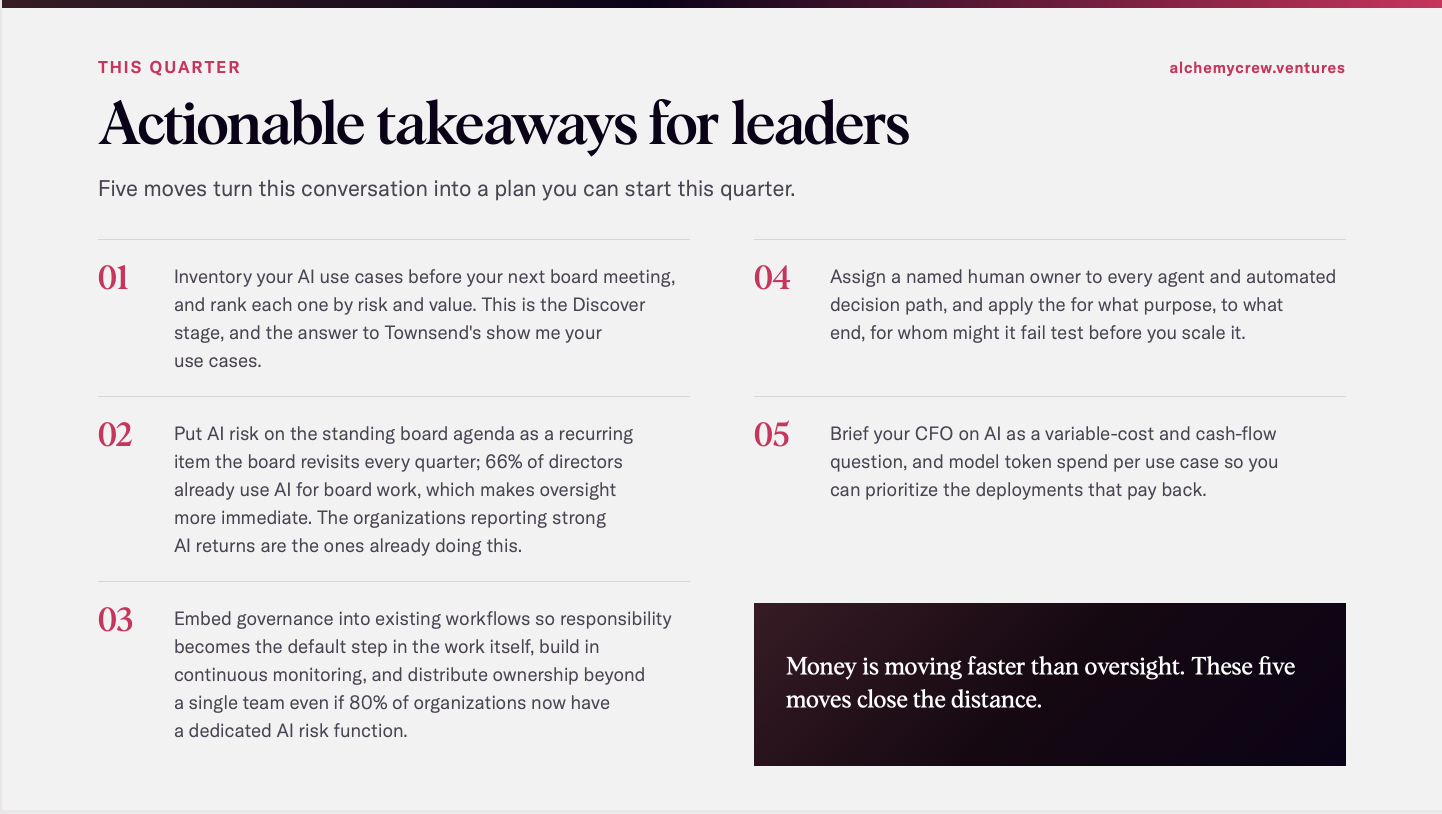
Five moves turn this conversation into a plan you can start this quarter.
-
Inventory your AI use cases before your next board meeting, and rank each one by risk and value. This is the Discover stage, and the answer to Townsend's show me your use cases.
-
Put AI risk on the standing board agenda as a recurring item the board revisits every quarter; 66% of directors already use AI for board work, which makes oversight more immediate. The organizations reporting strong AI returns are the ones already doing this.
-
Embed governance into existing workflows so responsibility becomes the default step in the work itself, build in continuous monitoring, and distribute ownership beyond a single team even if 80% of organizations now have a dedicated AI risk function.
-
Assign a named human owner to every agent and automated decision path, and apply the "for what purpose, to what end, for whom" might-it-fail test before you scale it.
-
Brief your CFO on AI as a variable-cost and cash-flow question, and model token spend per use case so you can prioritize the deployments that pay back.
Frequently Asked Questions
What is the AI trust dilemma in enterprise AI?
The AI trust dilemma is the gap between how much an organization trusts its AI and how trustworthy that AI actually is. The SAS and IDC Data and AI Impact Report found 46% of organizations sit in this state, often when ai usage outpaces governance and oversight, either underusing reliable systems or overtrusting unproven ones, which leaves close to half of AI's value untapped.
Should companies govern AI models or AI use cases?
Reggie Townsend of SAS argues governance should sit at the use-case level, because one model can run loan adjudication, claims triage, and resume screening, each with different risk and value. The EU AI Act, which entered into force on August 1, 2024, classifies AI systems into four risk tiers, and use-case governance helps determine where AI systems fall, from minimal risk to unacceptable risk, in the right context. Auditing the model alone tells a board little about where harm or value actually shows up in the business. Teams also need fairness, which means mitigating algorithmic bias and ensuring equitable access in sensitive decisions.
When does the EU AI Act apply to high-risk AI systems?
Enforcement of the Article 50 transparency duties and general-purpose AI obligations lands on 2 August 2026. Obligations for standalone high-risk systems under Annex III moved to 2 December 2027, and product-embedded high-risk systems follow on 2 August 2028, so preparation should already be underway.
Who is accountable when an AI agent acts without human instruction?
Townsend is direct: humans stay accountable for what they build, whether the system is deterministic, generative, or agentic. That accountability should sit inside a formal risk management framework such as the AI RMF, which NIST released on January 26, 2023. It organizes AI risk into four functions: GOVERN, MAP, MEASURE, and MANAGE. He rejects legal personhood for AI, arguing that handing agents their own accountability would strip humans of agency and give more power to the systems' designers.
Make it the easiest thing you do
The tension Townsend leaves us with is simple to state and hard to live. Governance scales judgment, and judgment preserves the culture of an organization, yet most companies still make the responsible path the hardest one to walk. The fix is better design: a governed system so intuitive that people choose it, anchored in the use cases where value and risk actually live, because responsible ai adoption depends on making governance usable for business leaders who otherwise treat AI ethics as a roadblock, in fact, 80% of business leaders view AI ethics as a major roadblock.
Townsend, a former member of the White House National AI Advisory Committee and a board member at EqualAI, has spent years arguing that this is a leadership capability within today’s ai landscape and for guiding ai initiatives responsibly. His challenge to every leader reading this is worth sitting with. If your people are routing around your governance today, what would it take to make being responsible the easiest thing they do this week?
Listen to the full conversation with Reggie Townsend on Scouting for Growth, and explore how Alchemy Crew helps leaders turn responsible AI into a growth advantage at alchemycrew.ventures/amplifying-success.
Sources and citations
Editor in Chief

Rebuilding Risk Resilience