Skan AI: The Intelligence Layer Nobody Bought... Until Last Week
Aug 21, 2026
Written by Sabine VanderLinden
State Farm Ventures just paid for the layer digital labor stands on. Most carriers have not yet named the problem.
Key Takeaways
- On 12 August 2026, Skan AI raised a $63 million Series C. The round was co-led by Cathay Innovation and Dell Technologies Capital, with State Farm Ventures, Citi Ventures, Bloomberg Beta and Wipro Ventures participating, taking the Menlo Park company’s total funding to roughly $120 million. The company says a quarter of the Fortune 50 runs on its platform, including seven of the ten largest US banks and three of the five largest US insurers. The Intelligence Layer, the work context beneath enterprise AI agents, now has a market price.
- The evidence behind the round is observational, and it has people in it. In Skan AI’s published bank case study, its software watched 1,500 finance professionals at a top ten US bank switch applications 11.2 million times, surfaced $37 million in operational friction, then turned those observations into agent execution logic that cut cost per transaction by 32%, lifted throughput by 41%, and delivered $18 million in annualized savings. The company reports more than 25 billion work signals processed in total.
- The strategic signal for insurers is the cap table, not the cheque. State Farm Ventures is the venture arm of America’s largest property and casualty insurer by direct premiums written (NAIC 2025 data). A carrier venture arm buying work context infrastructure is a Venture Client move on the operating model itself, and it lands six weeks before ITC Vegas (29 September to 1 October 2026), where agentic insurance will dominate the agenda. Gallagher Re’s Q2 2026 report already put 99.1% of the quarter’s $2.44 billion insurtech funding into AI companies.
Skan AI Series C at a glance
| Company | Skan AI, Menlo Park, California. Category: context graph of work, also described as the Intelligence Layer for enterprise AI. |
| Announcement date | 12 August 2026 |
| Round size | $63 million Series C |
| Co-leads | Cathay Innovation and Dell Technologies Capital |
| Participating investors | State Farm Ventures, Citi Ventures, Bloomberg Beta, Wipro Ventures |
| Total funding to date | Roughly $120 million across three rounds: $14 million Series A led by Cathay Innovation, $40 million Series B led by Dell Technologies Capital, and this $63 million Series C |
| Customer footprint | Company-stated: a quarter of the Fortune 50, seven of the ten largest US banks, and (per VentureBeat’s reporting) three of the five largest US insurers |
| Platform | Skan AI Blueprint, Skan AI Intelligence and Skan AI Agents. Blueprint and Agents reached general availability alongside the round. |
| Why insurers should care | A carrier venture arm bought operating model infrastructure rather than a use case, six weeks before ITC Vegas 2026 |
Inside one of America’s ten largest banks, software spent months watching 1,500 finance professionals work. It logged 11.2 million switches between applications: the CRM, the email client, the spreadsheet nobody admits is the real system of record. In Skan AI’s telling of its own case study, that watching surfaced $37 million in operational friction that no manual had a name for. Then the observations became the map a set of agents now runs on, and the numbers moved: cost per transaction down 32%, throughput up 41%, $18 million a year in savings.
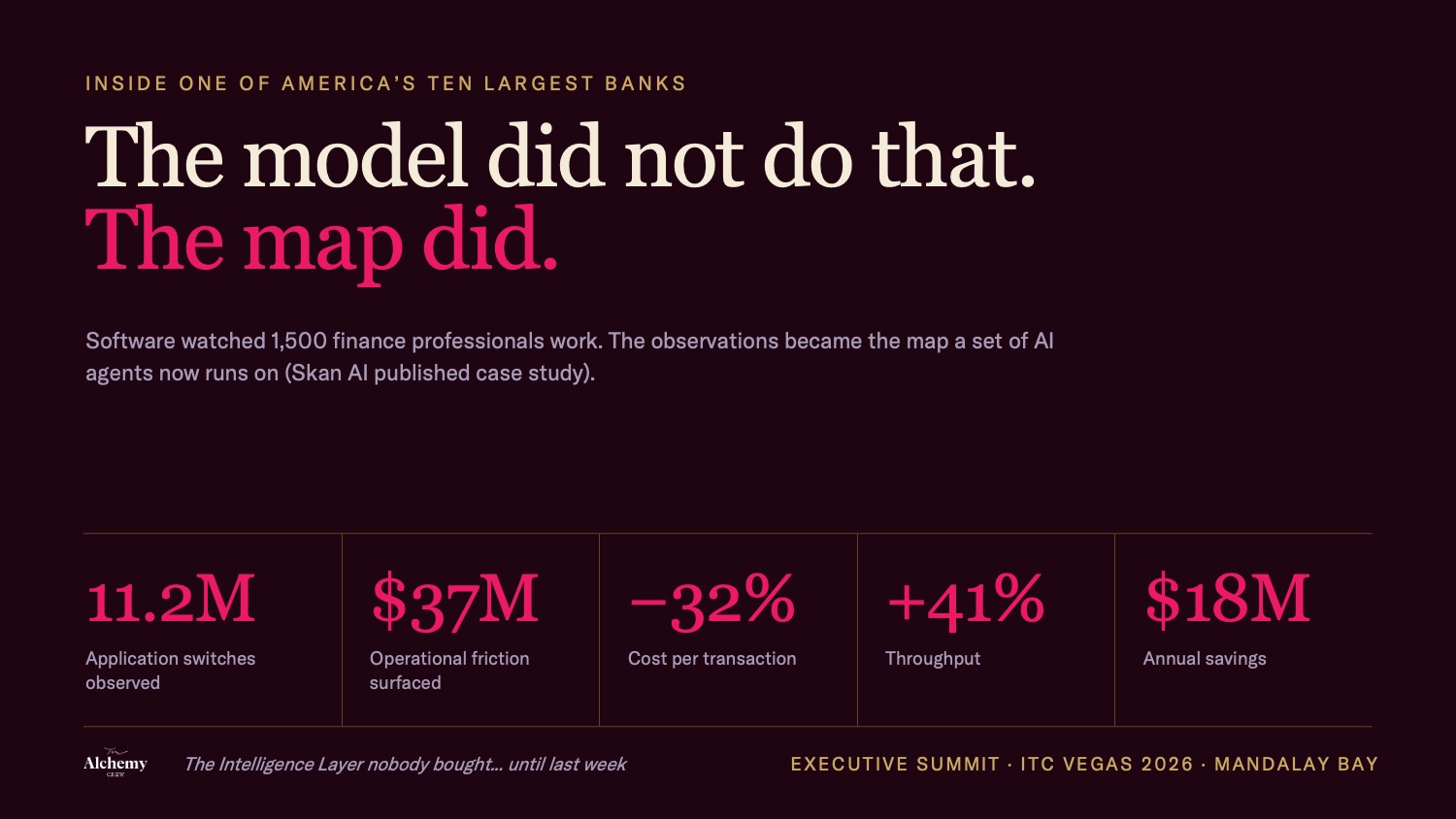
The model did not do that. The map did.
On 12 August 2026, that map was priced. Skan AI announced a $63 million Series C co-led by Cathay Innovation and Dell Technologies Capital, and the detail worth more than the headline number sits further down the investor list. Indeed, State Farm Ventures, the venture arm of America’s largest property and casualty insurer, invested in the Intelligence Layer: the work-context infrastructure that sits atop existing technology stacks and enables AI agents to operate within an organization’s data and workflows. “We invest in durable advantages,” is how Kate Strubhar, a State Farm Ventures executive, explained the cheque.
Durable is the operative word. Models are commoditizing by the quarter. Context is not.
Here is the uncomfortable reading for everyone else, especially large insurers, reinsurers, brokers, Fortune 500 operators, and the founders, investors, and policymakers building around InsurTech, FinTech, AI, climate-tech, and health-tech.
Every insurer in your network is buying agents. Almost none of them can describe, at the level of a single decision, how the work those agents are meant to carry actually gets done today.
That gap is not a tooling problem, and no foundation model closes it. It is why pilots stall in production, why operating costs stay stuck, and why the Human-Agent Ratio conversation keeps collapsing into headcount arithmetic.
This piece looks at the Intelligence Layer itself, the operational evidence behind Skan AI’s market footprint and funding, why State Farm Ventures buying work context infrastructure matters because owning this layer means training it on your data rather than renting generic capability, and what insurers can do next to adopt and scale AI-enabled workflows with intent.
What is the Intelligence Layer?
Definition: The Intelligence Layer is the work-context layer that connects an enterprise’s systems, data, and AI agents. It captures how work actually gets done, at the level of roles, screens, and decisions, and turns that context into execution logic agents can run. It reasons, plans, retrieves context, and orchestrates actions through agents, models, governed memory, and orchestration.
The Intelligence Layer sits between raw data and end-user applications, serving as the connective tissue linking an enterprise’s systems, data, and AI agents. Without it, digital labor operates on documentation rather than reality. Skan AI’s $63 million Series C, announced on 12 August 2026, is the clearest market pricing of the Intelligence Layer to date, reflecting a shift from traditional applications to intelligent systems as static information becomes dynamic automated decision-making.
Digital labor is deciding on the wrong evidence
The agentic insurance debate currently has two loud questions.
- Who is accountable when an agent sells, underwrites, or settles?
- And whose model are you dependent on when a handful of providers carry the whole market?
Both matter. Both are downstream of a quieter question almost nobody has asked: on what basis is the agent deciding at all? Increasingly, artificial intelligence is understood not as a model alone but as a system that combines models, context, and decision-making capabilities.
Most enterprise agents today are grounded in process documentation, training manuals, and system logs. Walk any campus, and you can see the flaw rendered in grass. There is the paved path the planners drew, and there is the desire path worn diagonally across the lawn, because that is where people actually walk.
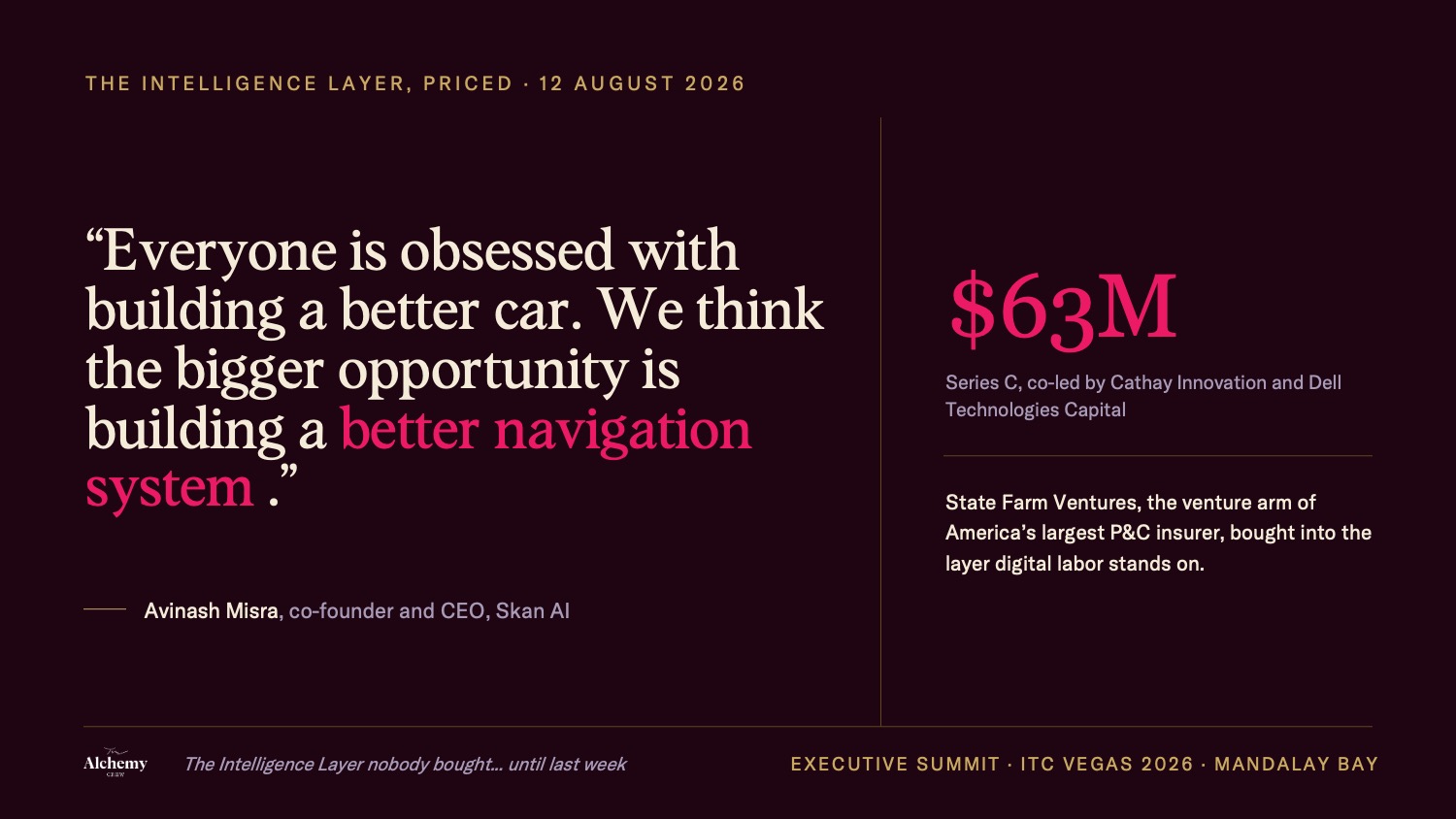
Today’s focus on the Intelligence Layer follows from generative AI, more computing power, massive digital datasets that train smarter models, and the transformer shift in how computers understand language. Process documentation is the paved path. The work flows along the desire paths: the workaround living in a spreadsheet, the judgment call at the fourth screen, the exception the manual never mentions. AI applications now hit operational bottlenecks when they must handle complex business logic without a robust Intelligence Layer, and the failure arrives late, in production, after the cheque has cleared.
Avinash Misra, Skan AI’s co-founder and CEO, compresses the bet into one line:
“Everyone is obsessed with building a better car. We think the bigger opportunity is building a better navigation system.”
The company says it has processed more than 25 billion work signals building those maps. Treat that figure as a first-party claim. Treat the customer list as the argument.
What $63 million buys: the Intelligence Layer, priced
A quarter of the Fortune 50 already runs on the platform, according to the company, including seven of the ten largest US banks and, per VentureBeat’s reporting, three of the five largest US insurers. The growth underneath is stated with equal confidence: revenue up more than 300% year over year and net dollar retention of 150%. Company numbers, and attributed as such.
The investor behavior is the harder evidence. Cathay Innovation led the $14 million Series A. Dell Technologies Capital led the $40 million Series B. Both co-led this round, and Citi Ventures has participated across all three. Three rounds of inside money re-upping is the strongest external signal a private company can send, because the people writing the cheques have seen the numbers the press release leaves out.
Set the round against the capital backdrop. As of March 2025, 71% of companies regularly used generative AI, and 97% of leaders investing in AI reported positive ROI. Gallagher Re’s Q2 2026 report put global insurtech funding at $2.44 billion, with 99.1% of it flowing to AI companies. That report answered the question of where the capital is going. AI-driven productivity gains are expected to lift global GDP by 14% by 2030, which is why business leaders are treating the category less like speculation and more like infrastructure.
Last week answered what the most patient slice of it is buying: not another underwriting copilot, but the context every copilot is starving for. Simon Wu of Cathay Innovation made the scale of that bet explicit, calling enterprise work context:
“the foundational infrastructure layer for enterprise AI, the same way CRM became the system of record for customer relationships.”
If you run transformation inside an insurance carrier, I suspect you recognize that starvation from the inside. You have sat through the demo that dazzled in the sandbox and stalled in the live workflow. You have defended a pilot at budget review with an adoption curve that flattened in month three.
Innovation theatre is exhausting, orphan pilots are demoralizing, and the post-mortem reads the same every time: the agent was fine, the context was missing.
That is not a failure of ambition. It is a missing layer, and until last week almost nobody would pay for it because almost nobody had named it.
State Farm Ventures and the Human-Agent Ratio question
Now look harder at the cap table. A carrier venture arm buying into process context infrastructure is a pure Venture Client move on the operating model itself. This is the lineage BMW’s Startup Garage established: the corporate becomes a paying client of the venture’s technology inside a live workflow, early, because the capability is structurally unavailable in the building.
State Farm Ventures bought the Intelligence Layer (rather than the chatbot) that its future digital labor will stand on: a shared context for multiple AI agents across the organization, with orchestration and integration, context retrieval, reasoning, and agentic execution. That is precisely the behavior most Fortune 500 insurers claim to want from their venture arms and mostly do not exhibit.
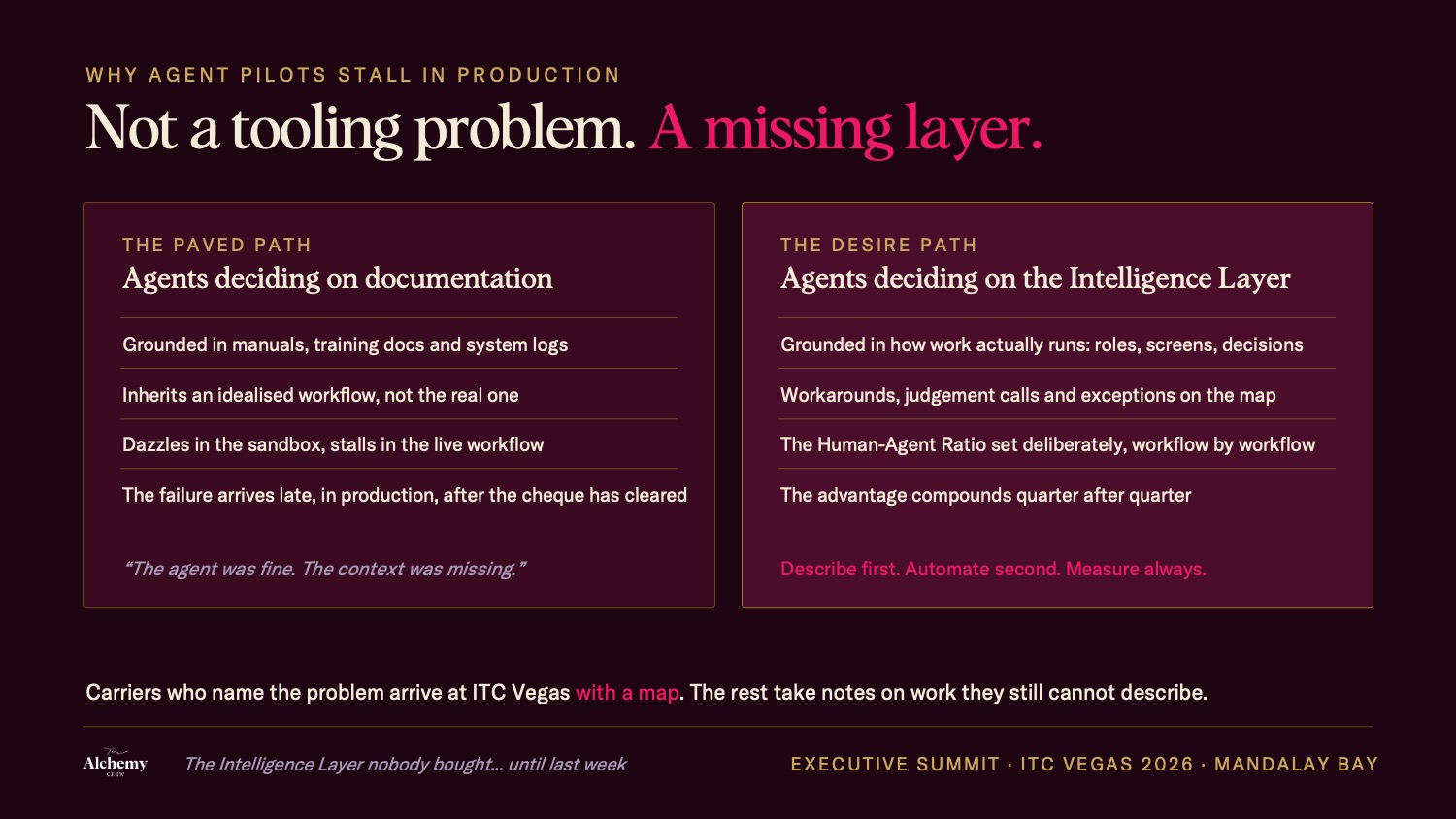
This is also where the Human-Agent Ratio stops being a slogan and becomes a design instrument. The ratio only means something if you can state, workflow by workflow, which decisions are carried out by people, which by agents, and on what evidence each is making its decisions. Agentic AI only works at that level if it has a defined Intelligence Layer to plan and execute workflows autonomously. Carriers that can describe their work will set that ratio deliberately and compound the advantage quarter after quarter. Carriers that cannot will discover it by accident, in the incident report.
In our DIVAAA work with insurers, the Validate gate asks one blunt question before any pilot advances: show me the map of the work as it runs today. Enthusiasm is not evidence. Frontier Firms already run this discipline: describe first, automate second, measure always.
The playbook: four moves this quarter
-
Map one workflow before you automate anything else. Pick the one closest to revenue. Document how it actually runs, including desire paths, and have the process owner sign it as true.
-
Ask your agent vendor one question, in writing. What evidence of our actual work does your agent decide on? If the answer is your own documentation, you have found the gap before it found you.
-
Apply the infrastructure test to your venture arm’s next cheque. Is this a use case, or a layer on which the operating model will stand? State Farm Ventures just showed the industry the difference.
-
Put the Human-Agent Ratio on one page, with units. Share of each workflow carried by agents, measured weekly. One page, one owner, one Friday number.
Here is the version of this that should worry you, because it is quiet. No carrier will ever announce that it declined to learn how its own work gets done. There will just be a pilot that tested well and thinned out in production. A vendor’s answer, in writing, that names your own documentation as the agent’s evidence. A transformation lead at Mandalay Bay on 29 September, notebook open, watching a competitor walk through a map of their work drawn before a single agent touched it, and knowing nobody in their own building could draw one. None of that will be called a decision. It will have been one anyway.
The other version starts smaller than a platform purchase. Describe one workflow. Ask one vendor the evidence question. Read your venture arm’s next term sheet for infrastructure rather than theatre. The insurance carriers who name the problem in the next six weeks arrive at ITC Vegas with a map, and those who do not will take notes on work they still cannot describe.
The Intelligence Layer is being bought, mapped, and priced right now. The only question that matters this quarter is whether your organization is describing its work or still guessing at it.
The model isn't the moat. Context is. While VaultSpeed solves the data-context problem, Skan solves the work-context problem.
Join us at ITC Vegas 2026 if you want to know whether your organization could pass the map test, and what that means for every agent pilot on your books. 2.45 hours. One conversation. A clear view of where you stand.
Frequently asked questions
What is the Intelligence Layer in enterprise AI, and why does it matter for insurers?
The Intelligence Layer is the work-context layer between an enterprise’s systems, its data, and its AI agents: a continuously updated record of how work actually gets done, at the level of roles, screens, and decisions, translated into execution logic that agents can run. It matters for insurers because agents grounded only in process documentation inherit an idealized version of the workflow and stall in production. Skan AI’s $63 million Series C on 12 August 2026, with State Farm Ventures participating, put the first headline market price on the Intelligence Layer. The company says a quarter of the Fortune 50, including seven of the ten largest US banks and three of the five largest US insurers, already runs on its work context platform.
What did Skan AI announce in its $63 million Series C, and who invested?
On 12 August 2026, Skan AI, based in Menlo Park, announced a $63 million Series C co-led by Cathay Innovation and Dell Technologies Capital, with participation from State Farm Ventures, Citi Ventures, Bloomberg Beta and Wipro Ventures, taking total funding to roughly $120 million. Cathay Innovation led the $14 million Series A and Dell Technologies Capital led the $40 million Series B. The round accompanied the general availability of Skan AI Blueprint and Skan AI Agents, which join Skan AI Intelligence as a platform that observes real work and turns it into execution logic for AI agents. The company reports more than 25 billion work signals processed, revenue growth above 300% year over year, and net dollar retention of 150%.
Why did State Farm Ventures invest in Skan AI, and what does it signal for carrier venture arms?
State Farm Ventures, the venture arm of America’s largest property and casualty insurer by 2025 direct premiums written, joined Skan AI’s $63 million Series C on 12 August 2026. Kate Strubhar, a State Farm Ventures executive, framed the investment as backing durable advantages: infrastructure that connects the information and context behind how work gets done. The signal for carrier venture arms is a shift from use case bets to operating model infrastructure, the Venture Client pattern BMW’s Startup Garage established, in which the corporate becomes an early paying client of capability it cannot build internally. A venture arm cheque into the Intelligence Layer is a bet on how every future agent will be grounded, not on a single application.
Why do AI agent pilots stall in production, and how does integrating multiple AI agents with the Intelligence Layer fix it?
Most enterprise AI agents are grounded in process documentation, training manuals, and system logs, which describe an idealized workflow rather than the desire paths real work follows: the spreadsheet workaround, the judgment call at the fourth screen, the exception the manual never mentions. Agents inheriting that fiction fail late, in production, after budgets are committed. The Intelligence Layer fixes the evidence base rather than the model. In Skan AI’s published bank case study, observing 1,500 finance professionals across 11.2 million application switches revealed $37 million in operational friction and yielded agent execution logic that cut cost per transaction by 32% and increased throughput by 41%, worth $18 million in annualized savings. Fix the map first. The agent follows.
How should an insurance carrier set its Human-Agent Ratio before automating a workflow?
Describe the workflow before you automate it. Within a few years, 40% of workers are expected to manage AI agents, making the Human-Agent Ratio something to design deliberately for every future agent boss. The Human-Agent Ratio, the share of a live workflow carried by people versus digital labor, only becomes a design instrument once a carrier can state, decision by decision, how the work runs today and on what evidence each decision rests. Practically, that means four moves inside one quarter: map one revenue-adjacent workflow with its desire paths and have the process owner sign it as true; ask each agent vendor in writing what evidence of actual work their agent decides on; test the venture arm’s next cheque against infrastructure rather than use case criteria, as State Farm Ventures did with Skan AI on 12 August 2026; and put the ratio on one page with a named owner and one weekly number.
What is the Venture Client model, and how did State Farm Ventures apply it?
The Venture Client model is a corporate venturing approach in which a large company becomes an early paying customer of a startup’s technology inside a live workflow, rather than acquiring the company or running an arms-length pilot. BMW’s Startup Garage established the pattern, and the test it applies is whether the venture supplies a capability that is structurally unavailable inside the corporate. State Farm Ventures applied that logic on 12 August 2026 by participating in Skan AI’s $63 million Series C: rather than backing a single insurance use case such as a claims chatbot, it invested in the work context infrastructure on which future AI agents across the organization will be grounded. For a carrier venture arm, the difference is between funding an application and funding the operating model beneath every application.
What is a context graph of work, and how is it different from a process map?
A context graph of work is a continuously updated model of how work actually happens across systems, applications, and exceptions, built by observing real user activity rather than by documenting intended process. A process map is a designed artifact: it records how a workflow is supposed to run. A context graph records what people do instead, including the workarounds, the judgment calls, and the exceptions that never reach a manual, and then translates that record into execution logic AI agents can run. Skan AI describes itself in these terms, and its published bank case study illustrates the gap: 11.2 million observed application switches across 1,500 finance professionals surfaced $37 million in operational friction that existing documentation had not named.
About the author
Sabine VanderLinden is CEO and Venture-Client Partner at Alchemy Crew Ventures, where she helps Fortune 500 insurers and AI-native scaleups turn pilots into production through the DIVAAA venture adoption methodology. She is co-editor of The InsurTech Book, host of the Scouting for Growth podcast, and a recognized voice on the Frontier Operating Model, the Human-Agent Ratio, and the Intelligence Layer in insurance.
References
- Skan AI. “Skan AI Raises $63 Million to Give Enterprise AI the Context It’s Missing: How Work Actually Gets Done.” PR Newswire, 12 August 2026.
- Skan AI. “Skan AI Raises $63 Million in Series C Funding Round.” 2026.
- Skan AI. “Skan AI Raises $63 Million to Give Enterprise AI the Context It’s Missing.” In the News, 2026.
- Skan AI. “The Context Graph of Work: Why Enterprise AI Fails Without It.” 2026.
- VentureBeat. “Skan AI raises $63 million betting that watching how employees actually work is the missing layer of enterprise AI.” 12 August 2026.
- SiliconANGLE. “Skan AI raises $63M to give AI agents a map of enterprise work.” 12 August 2026.
- FinSMEs. “Skan AI Raises $63M in Series C Funding.” August 2026.
- Unite.AI. “Skan AI Raises $63M Series C to Build a Context Layer for Enterprise AI Agents.” August 2026.
- The SaaS News. “Skan AI Raises $63M Series C.” August 2026.
- citybiz. “Skan AI Raises $63M to Scale Enterprise AI Context Platform.” August 2026.
- Coverager. “Skan AI raises $63 million.” August 2026.
- Dell Technologies Capital. “Skan AI Series C.” August 2026.
- Agency Checklists. “NAIC 2025 Market Share Report: Top 25 Homeowners’ Insurers.” March 2025.
- Insurance Information Institute. “Facts + Statistics: Insurance company rankings.”
- Statista. “Leading U.S. property and casualty insurance companies by direct premiums written.” 2025.
- Carrier Management. “Progressive Is Biggest Auto Insurer, Surpassing State Farm: S&P GMI.” 18 May 2026.
- Gallagher Re. “Global InsurTech Report for Q2 2026.” 2026.
- Insurance Asia News. “Global insurtech funding hits US$2.44bn in Q2, but early-stage plunges 51.8%: Gallagher Re.” 2026.
- Insurance Business. “AI takes 99.1% of insurtech funding as data centre risk mounts, Gallagher Re finds.” 2026.
- InsureTech Connect. “ITC Vegas 2026.” 29 September to 1 October 2026, Mandalay Bay, Las Vegas.
- BMW Startup Garage. “Venture client model.”
Editor in Chief

Rebuilding Risk Resilience