Why Is Frontier Firm Advantage A Market-Product Fit with Kevin Maney
Sep 14, 2026
Written by Sabine VanderLinden
Category Design Advisors did not write a second book to restate Play Bigger. It wrote one because nearly a decade with more than 50 companies kept showing the same failure: excellent products arriving in markets never prepared to want them. Kevin Maney, bestselling author and founding partner of the firm, argues the Frontier Firm advantage sits upstream of the product entirely. Play Bigger’s research put 76% of a category’s market value with the category leader. MIT’s NANDA project found 95% of enterprise AI pilots returning nothing measurable.
Key takeaways
- Category design is a strategy, and positioning is something a company does afterward. Strategy decides which market should exist. Positioning decides how you describe yourself inside a market someone else defined, a far smaller decision with a smaller payoff.
- Market-product fit reverses the order the last decade taught. The Category Creation Formula, published by Harper Business in February 2026, runs Context plus Missing plus Innovation: name what changed around the customer, name the need it made urgent, then design what the market will now accept.
- Being first is worth less than owning the dominant design. A Frontier Firm wins by setting the terms competitors must follow, so rivals entering a new category validate it rather than dilute it.
Why Category Design Is a Strategy and Positioning Is Not
Category design decides which market deserves to exist, and every marketing decision downstream inherits that answer.
Maney co-wrote Play Bigger in 2016 with Al Ramadan, Dave Peterson and Christopher Lochhead, then founded Category Design Advisors with Mike Damphousse the same year. He is allergic to the way the two words get swapped, and the distinction he draws now is sharper than the first book’s.
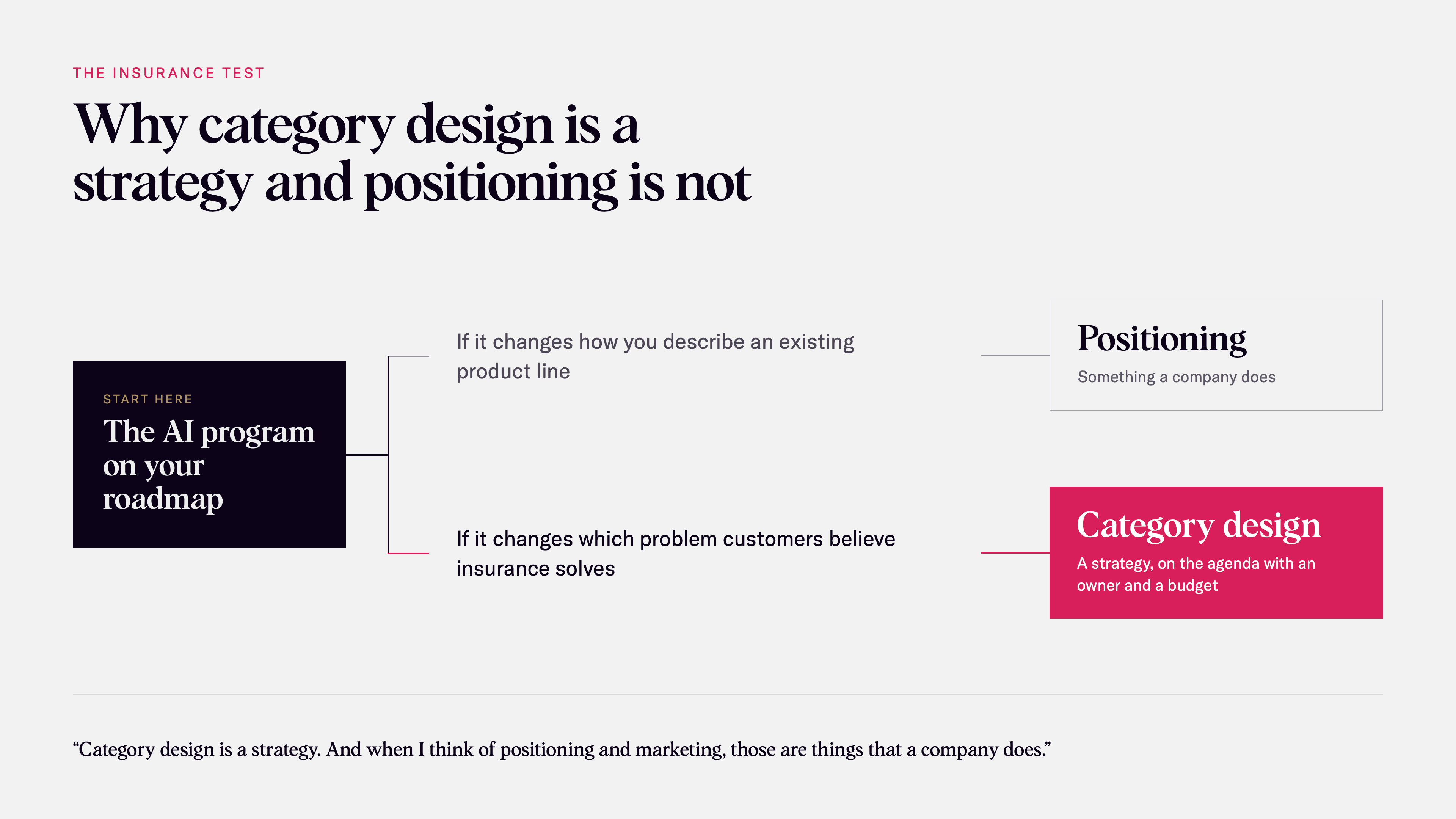
“Category design is a strategy. And when I think of positioning and marketing, those are things that a company does.”
For insurance leaders, the test is simple. If the AI program on your roadmap changes how you describe an existing product line, that is positioning. If it changes which problem customers believe insurance solves, that is category design, and it belongs on the strategy agenda with an owner and a budget.
This is the Frontier Firm distinction most insurers have not made. Frontier Firms treat market definition as a board-level choice, not a marketing deliverable handed down after the build.
Why Market-Product Fit Beats Product-Market Fit in the AI Era
Product-market fit sends teams hunting for a market for a product they already built, and in a crowded AI market, that search usually fails.
MIT’s NANDA project, in its July 2025 report The GenAI Divide, assessed roughly 30 to 40 billion dollars of enterprise generative AI spending and found 95% of organizations in its sample getting no measurable return. Maney’s diagnosis starts at the question nobody asked before the build.
“Product-market fit has led a lot of people to think we’ll build this product and figure out a market to put it into. And we talked about it, saying, like, it’s actually market-product fit.”
The Category Creation Formula gives the reversal a structure: Context plus Missing plus Innovation. Context is what shifted around the customer. Missing is the newly urgent need that shift created. Innovation is what the market will finally accept. Run in that order, it is a diagnostic for timing, and timing separates a category creator from a casualty.
This is the Intelligence Layer applied to market selection. Your intelligence core should tell you what changed around your customer before it tells you what your model can generate.
The Four Insights That Reframe How Frontier Firms Create New Markets
1. The Goal Is the Dominant Design, Not the First-Mover Headline
Winning a category means setting the design everyone else copies, and that prize is almost never claimed on day one.
Google was not the first search engine. Facebook was not the first social network. Both established the shape customers came to expect, and that shape is what compounds.
“Your ultimate goal is to win the dominant design. It’s not to be the day one, first mover, be the first one to say, ‘We’re creating this category.’”
Insurance has its own version. Usage-based motor cover, embedded travel protection and parametric weather were all launched early by firms that never became the reference point.
This is the Frontier Firm patience trade. Frontier Firms spend their early advantage on defining the standard rather than claiming the announcement.
2. Competitors Entering Your Category Are Evidence, Not Erosion
A new category with one participant looks like an experiment, and buyers price it accordingly.
The instinct in a regulated industry is to treat a rival launch as lost ground. Maney inverts it. Competition makes a category legible to customers, analysts, and procurement committees, which a single pioneer cannot do alone. The real question is whose definition rivals must argue with when they arrive.
“Your goal is not to wipe out all competition, your goal is to be the dominant design and make all of your competitors follow you.”
This is venture clienting read as category evidence. A second carrier piloting in your category is proof the market exists, provided you own the definition it moves toward.
3. The Models Become Boring Infrastructure, and That Is the Opportunity
Foundation models are heading toward utility status, and utilities do not differentiate the firms running on them.
Maney reaches for the comparison that has run through this podcast all year: electricity. Infrastructure everyone has becomes a story about what gets built on top. The investment question flips from which model to buy toward which product was impossible before the model was cheap.
“I actually believe that the big AI models… that’s going to become, at some point, as boring as the internet or as electricity. What excites me is what you can do with it.”
This runs counter to how our industry typically budgets for AI. Faster underwriting is an efficiency gain within an existing category. A prevention product that was impossible when risk data was expensive is category creation, and only one of those earns new revenue.
This is Frontier Firm economics in a sentence. When intelligence is a commodity input, advantage goes to the firm with the best idea of what should exist next.
4. AI Is Trained on the Past, So the Future Stays a Human Job
Models learn from what already happened, which makes them poor sources for the one decision category design needs.
Ask a model what customers want, and it returns a summary of what customers have wanted. Useful for positioning, close to useless for invention. The judgment about what is now missing is the part of the formula no training corpus contains.
“AI is trained on the past, and it’s only going to understand the past, and it’s going to be the humans that create the future.”
Put that in front of any team using AI to generate strategy options. The machine is a strong research assistant on context, and a weak witness on what is missing, because missing things leave no data behind.
This is workforce transformation stated as a division of labour. The Frontier Firm spends machine capacity on the past and human capacity on the future, and knows which is which.
What Insurance Operators and Founders Should Do This Quarter
Four moves: separate strategy from positioning, run the formula, audit the AI budget, name your dominant design.
- Separate category decisions from positioning decisions in the next two weeks. Mark every live initiative as changing how you are described inside an existing market, or changing which market exists. Anything in the second column needs an executive sponsor, not a campaign brief.
- Run Context plus Missing plus Innovation on one business line before the next quarterly review. One page: what changed around this customer in 24 months, what that made urgent, and what you could now build that was impossible before. An empty Missing column is a useful answer.
- Audit how much of your AI budget buys efficiency and how much buys new revenue. Efficiency inside an existing category is a cost line. New categories are a growth line. A portfolio that is entirely efficiency has no answer when a competitor defines the next product class.
- Write the dominant design you intend to own in one sentence, and test it on a sceptic. Name the expectation you want every customer in that category to carry. If a colleague can restate it after hearing it once, it is designable. If it needs a slide, it is positioning in a strategy costume.
The Imagination Question for Insurance Leaders
The gap Maney exposes is not a technology gap and not a talent gap. It is an imagination gap: the distance between firms building better versions of products that already exist, and firms deciding which product should exist next.
Insurance has spent three years proving it can apply AI to claims, underwriting and service. The harder question is which categories of protection become possible when risk intelligence is cheap, continuous and contextual, and who writes the rules of those categories first.
What the next decade rewards is the discipline to define a market before building for it, the patience to win a dominant design rather than an announcement, and the confidence to treat rivals as proof. The machine knows the past. The future is still ours to design.
Listen to the full conversation with Kevin Maney on Scouting for Growth.
Are you designing a market your customers will recognize, or describing yourself inside one someone else already defined?
Want to talk about it? Just set up a call with me here.
Frequently Asked Questions (FAQs)
What is the Category Creation Formula?
The Category Creation Formula is Context plus Missing plus Innovation equals a new market category, developed by Kevin Maney and Mike Damphousse at Category Design Advisors and published by Harper Business in February 2026. Context is what changed around the customer. Missing is the need it made urgent. Innovation is what the market will accept.
What is the difference between market-product fit and product-market fit?
Product-market fit starts with a built product and searches for a market to place it in. Market-product fit, the term Kevin Maney uses, starts with what changed in the customer’s world and designs the product that fits it. A strong product landing in an unready market still fails.
Why does Kevin Maney say being first does not win a category?
Because customers reward the dominant design rather than the earliest entrant. Maney argues the goal is to establish how the category is expected to work, so later competitors follow that definition. Early movers that never set it routinely lose categories they opened.
How should insurers use AI to create new categories rather than efficiencies?
By asking what became possible once risk intelligence turned cheap and continuous, instead of what became faster. Efficiency improves an existing category’s cost line. Category creation builds a product class that could not previously exist, such as prevention-led or contextual protection, and that is where dominant design is won.
Who is Kevin Maney?
Kevin Maney is a bestselling author, technology commentator and founding partner of Category Design Advisors, founded with Mike Damphousse in 2016. He co-authored Play Bigger in 2016 and The Category Creation Formula in 2026, and spent 22 years as a columnist and reporter at USA Today.
References
The Category Creation Formula, the book behind market-product fit
Category Design Advisors on the book’s genesis and the firm’s founding in 2016
Christopher Lochhead on the Play Bigger finding that category leaders take 76% of market cap
MIT NANDA, The GenAI Divide: 95% of enterprise AI pilots show no measurable return
The episode on Spotify: Kevin Maney on the Category Creation Formula
Editor in Chief

Rebuilding Risk Resilience