Intelligence Layer Fix for Nuclear Verdicts: When a $25K Claim Becomes $7M
Aug 10, 2026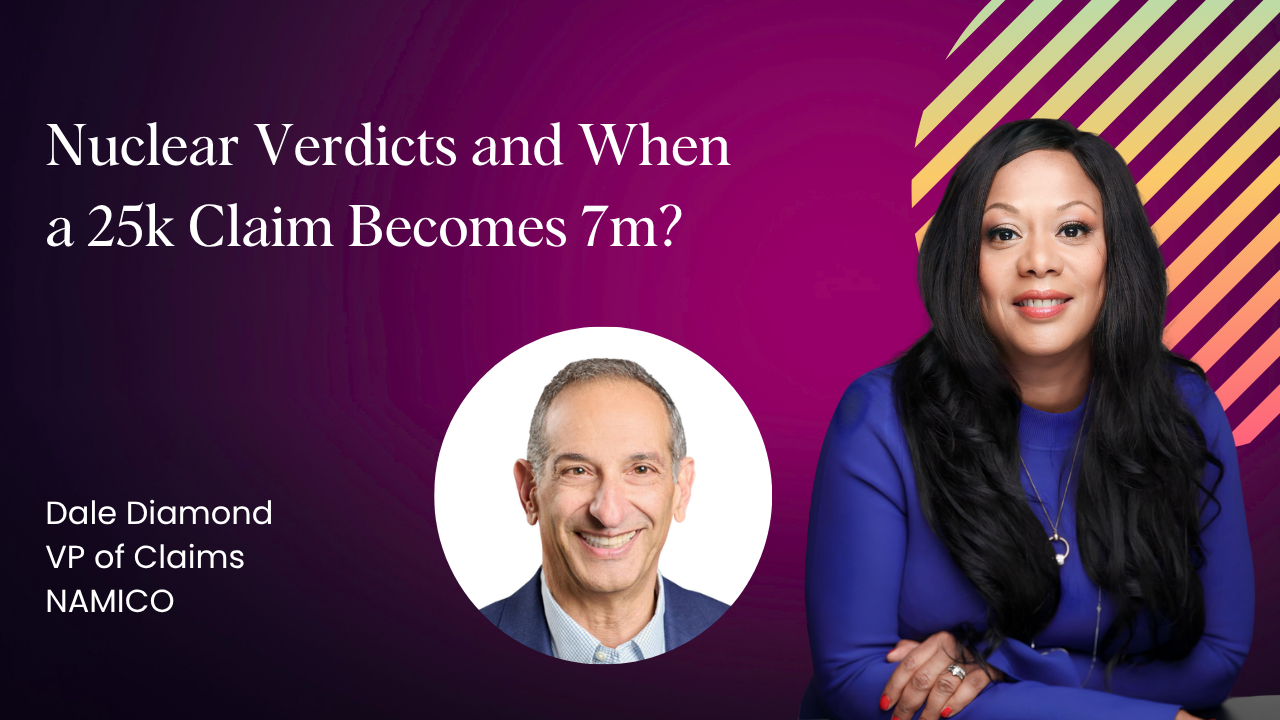
Written by Alchemy Crew Team
Three things this conversation makes clear:
- Nuclear verdicts are still climbing. Marathon Strategies counted 135 corporate verdicts above $10 million in 2024, a 52 percent jump over 2023, totaling $31.3 billion.
- Social inflation is now the main growth driver of US liability claims, adding an estimated 7 percentage points to claims growth in 2023, according to the Swiss Re Institute.
- The window to save a severe claim is short. Diamond argues the decisive work happens in the first 90 to 180 days, before discovery hardens the case and the settlement window closes.
A $25,000 auto claim can end as a $7 million jury verdict, and when it does, the cause is almost always a chain of small, avoidable decisions inside the carrier that begins long before a jury is seated. For mutual insurers, claims leaders, carriers, and risk resilience professionals in insurance and financial services, that makes nuclear verdicts an operational problem, not just a courtroom outcome: they are rising fast, creating volatility that traditional claims models struggle to absorb, and the best chance to stop them is disciplined triage in the first 90 to 180 days.
This article draws on a conversation with Dale Diamond, Vice President of Claims at NAMICO, the insurance arm of the National Association of Mutual Insurance Companies (NAMIC), to show how ordinary claims turn nuclear, why mutual insurers carry outsized exposure, and which early claims-handling moves prevent a small file from becoming a catastrophic one. It also examines the forces pushing verdicts higher, including social inflation, litigation funding, plaintiff strategies such as reptile theory, and where AI can strengthen triage and claims management rather than add noise.
A wheel comes off on the freeway, and a minimal claim goes nuclear
The most dangerous claim rarely looks dangerous on day one. Diamond points to a short-haul trucking case. A wheel separates from a truck on the freeway, crosses the median, and strikes an oncoming car driven by an elderly man. He declines treatment at the scene, complains of a sore wrist, and drives home. An experienced adjuster reads the first file and sees exactly what it looks like: no treatment, a minor injury, a modest claim. The offer goes out at the policy figure of $25,000.
Then the medicals arrive, hundreds of pages of them. A treating physician records a brain bleed, and the theory shifts. The driver's own head, the plaintiff argues, is what cracked the windshield. The defense bets that damages are exaggerated and takes the case toward trial. The demand climbs to $40 million. The jury returns roughly $7 million.
"When a claim goes bad, it's not one thing usually. It's kind of a series of unfortunate events."
That is the argument Diamond makes to mutual insurers nationwide, and it frames the question at the center of this piece: how does a carrier see the detonation coming while it can still be stopped?
Why this matters now
Severity is rising faster than any single carrier can absorb through pricing. Marathon Strategies recorded a record 135 nuclear verdicts in 2024, with the total sum up 116 percent year over year to $31.3 billion, and "thermonuclear" awards above $100 million reaching a record 49 cases. The median verdict has climbed to $51 million, up from $21 million in 2020.
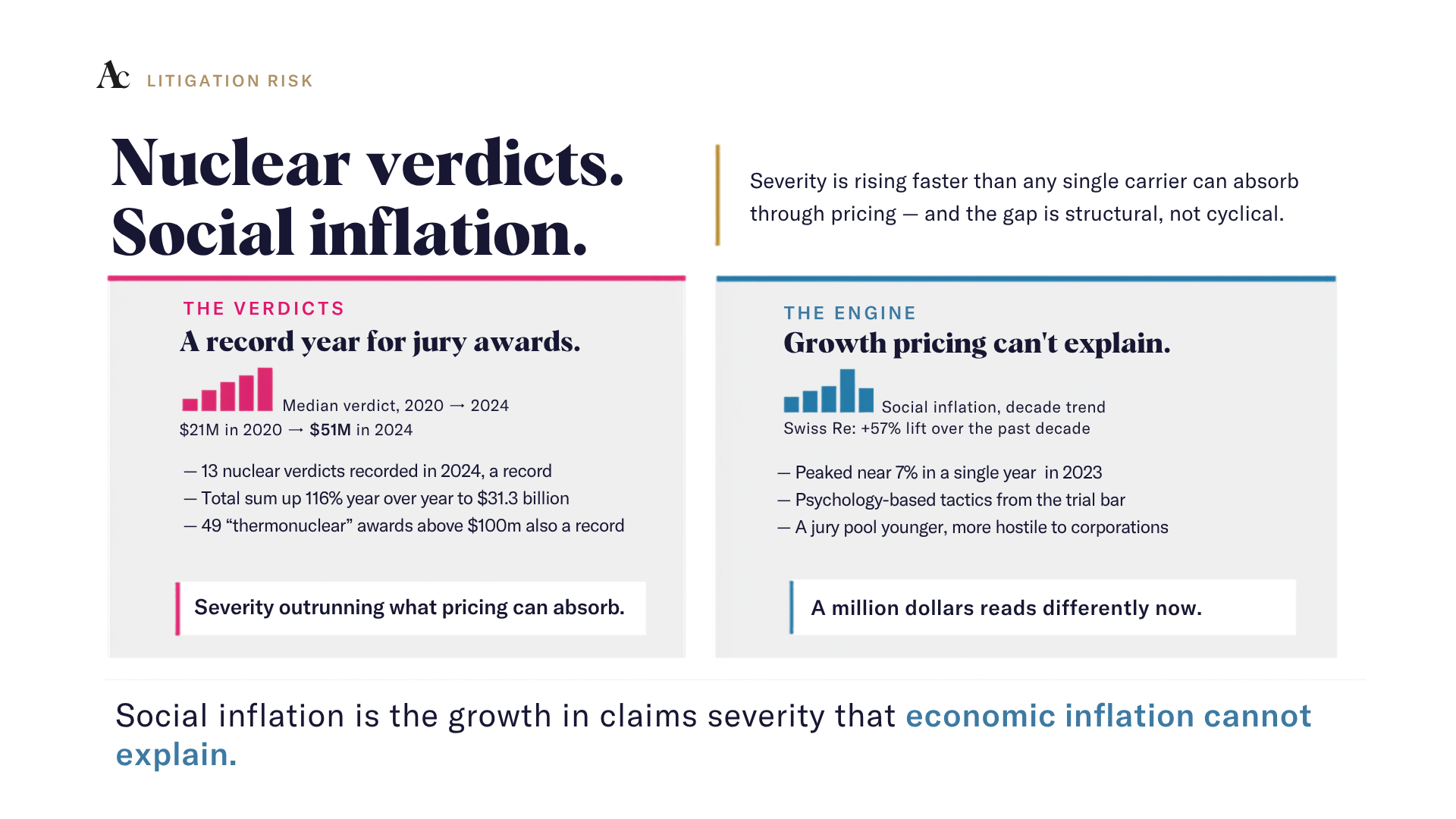
The engine underneath those numbers is social inflation, the growth in claims severity that economic inflation cannot explain. The Swiss Re Institute estimates it lifted US liability claims by 57 percent over the past decade and peaked near 7 percent in 2023. Two forces sit underneath that figure: psychology-based tactics from the trial bar, and a jury pool that is younger and more hostile to corporations, one that reads a million dollars very differently than its parents did.
For mutual insurers, the exposure is sharper. These are trust-based carriers, often rooted in small communities, frequently running on lean claims teams and, in Diamond's words, still on "facts and spreadsheets." A single mishandled severe claim can move the whole book. This is the Frontier Firm gap in claims operations: the volatility has gone up, but the operating model has not.
The most dangerous risk claim is clear liability with disputed damages
Clear fault plus an argument about the number is the profile that produces nuclear results. When liability is obvious, a jury has already decided you are wrong. The only question left is how much, and that is the question plaintiff attorneys are best at inflating.
Diamond's post-mortem on the trucking case reads like a checklist of missed gates. The claim was never mediated. It never went to a roundtable with senior claims leadership. The handler leaned too heavily on defense counsel, who liked the right cases and liked to try them. No mock jury tested a matter with an obvious upside. And the medical file, once it flagged a brain bleed, should have ended any appetite for trial.
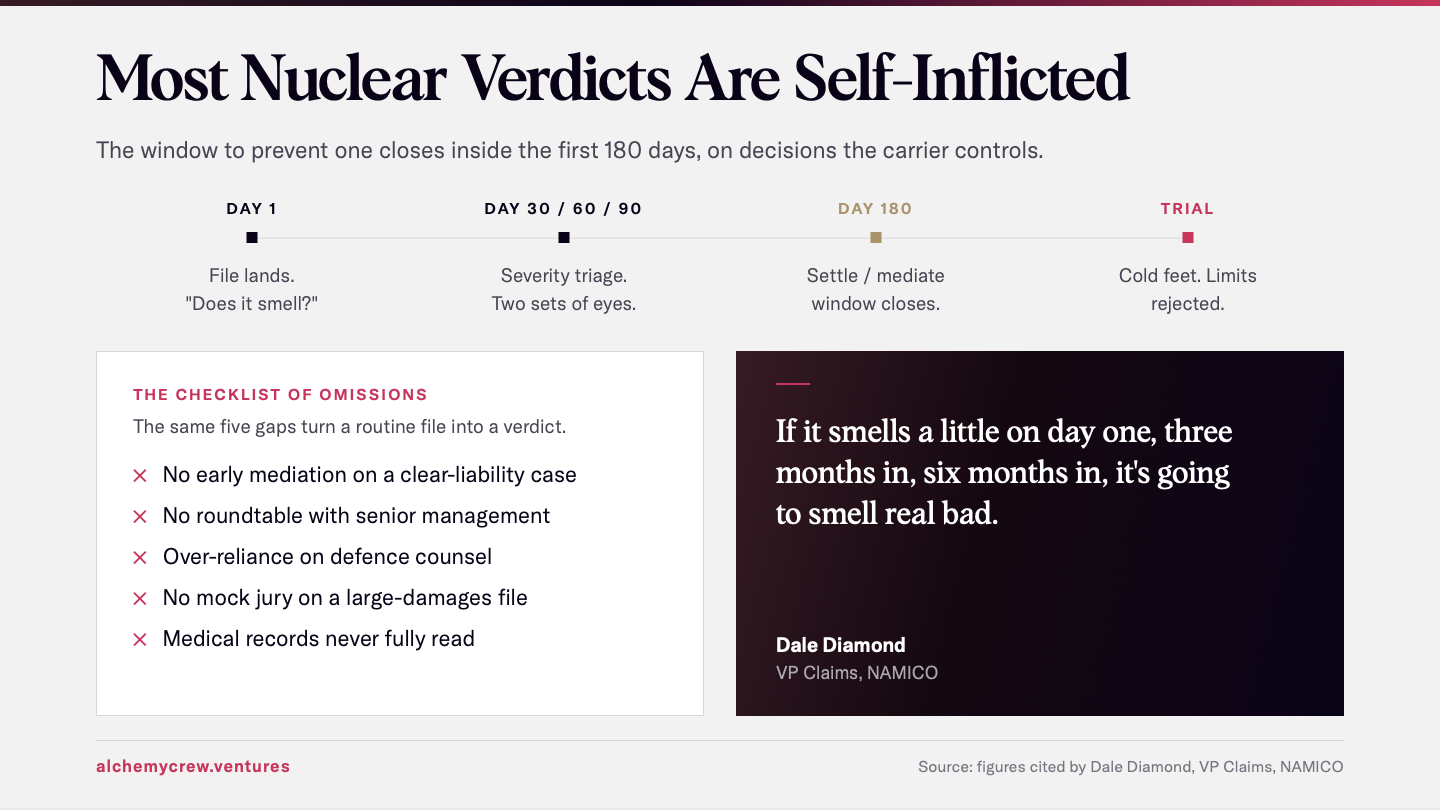
His remedy lies in the process. At NAMICO, severe claims are triaged onto a 30-, 60-, or 90-day calendar, carry a severity reserve, and get a second and often a third set of eyes before anyone approaches a courtroom. This is DIVAAA™ thinking applied to a claim file. Discover the exposure early, investigate it from more than one perspective, and validate the trial decision before it becomes irreversible.
This is the Intelligence Layer question every mutual now faces: can your process surface the one file in the stack that will hurt you before it is too late to settle?Reptile theory turned sympathy into anger, and "three times the medicals" is now a trap
Juries no longer feel sorry for the plaintiff. They feel angry at the defendant. Diamond describes how the plaintiff's bar uses reptile theory to reframe an accident as a threat to the juror personally: this could have been you on that freeway, and the only way to protect everyone is to punish the company hard.
"The only way to send a message to these companies that they have to put our safety over their profits is to hit them hard."
The old actuarial shortcut has not survived this shift. Diamond recounts a slip-and-fall with about $100,000 in medical expenses. A handler applied the familiar rule, three times the medicals, and offered in the $300,000 to $400,000 range. The case went to trial and resulted in roughly $6 million in damages.
"That's what a jury thinks is fair. You cannot do three times the medicals."
The lesson here is calibration. Price severity to how a jury behaves in 2026. A benchmark from 2005 will get you hurt. That recalibration is an Intelligence Layer problem. It needs current verdict data feeding the reserve, and a rule of thumb from a calmer era will not deliver it.
The three-headed monster: class actions, litigation funding, and artificial intelligence turned against the carrier
Three forces are compounding at once across claims and litigation trends, and litigation funding bites hardest. Third-party litigation funding, in which outside investors bankroll lawsuits for a share of the award, has grown into a roughly $17 billion global industry, with more than half deployed in the United States, according to the Swiss Re Institute. It sustains cases that would once have run out of money, and it lengthens the ones that do not.
"It shouldn't be a profit center for investment companies, for private equity, foreign investment in litigation."
The second head is the class action, which funding makes viable at scale. The third is AI turned against the carrier. Diamond points to a pre-AI salvage class action, in which software that shorted salvaged vehicles by a few hundred dollars each became a mass claim when multiplied across every policyholder. Generative tools lower the barrier further: a self-represented plaintiff can now file a complaint clean enough to survive a motion to dismiss, and any automated valuation step becomes the next target. AI is now used by both insurers and plaintiffs in litigation, which makes the problem harder to manage. Those tools also give each side faster access to legal insights and claims knowledge, raising the stakes for oversight in both trial practice and claims handling.
NAMIC's advocacy response is to push for disclosure, so that funded litigation is out in the open and discoverable. The operational response is the carrier's responsibility, and it is a governance question: carriers need clear criteria to determine where AI can assist, how to mitigate avoidable risk, and how to manage performance effectively as they navigate these challenges. New litigation trends also need to be reflected in workflow rules and model oversight, with human review in place to support the process rather than fully automated decisioning. That boundary is the heart of the Intelligent Layers architecture, and drawing it incorrectly turns efficiency into liability.
AI's real job in claims is buying back judgment time
Used correctly, AI does the reading so the human can do the thinking, and the broader evolution of claims-handling technology now includes natural language processing that pulls key details from large medical and claims files more efficiently. Diamond describes a medical malpractice matter against a retired pathologist that his team could not afford to try. He put two clinical questions to an AI tool and had grounded answers in minutes, work that would have taken hours on Westlaw.
"All this stuff that I would have had to dig in for hours and research came back in minutes."
Then came the part that matters. He verified the output with specialist counsel, used it to identify the real target, the surgeon, and settled out of court without going near a jury. In practice, certain findings in the record act as a signal for escalation, and the same tools can surface details buried in or missing from fragmented files. The AI compressed the busywork. The human still made the call.
That is the Frontier Firm in one sentence: human-led, agent-operated. The failure mode is skipping the verification. When a consulting firm let generative AI fabricate citations in a report for the Australian government, the result was a public correction and a partial refund on a A$440,000 engagement, a reminder that unverified AI output is a reputational claim waiting to happen. Trust comes from a carrier's ability to rely on the output only after human review, which builds confidence in the process. Diamond now flags every AI-assisted memo in bold as machine-generated and unverified, marking exactly what still needs checking.
This is where the Venture Client Model earns its place. The tools Diamond values, drone roof inspections that report in 24 hours instead of three weeks and timeline builders with features that improve efficient review of thousands of pages into a readable narrative, are best adopted the way he already trials them: a free pilot, a real file, a measured result, then a decision. That is venture clienting by another name, and for a lean mutual it is the disciplined path from Discover to Adopt. A pilot can test whether a tool improves claim scoring or prioritization and helps direct human resources toward the files that need expert judgment most.
Five moves for mutual claims leaders this quarter
These five moves convert the conversation into operational change and help leaders allocate time and budget earlier in the life of a severe file. None require a large budget. All require a decision.
-
Triage every severe claim in the first 90 days. Flag it, reserve it for severity, and route it to a named escalation owner with authority to act. Severe-claim triage should redesign existing processes, not just add another flag.
-
Mandate an early liability, damages, and cost analysis from defense counsel on every serious file, with a real plan and a real number attached. That analysis should reflect the right trial or medical expertise. Without the plan and the price, you cannot reserve or settle intelligently.
-
Roundtable and mediate clear-liability cases. Two or three perspectives beat one, and these sessions work because they force collaboration across claims, legal, and leadership. Mediation is where a $25,000 problem stays a $25,000 problem.
-
Retire "three times the medicals." Refer to current verdict behavior in your jurisdiction, and price the plaintiff and the picture alongside the bills.
-
Pilot before you adopt. Test one solution on one real file this quarter, verify every output, and measure the operational benefits before you buy. Piloting first reduces financial commitment and wasted implementation effort, and lets the result drive the buy.
Frequently Asked Questions
What is a nuclear verdict?
A nuclear verdict is a jury award above $10 million. Marathon Strategies recorded 135 of them against corporate defendants in 2024, totaling $31.3 billion, with awards exceeding $100 million labeled "thermonuclear."
What is reptile theory in insurance litigation?
Reptile theory is a plaintiff tactic that reframes an incident as a danger to the juror personally, converting sympathy into anger so the jury punishes the defendant to protect the wider community. Diamond cites it as a primary driver of outsized awards.
How can a mutual insurer prevent nuclear verdicts?
Triage severe claims early, roundtable and mediate clear-liability cases, demand a real litigation and cost plan from counsel, and reserve to how juries behave now. Diamond stresses the decisive window is the first 90 to 180 days.
What is third-party litigation funding?
Third-party litigation funding is outside investment in lawsuits in exchange for a share of the award. The Swiss Re Institute estimates it as a roughly $17 billion global market, over half of it in the US, and a contributor to social inflation.
Identify and stop the detonation before it starts
The tension Diamond leaves us with is simple. The verdicts keep getting bigger while the claims teams keep getting leaner. The carriers that come through this share one habit. They catch the dangerous file on day one, keep human judgment at the decision points, and use AI to buy back the time that judgment needs for the future of claims.
So here is the question for your next claims meeting. If a $25,000 file landed on your desk this morning, would your process catch it before it became a $7 million verdict, or would you, as a claims leader, find out at trial? The carriers that adapt fastest will be the leading claims organizations.
The Venture Client Model gives a corporation quick access to startup tools by letting it buy solutions early; BMW Startup Garage launched the model in 2015. It also lets teams shape those tools during development while ventures gain early revenue, helping build a culture of innovation inside corporates.
Sources and citations
Marathon Strategies, "Corporate Verdicts Go Thermonuclear: 2025 Edition."
Insurance Journal, "Corporate Nuclear Verdicts Surged to New Record High in 2024."
ABA Journal, "2024 produced a record number of thermonuclear verdicts."
Swiss Re Institute, sigma 4/2024, "Social inflation: litigation costs drive claims inflation."
Swiss Re Institute, "US litigation funding and social inflation."
Swiss Re, press release, "Litigation costs drive US liability claims by 57% over past decade."
The Guardian via CFO Dive, "Deloitte AI debacle seen as wake-up call."
Editor in Chief

Rebuilding Risk Resilience