The Agentic Divide: What Gartner and MasterCard’s Timeline Means
Apr 30, 2026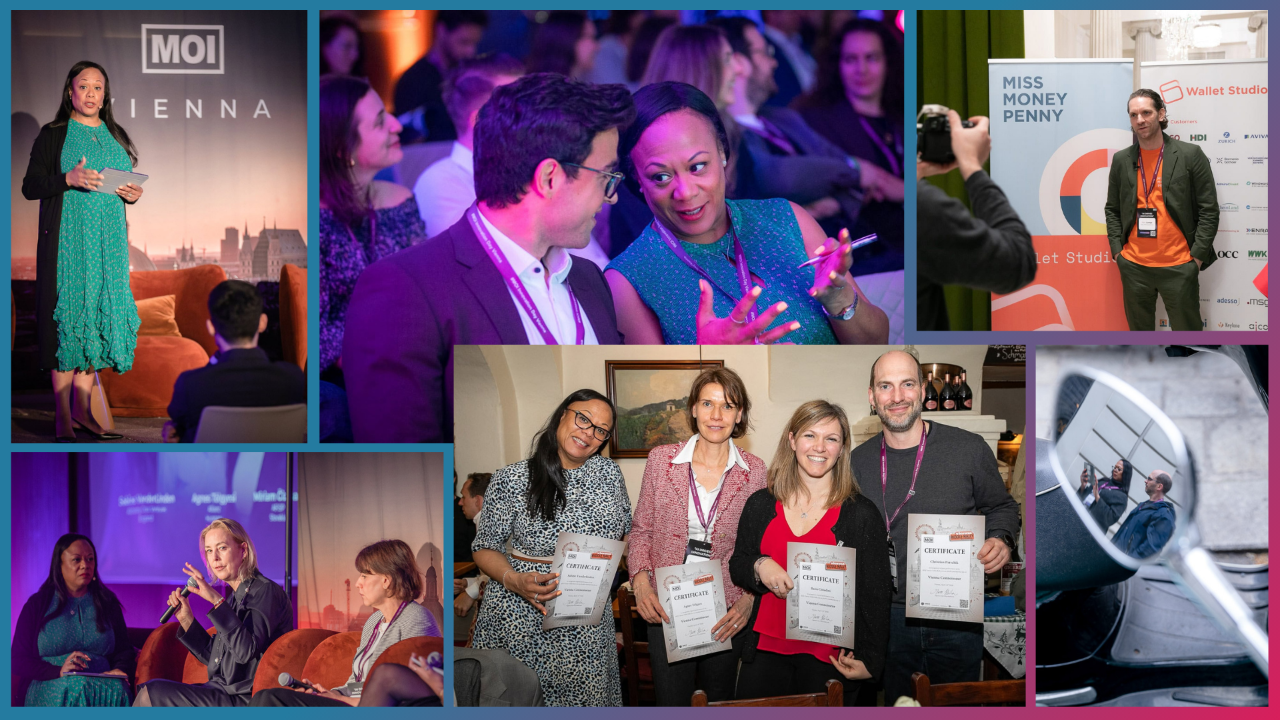
Written by Sabine VanderLinden
Two projections. Two timelines. One Agentic Frontier is closing faster than most boards realize.
- The Agentic Frontier is splitting the insurance industry into Frontier Firms and slow adopters — and the gap compounds every quarter. Gartner projects that 15 percent of day-to-day work decisions will be made autonomously through agentic AI by 2028, while MasterCard's Agent Pay architecture is rewiring the checkout surfaces where embedded insurance lives. Insurers face both timelines simultaneously: the back office must transform by 2028, the distribution surface by 2030.
- Workforce transformation, not technology, determines who captures the Frontier Firm advantage. Governance and change management carry 60% of the transformation load; technology carries 40%. Microsoft's Work Trend Index confirms a 34-point thriving gap between Frontier Firms and the rest of the market — yet most innovation teams have the ratio inverted, deploying agents without redesigning the Human-Agent Ratio that makes digital labor productive.
- Five moves in 90 days separate the leaders from the committees. Name one squad team. Audit embedded-insurance partners for agentic commerce readiness. Kill one orphan pilot. Set a Human-Agent Ratio target for claims or underwriting triage. Use the freed budget to fund the squad. The Agentic Frontier does not wait for re-forecasts.
TL;DR
The Agentic Frontier moved from demo stage to settlement layer at MOI Vienna 2026. Gartner projects that at least 15 percent of day-to-day work decisions will be made autonomously through agentic AI by 2028, and 33 percent of enterprise applications will include agentic AI by that same year. In parallel, MasterCard’s agentic commerce thesis frames a world in which close to a billion people are already active on ChatGPT, and agents increasingly route product discovery and purchases. One timeline rewires the back office. The other rewires the checkout. Insurers sit at the intersection of both.
Insurers are building for a world where chat replaces the front end, merchants are never visited directly, and leading claims operations run at a 1:3 Human-Agent Ratio. Most haven’t noticed. MasterCard’s commerce horizons, from chat checkout to fully autonomous prediction and purchase, threaten every embedded-insurance distribution surface that lives at the point of sale.
The closing gap is not technical. It is a workforce transformation problem that splits 60/40, with governance and change ahead of technology. Companies that deploy agents without transforming workforce design capture less than 20 percent of the available Frontier Firm advantage. The 34-point thriving gap Microsoft identified between Frontier Firms and the rest of the market compounds every quarter of inaction.
Vienna, 15 April: two clocks, one stage
MOI Vienna 2026 opened with a gamified scoreboard and closed with a billion-user statistic most insurers are still wishing away. Between the two sat an architectural shift the industry cannot afford to treat as theoretical.

Gartner now forecasts that at least 15 percent of day-to-day work decisions will be made autonomously through agentic AI by 2028, up from zero percent in 2024, and that 33 percent of enterprise applications will include agentic AI by 2028. In the same analysis, Gartner also flagged that more than 40 percent of agentic AI projects will be canceled by the end of 2027, due to the cost of pilots that were never designed to scale.
In parallel, MasterCard has set out the commerce architecture for the next five years. Agent Pay, launched in April 2025, was positioned as the payments layer for AI agents acting on behalf of consumers. By early 2026, MasterCard was publishing its rules of the road for agentic commerce, framing trust, identity, and Proof of Intent as the new settlement primitives. Reach is no longer hypothetical. ChatGPT alone crossed 900 million weekly active users by February 2026.
If you sell a financial product that lives inside a web page customers may never visit again, that sentence is an earnings warning.
What is the Agentic Frontier?
The Agentic Frontier is the operating horizon in which AI agents act. They purchase, underwrite, route, pay, and escalate, with humans supervising rather than executing. It is defined by three shifts: from chat to transaction, from single-agent to squad team, and from human labor to digital labor, as measured by a Human-Agent Ratio. Alchemy Crew’s own benchmarks from Fortune 500 insurer deployments show leading claims operations already running at 1:3.
How does Gartner’s enterprise timeline differ from MasterCard’s commerce timeline?
Gartner’s lens is the back office. The maturity arc every insurer should be tracing runs from chatbot, to virtual assistant, to AI assistant, to agentic AI. The crucial word is agentic. The agent is no longer answering; it is acting. Gartner’s 2028 projections are not a productivity story. They are a workforce transformation story. Gartner itself warns that 40 percent of enterprise applications will feature task-specific AI agents by 2026, up from less than 5 percent in 2025, and has separately predicted that AI agents will outnumber sellers by 10x by 2028.

MasterCard’s lens is the checkout. Electricity took almost 50 years to reach 25 percent household adoption. Generative AI is moving faster than any consumer technology in living memory, and the commerce stack is rewiring around it. MasterCard has been explicit that agentic commerce demands new primitives for identity, consent, and Proof of Intent. Scale the dog-toy demo on stage, agent searches, compares, buys, ships, to a Thailand holiday booked across ten merchants by one agent, and every loyalty program, every affiliate model, every insurance checkout flow in that chain has to rewire.
The five horizons MasterCard has outlined accelerate from simple to autonomous:
- Chat checkout, in which the purchase is completed within the AI interface, and the merchant website is never visited.
- Multi-merchant orchestration, where one prompts for flights, hotels, and activities across ten providers in a single transaction.
- An asynchronous purchase, in which the agent monitors prices over months and buys when a threshold is met, without the consumer being present during the session.
- Loyalty and personalization integration, where airline miles, reward points, and personal preferences reshape every recommendation.
- Fully autonomous prediction and purchase, where the agent identifies the need, checks the calendar, and books before the consumer asks.
Insurance lives at checkout. Travel cover, rental excess, gap insurance, product warranty, cyber add-on. If a meaningful share of online transactions route through an agent by 2030, and a fraction of those carry an insurance decision, a single missed integration means seven-figure embedded-insurance revenue disappears before the board has finished approving the roadmap.
What does the comparison reveal for insurance leaders?
The table below distills the two projections side by side. The pattern is clear. Gartner rewires the workforce. MasterCard rewires the customer.
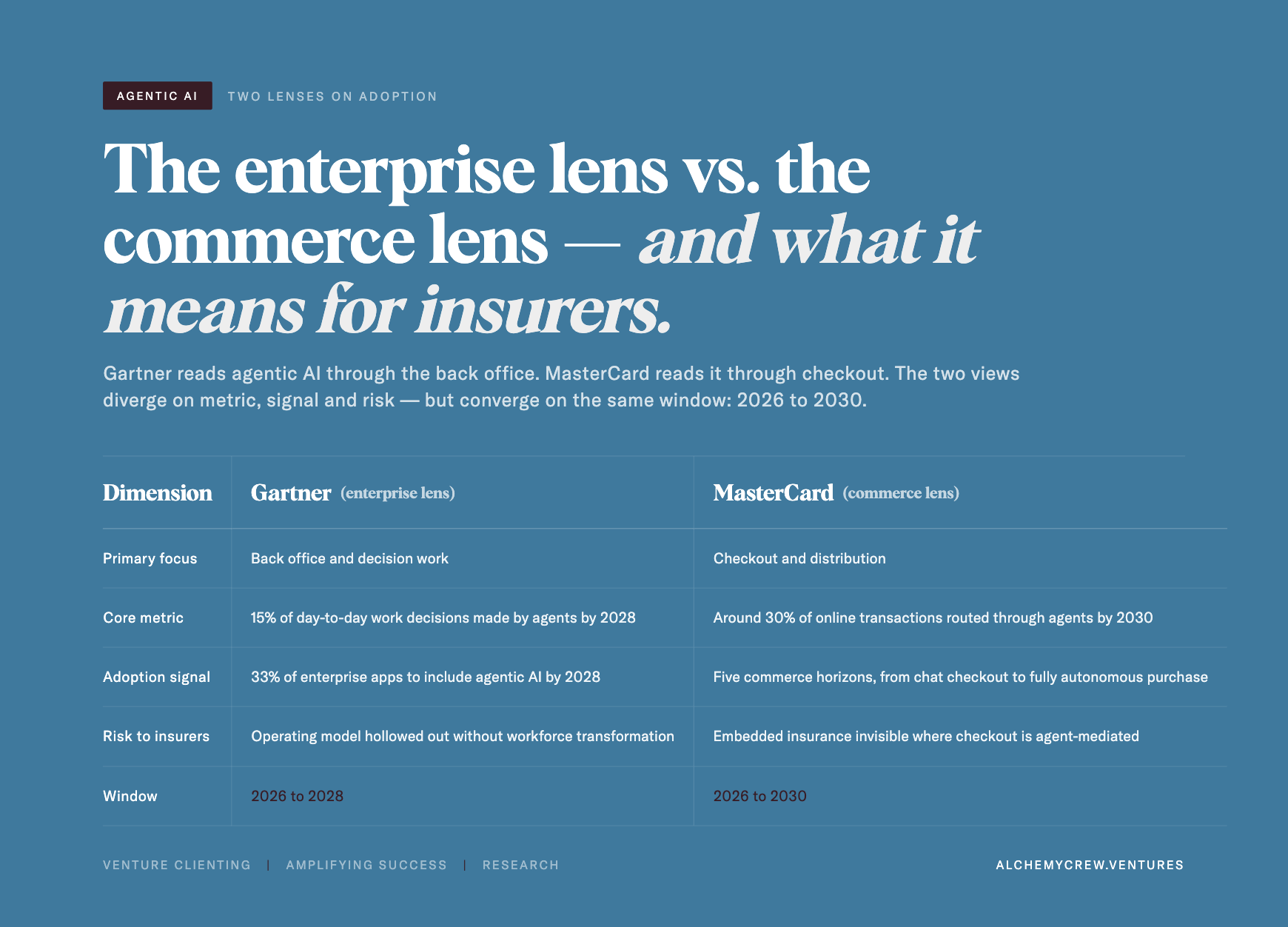
The uncomfortable truth is that insurers face both timelines simultaneously. The back office must transform by 2028. The distribution surface must be rewired by 2030. Neither waits for the other.
Frontier Firms pull away every quarter. The only variable is when you start.
Why does the 60/40 split matter more than the technology?
Microsoft’s Work Trend Index, published last year, introduced the Frontier Firm concept and reported that 71 percent of leaders at Frontier Firms say their companies are thriving, compared with 37 percent globally. That 34-point gap is the cost of hesitation. Microsoft’s same research flagged that 82 percent of leaders see the year ahead as the pivotal window to rethink strategy and operations.
Yet companies that deploy agents without transforming workforce design capture less than 20 percent of the available advantage, based on Alchemy Crew’s proprietary analysis of engagements. The split is consistent across every Alchemy Crew DIVAAA™ Activate-stage benchmarks: governance and change management carry 60 percent of the workforce transformation load, technology carries 40 percent. Most innovation teams have the ratio inverted.
The capacity gap is a math problem, not a people problem. Digital labor is liberation for higher-value work. McKinsey’s State of AI research, published in November 2025, maps the transition as a skill partnership between humans and agents rather than a substitution story, and tracks how leading organizations are already redesigning roles around it. When that crossover finishes, the insurer still staffing first-notice-of-loss with human-only teams is carrying a cost disadvantage no pricing committee can absorb.
What should the Frontier Transformation leader do in the next 90 days?
Five moves. No matrix. No steering committee that meets every six weeks.
- Name one squad team this quarter. Business owner, compliance lead, data engineer, model steward. Four seats. One agent. One Human-Agent Ratio target for claims or underwriting triage.
- Audit every embedded-insurance distribution partner for an agentic commerce readiness score. Which partners will have agent integrations by 2027, which will not?
- Align with the emerging payment and agent protocols. MasterCard’s Agent Pay, Google’s Agent Payments Protocol, Agent2Agent, and OpenAI’s Agentic Commerce Protocol. If your checkout is not agent-readable, your product is invisible.
- Kill one orphan pilot. The one that has not produced a decision in ninety days. The budget pays for the squad.
- Set a digital labor unit-economics tripwire. When the cost per processed claim drops below a defined threshold on your AI-augmented queue, expand. Until then, learn.
What happens if the next ninety days go nowhere?
The insurer that exists in Q3 2026 without a squad team, a published Human-Agent Ratio target, or an agentic commerce partner audit is not behind. They are compounding the 34-point thriving gap Microsoft has already quantified. Every quarter of inaction is a quarter the Frontier Firm across the table locks in another margin point. The Agentic Frontier does not wait for re-forecasts.
Innovation theatre is exhausting. Orphan pilots are demoralizing. The Agentic Frontier rewards neither.
One conversation is enough to see where you stand
Forty-five minutes. One conversation. A clear view of where your insurance organization sits on the six DIVAAA™ gates, what it would take to stand up a squad team by the end of Q2, and which embedded-insurance partners are actually building for the Agentic Frontier. Email us if you want to know more.
Frequently asked questions about the Agentic Frontier
What is the Agentic Frontier in insurance?
The Agentic Frontier is the operating horizon in which AI agents transact on behalf of humans — purchasing, underwriting, routing, paying, and escalating — with humans supervising rather than executing, governed through squad teams, and measured by Human-Agent Ratio. Gartner projects that at least 15 percent of day-to-day work decisions will be made autonomously through agentic AI by 2028, and 33 percent of enterprise applications will include agentic AI by that same year.
What is the difference between Frontier Firms and traditional insurers?
Microsoft's Work Trend Index identifies a 34-point thriving gap between Frontier Firms and the rest of the market — 71 percent of Frontier Firm leaders say their companies are thriving, compared with 37 percent globally. Companies that deploy AI agents without transforming workforce design capture less than 20 percent of the available Frontier Firm advantage, based on Alchemy Crew's DIVAAA™ Activate-stage benchmarks.
Where does digital labor fit into workforce transformation?
Digital labor is the unit of output; workforce transformation is the operating model around it. The 60/40 split — governance and change management carrying 60 percent of the load, technology carrying 40 percent — holds across every Alchemy Crew DIVAAA™ Activate-stage benchmark. Most innovation teams have the ratio inverted, deploying agents without redesigning the operating model that makes digital labor productive.
What is Proof of Intent, and why does it matter for agentic commerce?
Proof of Intent addresses whether an agent proposing or accepting a transaction genuinely intended to do so. As mobile networks, fintechs, insurtechs, and AI agents converge, verifiable intent becomes as critical as verifiable identity. MasterCard has placed it at the center of its 2026 agentic commerce rulebook.
What should insurance leaders do about agentic AI in the next 90 days?
Five moves: name one squad team this quarter (business owner, compliance lead, data engineer, model steward). Audit every embedded-insurance distribution partner for agentic commerce readiness. Kill one orphan pilot that has not produced a decision in 90 days. Set a Human-Agent Ratio target for claims or underwriting triage. Use the freed budget to fund the squad. Not a strategy deck — a squad.
References
Gartner, “AI Agents Will Outnumber Sellers by 10x by 2028,” 18 November 2025.
Microsoft, “2025: The Year the Frontier Firm Is Born,” Work Trend Index, 23 April 2025.
MasterCard, “Mastercard Unveils Agent Pay,” 29 April 2025.
MasterCard, “Building Trust in AI Commerce: Mastercard’s Agentic Protocols,” 20 January 2026.
McKinsey Global Institute, “The State of AI,” November 2025.
TechCrunch, “ChatGPT Reaches 900M Weekly Active Users,” 27 February 2026.
Google, “Announcing the Agent2Agent Protocol,” 9 April 2025.
Google Cloud, “Announcing Agent Payments Protocol (AP2),” 16 September 2025.
OpenAI, “Buy It in ChatGPT: Instant Checkout and the Agentic Commerce Protocol.”
Editor in Chief

Rebuilding Risk Resilience