The Agentic Frontier: Are You Building a Legacy or a Relic?
Dec 13, 2025
Written by Sabine VanderLinden
-
The end of the traditional firm is here. A new breed of company, the Frontier Firm, is not just adopting AI, but is being built around it. New technologies like agentic AI are driving this transformation, enabling organizations to reimagine their business models and operations.
-
Your competition is already moving. Leaders like Nestlé, UBS, and Mercedes-Benz are not just experimenting with AI, they are fundamentally rewiring their operations for an agentic future. AI is becoming the fastest-scaling software category in history, with enterprises seeing real returns on their investments. Broad adoption of AI is now evident across industries, with organizations integrating these solutions at scale for tangible business impact. Our data shows that global AI infrastructure spending has surged by over 30% year-on-year, and enterprises that adopt AI solutions convert deals at nearly twice the rate of traditional software, with 47% of AI deals going to production.
-
The choice is yours: Lead the change or become a case study in corporate obsolescence. This is not about another digital transformation. This is done now. This business transformation is about a new industrial revolution.
It’s 5:30 AM. The house is quiet. You’re on your second coffee, scrolling through reports, and the same question echoes in your mind, the one the board asks every quarter: “What’s our AI strategy?” As decision makers, your role is critical in shaping AI adoption and ensuring the right strategies and technologies are selected to drive organizational success. You’ve downloaded the whitepapers, you’ve seen the presentations, but you have a secret worry that your twenty years of experience might be becoming worthless in the face of this new technological wave. You’re a transformation executive, an adaptive leader tasked with navigating the future, but the path forward seems shrouded in a fog of buzzwords and hype. What if you could cut through the noise? What if you had a blueprint not just to survive but to thrive in this new era? What if you could build a legacy, not a relic?
Key takeaways: The agentic frontier is reshaping industries through the broad adoption of new technologies, and decision makers must act decisively to lead this transformation. Data shows that those who move early are already seeing significant returns, making it essential to develop a clear AI strategy to build a lasting legacy.
Introduction to Agentic AI
More than a tech trend, Agentic AI is the corporate equivalent of hiring a brilliant intern who never sleeps, never complains, and actually gets smarter every day. Here's what makes it different: AI agents are autonomous systems that chase specific goals, make real decisions, and solve messy problems without someone holding their hand every five minutes. Unlike your typical automation that follows scripts like a well-trained robot, agentic AI adapts on the fly: leveraging generative AI and large language models (LLMs) to navigate the beautiful chaos of modern business like a seasoned executive who actually reads the room.
From theory to practice — this new breed of AI is already rewriting the playbook across industries, and the results are hard to ignore. Companies embedding agentic AI into their operations aren't just keeping up; they're gaining what every CEO dreams about: the ability to respond faster than their competitors, learn continuously without expensive consultants, and optimize outcomes at scale without breaking things. Whether it's making customer success workflows actually work, turning software development from a months-long marathon into a sprint, or making data science initiatives deliver real value, agentic AI empowers organizations to tackle the kinds of challenges that used to require an army of ingenious, costly humans watching every move.
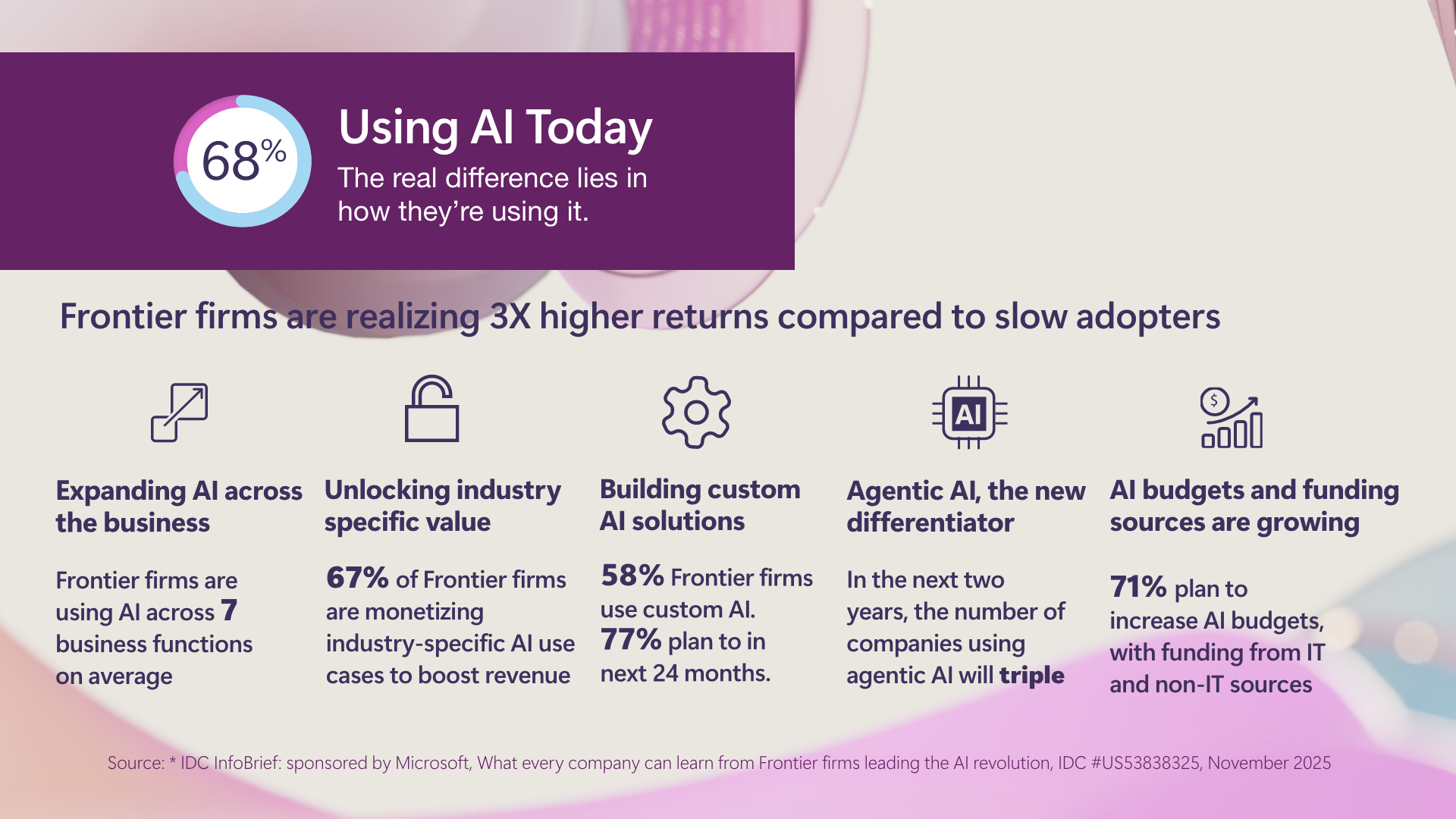
Here's the number that should make every board member sit up straight: according to a leading independent research firm, more than half of enterprises are expected to adopt agentic AI solutions within the next two years, and that's not wishful thinking, that's market reality hitting at velocity. As companies race to integrate these game-changing solutions, the winners will be those who embrace agentic AI early and smartly, positioning themselves to lead markets, leave competitors in the dust, and future-proof their business before the next wave crashes over everyone else. While many think the agentic frontier is just another technological shift you can sleep through, the few already know it is a fundamental mindset shift, a business transformation in which AI becomes your actual business partner in decision-making and transformation, not just a fancy tool that sits on the shelf.
Why This Matters Now
The age of AI is here. We are at a pivotal moment, a once-in-a-generation shift that will redefine the very nature of work and the structure of our organizations. The pressure to increase productivity is relentless, yet 80% of the global workforce reports lacking the time and energy to do their work. Most organizations are identifying multiple AI use cases, often prioritizing cost savings and productivity gains as immediate benefits.
The old ways of working are no longer sustainable. Enterprise AI spending was projected to reach $37 billion by the end of this year, up from $11.5 billion in 2024, underscoring the urgency of this transformation. According to recent survey data from enterprise AI decision-makers, these projections reflect strong buyer intent and rapid AI adoption. AI applications (user-facing products and the application layer) accounted for $19 billion in 2025, while infrastructure accounted for $18 billion, representing for some market players more than half of all generative AI spending. Within the broader generative AI market, AI infrastructure spending is segmented into three categories, underscoring the foundational role of technology platforms and the diversity of investment across them. Healthcare accounted for nearly half of all vertical AI spending in 2025, totaling approximately $1.5 billion.
The advancement toward the Frontier Firm concept is inevitable. The change is happening, but who will lead it? As organizations shift their structures, the real-world impact of these changes is already being felt in day-to-day operations.
What is a Frontier Firm?
A Frontier Firm is a new type of organization, one that is “powered by intelligence on tap, run by human-agent teams, and defined by a new role for every employee: the agent boss.” Early adopters have played a crucial role in shaping AI deployment strategies, fostering innovation and accelerating organizational learning. A Frontier Firm is a company that has moved beyond using AI as a tool and has begun to rebuild itself around AI as a core capability. Agentic systems can maintain long-term goals, manage multistep problem-solving tasks, and track progress over time without constant human oversight. These systems provide the flexibility of large language models (LLMs) with the structured features of traditional programming. The integration of AI agents into workflows requires a strong foundation of AI-ready data and governance to ensure high-quality, consistent, and well-governed data for successful deployment. This journey typically unfolds in three phases:
-
Phase 1: Human with AI Assistance. This is where most companies are today. An AI assistant helps employees be more productive by supporting them in daily activities. Think of it as a supercharged intern, great for research and drafting emails, but still requiring constant direction. AI agents can also replace complex software interfaces with natural-language prompts, enhancing the user experience and productivity.
-
Phase 2: Human-Agent Teams. Here, AI agents become digital colleagues, taking on specific tasks within a team. A human might delegate a task to an AI agent, just as they would to a human team member. This is where the real magic begins, as the speed and scale of AI augment human creativity. Agentic AI can handle complex tasks and support complex workflows, orchestrating multiple steps and integrating with external tools. Engineering teams play a key role in developing, governing, and scaling these agents within organizational processes. Organizations that successfully implement AI agents often start with high-volume, low-complexity processes to build their first human-agent teams.
-
Phase 3: Human-Led, Agent-Operated. In this final phase, autonomous agents execute entire workflows, with humans providing strategic direction and managing exceptions. Agentic AI systems can manage complex workflows and adapt to new challenges. Engineering teams are essential for maintaining and evolving these systems. Adaptability is achieved through continuous learning and reinforcement learning, enabling AI agents to learn from experience, adjust their behavior based on feedback, and improve over time. Organizations should start AI adoption with high-volume, low-complexity processes to build expertise and confidence. This is the agentic frontier, where organizations can operate with unprecedented agility and efficiency.
Organizations that successfully scale agentic AI typically start with one high-volume, low-creativity process that is causing real pain in their organization.
The Frontier Firm in Action with Generative AI

This is not science fiction. Across the globe, leading companies are already on this journey. Nestlé is deploying AI “from farm to fork,” using AI tools to optimize everything from supply chains to product development, demonstrating the importance of domain expertise in selecting and integrating these solutions. UBS has equipped 30,000 of its employees with AI assistants to synthesize vast amounts of market data in seconds, directly impacting day-to-day work by automating routine analysis and decision-making. At the Mercedes-Benz factory floor, multi-agent systems are helping optimize production and improve quality—an example of how agentic AI is transforming operational workflows. At EY, they have embraced an “AI-first” operating model, with a human-led, agent-operated workforce that addresses the capacity gap by augmenting human productivity with advanced AI. Notably, 76% of AI use cases in enterprises are purchased rather than built internally, reflecting the growing reliance on external innovation. This shift highlights the time and resource investment required to develop solutions in-house versus the speed and efficiency of sourcing externally. Furthermore, 82% of leaders plan to invest significantly in agentic technology over the next 12-18 months, driven by the need to bridge the capacity gap and stay competitive.
Organizations are increasingly adopting AI through product-led growth, with individual users driving adoption faster than with traditional software. AI-native startups are emerging as key players in both the AI application layer and the rapidly evolving AI infrastructure sector, often outpacing traditional incumbents. The enterprise-led venturing model, known as the venture client model, enables companies to make data-driven decisions about whether to engage in long-term collaborations with startups and scaleups, providing quick access to new solutions while giving such growth ventures the early revenue they need to grow. This model is a low-risk and relatively inexpensive way for corporations to access new startup solutions, with most active venture client units engaging with 15-25 startups per year through pilot projects. Startups win by partnering closely with corporates, gaining access to industry knowledge, expertise, and mentoring that support their long-term success. Tailored adoption strategies are also being developed for specific regions to ensure effective change management and technology deployment. Other factors, such as economic principles, governance, and technological advancements, continue to influence the pace and success of AI adoption.
These companies are not just tinkering with AI; they are fundamentally rethinking how they create value. They are building a future where human ingenuity is amplified, not replaced, by artificial intelligence.
How to Become a Frontier Firm: Your Playbook for Competitive Advantage

So, how do you begin this journey? It’s not about a single, monolithic “AI strategy,” but about a series of deliberate, calculated steps. Creating a lasting legacy involves planning for succession—including establishing clear transition goals, considering both internal and external candidates for leadership roles, mentoring, and embedding values in the culture. Engaging in philanthropy, such as supporting education or conservation, can also ensure your values-driven impact continues. Building a meaningful legacy requires shifting from self-focus to future impact: define your core values, empower future leaders, create sustainable systems, foster strong relationships, and consistently act in alignment with your vision. Here is your playbook:
-
Data Governance & Ethics: The Foundation of Trust. You cannot build an agentic organization on a data swamp. The first step is to get your data house in order. This means investing in a modern data platform, establishing transparent data governance, and embedding ethical AI principles from day one. This is not just about compliance; it is about building the trust essential for AI adoption at scale.
-
Ecosystem Partnerships & Open Innovation: You Can’t Go It Alone. The pace of change is too fast for any single organization to keep up. Frontier Firms are not islands; they are hubs in a network of innovation. This means partnering with technology providers, growth ventures, and academic institutions. It means embracing open innovation and learning from others' successes and failures. As noted, the venture client model is a corporate innovation strategy where corporations purchase solutions from startups at an early stage. Here, corporations must decide how to best blend the expertise of leading providers like Microsoft, Google, SAP, IBM, or core system vendors such as Guidewire or Majesco, Foundational Generative AI players such as Copilot, Gemini, OpenAI, or Claude, with niche industry-specific and function-specific agentic AI providers that solve very targeted business workflow challenges.
-
Transformational Change Enablement: It’s a People Business. AI transformation is not a technology project; it is a change management project. You need to bring your people on the journey with you. This means investing in upskilling, fostering a culture of experimentation, and communicating a clear, compelling vision for the future. It also requires developing essential skills—such as business development, technical expertise, problem-solving, negotiation, and understanding the emerging agentic AI startup ecosystem—so venture client teams can effectively evaluate startups, manage projects, and navigate corporate processes. It means creating a safe space for your employees to learn and adapt to new ways of working. Cultural readiness is a significant barrier to AI adoption in organizations.
-
AI integration & Human-Agent Teaming: Where the Rubber Meets the Road. This is where the theory becomes reality. Start by identifying the areas of your business where AI can have the most significant impact. Begin with pilot projects, but have a clear path to scale. The goal is to move from Phase 1 to Phase 2, to create true human-agent teams. Continuous improvement practices are essential to maximize the value of AI technologies.
-
Organizational Agility & Leadership Alignment: The Engine of Change. This transformation must be driven from the top. The CEO and the board must be aligned on the vision and committed to the journey. This is not a time for half-measures. It is a time for bold, decisive leadership. Cultivating leadership means identifying, mentoring, and empowering potential leaders early for smooth succession. Creating scalable systems requires documenting processes, standardizing operations, and developing training so the organization can operate independently. It is a time for Calculated Revolutionaries like you to step up and lead the way.
The Future is a Choice: Embracing Continuous Learning
We are at a crossroads. The path of the traditional firm leads to irrelevance. The path of the Frontier Firm leads to a future of unprecedented growth and opportunity. Resisting the agentic frontier leads to reliance on outdated infrastructure, resulting in manual interventions, data silos, and costly operational drag. The choice is yours. Will you be a bystander or a pioneer? Will you build a legacy, or will you become a relic? The future is not something that happens to us; it is something we make. Let’s build it together.
Frequently Asked Questions
What is the most critical step to becoming a Frontier Firm?
Leadership alignment. Without a clear and committed vision from the top, any transformation effort is doomed to fail.
Will AI replace jobs?
Some jobs will be automated, but new jobs will be created. The focus will shift from performing tasks to managing agents and providing the human judgment and creativity that AI cannot replicate.
How do I get started?
Start small. Identify a single, high-impact use case and build a pilot project around it. Learn from the experience, and then scale what works.
Resources:
Why insurer Nationwide is investing $1.5 billion through 2028 on AI and other tech initiatives
2025: The State of Generative AI in the Enterprise
Enterprise AI in 2025: $37 Billion and Counting
Nestle, Microsoft & Harvard: AI for Food Retail & Production
Agentic AI: a strategic shift in business evolution
How UBS Deploys Microsoft AI Platform in Global Operations
How EY is unlocking the next iteration of GenAI advancement with EYQ
The Great AI Flip: Why 76% of Enterprises Stopped Building AI In-House
Bridging the AI divide: How Frontier Firms are transforming business
Editor in Chief

Rebuilding Risk Resilience