The Post SAS Innovate Frontier Firm Playbook: A Letter to Regulated Sectors
May 30, 2026
Written by Sabine VanderLinden
Five dimensions separate the insurers, banks, and healthcare systems that are building a durable AI advantage from those still waiting for permission.
Key Takeaways
- Frontier Firms generate 3× the ROI on AI of slow adopters, and in regulated sectors (insurance, banking, healthcare), the gap is widest because that's where the Generative AI Paradox bites hardest: 78–81% have deployed GenAI, yet 80%+ report no material earnings impact.
- The constraint is architecture, not technology. Frontier Firms engineer five dimensions at once — Data Governance, Ecosystem Partnerships, Change Enablement, Human-Agent Teaming, and Leadership Alignment — and treat compliance as competitive infrastructure. The compound result is the Trust Premium; the alternative is Pilot Purgatory.
- The metric that matters is the Human-Agent Ratio. Just as headcount measures the industrial enterprise, the Human-Agent Ratio measures the agentic one, or how much routine work is delegated to digital labor under human accountability. Five 90-day moves convert the framework into production.
I wrote this on the final morning of SAS Innovate 2026 in Grapevine, Texas, where 3,000 data and AI leaders spent three days in the same room facing the same question: why does the gap between what AI promises and what it delivers keep widening?
Over three days, I attended keynotes, co-hosted the Frontier Firm Executive Roundtable with Franklin Manchester and Natalie Janes with twenty senior leaders from insurance, reinsurance, and financial services, and conducted in-depth interviews with four of the most consequential thinkers in enterprise AI. I came looking for patterns. I found five.
Remember that this playbook does not intend to be a conference recap. It is a letter — direct and deliberate — to every leader in a regulated sector who knows that AI transformation is urgent and still cannot move an AI initiative past the legal review, the risk committee, or the board. You are not failing because your technology is wrong. You are failing because your architecture is backward. And the gap between Frontier Firms and the organizations still circling the runway is compounding every quarter.
The Generative AI Paradox Is Most Acute Where the Rules Are Strictest
The evidence is unambiguous. The Microsoft Work Trend Index finds that Frontier Firms — enterprises that have rebuilt their operating model around human-agent teams and intelligence-on-tap — generate three times the return on AI investment of slow adopters. 71% of Frontier Firm leaders report that their company is thriving, compared with a global average of 37%. And yet 78% to 81% of organizations have deployed some form of generative AI, while more than 80% report no material impact on earnings.
In regulated sectors, that paradox bites hardest. Every model you deploy has a regulator watching it. Every agent you ship has a compliance function reviewing it. Every pilot you run has a legal team that can pause it. Forty-six percent of companies worldwide are experiencing an AI trust deficit, leaving up to fifty percent of their AI potential unrealized, and that figure is not evenly distributed. It is concentrated precisely where the rules are strictest, and the consequences of a governance failure are most severe. Insurance. Banking. Healthcare. Public sector. The domains that cannot afford to get AI wrong are the ones most likely to keep it in Pilot Purgatory.
Those conditions do not make AI impossible. They make the underlying architecture non-negotiable.
What is a Frontier Firm?
A Frontier Firm is an enterprise that has rebuilt its operating model around human-agent teams, governed intelligence at production scale, and a data foundation engineered for both speed and accountability. Frontier Firms do not deploy AI on top of existing structures. They redesign the structures first. In regulated sectors, they treat compliance architecture as competitive infrastructure, not a constraint. Frontier Firms score 22 or higher across five transformation dimensions. The 3× ROI advantage over pilot-purgatory organizations is the compound return on doing all five simultaneously.
The Five Dimensions of Frontier Transformation
At SAS Innovate, three days of announcements, keynotes, and one extraordinarily candid roundtable converged on a single framework: five dimensions of Frontier transformation that separate the organizations pulling ahead from those still circling the runway. Frontier Firms score twenty-two or higher across all five. The three-times ROI gap is the compound return on doing them simultaneously, not sequentially.
Dimension One — Data Governance and Ethics
"The license to operate is granted at the data layer, not the model layer."
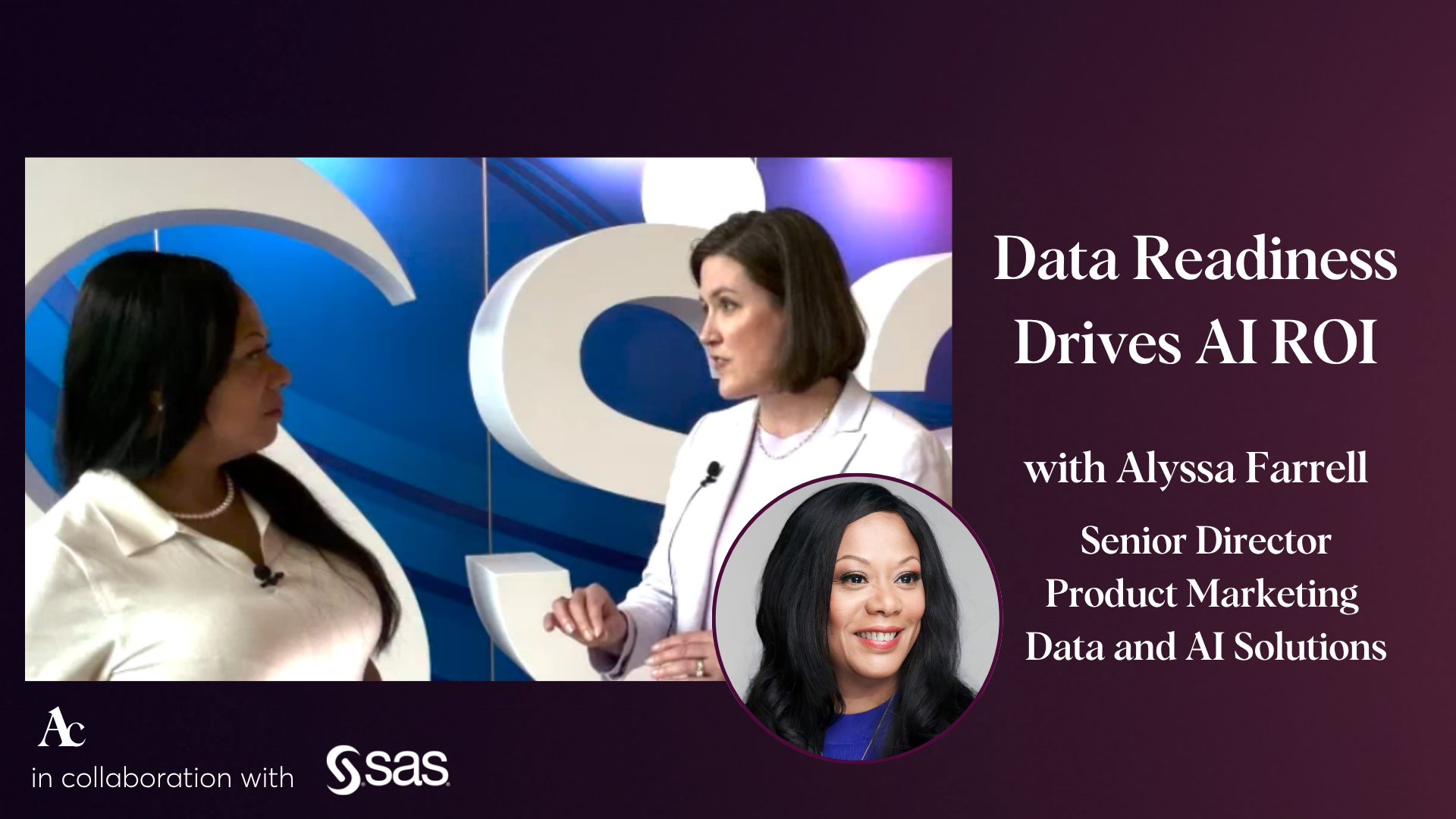
Every regulated sector leader in Grapevine this week was solving a version of the same problem: how do you move fast on AI when the data underneath it is messy, siloed, and governed inconsistently? The answer, as Alyssa Farrell, Senior Director of Product Marketing at SAS, made plain, is that you do not move fast until you solve it.
“Governance literally starts at the beginning when you are accessing a piece of data. It tracks through the lineage of how you use that data and how it supports your analytical models. That is what allows organizations to scale AI with confidence.” — Alyssa Farrell, Senior Director, Product Marketing, SAS
The data engineering argument has given way to the competitive architecture argument. The Frontier Firm that builds lineage, audit trails, and bias detection into its data estate from day one pays the governance cost once. The organization that bolts them on after the model is deployed — after the agent is live, after the regulator asks — pays the cost every quarter, in delayed deployments, withdrawn pilots, and the quiet attrition of the people who knew how to do it right.
The most instructive proof came from the SAS Innovate main stage: a fraud detection model that caught fewer than 4% of actual fraudulent transactions, not because the model was wrong, but because the training data was imbalanced. One hundred thousand synthetic fraudulent records corrected the imbalance. The KS statistic moved from 0.83 to 0.86. The model did not change. The data did. Better production outcomes do not require better algorithms. They require better inputs.
Gartner confirms the pattern at scale: 60% of AI initiatives fail due to a lack of AI-ready data. The data foundation is not the supporting act. It is the enabling condition.
For the Marketing Modernizer at leading corporations, this dimension focuses on campaign data quality and MarTech integration. For the Platform Engineer, it is about cloud-native architecture and hybrid data flexibility. The dimension is the same. The entry point is different. Pick yours, and engineer governance into it before the first agent runs.
The move: Appoint a single accountable owner for data governance, not a committee, not a working group, one executive with a mandate and a deadline. Audit every AI use case against the data that feeds it. The inventory will surprise you.
Dimension Two — Ecosystem Partnerships
"The regulated sector leader who builds alone is already behind."
The most structurally underestimated dimension in every regulated sector is the ecosystem. Insurance, banking, and healthcare are not winner-take-all markets; they are deeply interdependent. Reinsurers sit upstream of primary carriers. Platform providers sit inside every core system. Technology partners sit alongside every transformation program.
At our roundtable, a few delegates occupied the most strategically important seats, not because they were buying, but because they were seeing. One executive observed AI adoption patterns across hundreds of enterprise clients in regulated industries. Another saw, across the entire cedent market, which primary carriers are building AI capability that compounds, and which are running pilots that evaporate. The Cession Strategist and Ecosystem Catalyst archetype carries the most portable intelligence about what works. The regulated sector leader who treats them as vendors leaves strategic advantage on the table. The one who treats them as intelligence sources compounds faster.
SAS’s announcement of the Viya MCP Server makes the architecture of ecosystem partnership concrete: a Model Context Protocol server that exposes SAS’s fraud detection models, analytical capabilities, and decisioning systems to any external agent workflow. The Intelligence Layer extends outward. Partners connect. The ecosystem compounds. This is what Dimension Two looks like in production, not a partnership agreement, an architectural integration that scales without friction.
The move: Map your three most consequential external partners — reinsurer, technology platform, professional services — and identify what AI intelligence each is carrying that you are not accessing. Then build one deliberate intelligence-sharing arrangement before year-end.
Dimension Three — Transformational Change Enablement
"Governance is a cultural commitment, not a compliance checklist."
Of the four SAS leaders I interviewed this week, Reggie Townsend, VP of AI Ethics, Governance and Social Impact — former White House National AI Advisory Committee advisor, board director at EqualAI, and architect of SAS’s AI governance philosophy — delivered the most unexpected argument. The conversation I expected was about regulation, policy, and risk management. The conversation I had was about culture.
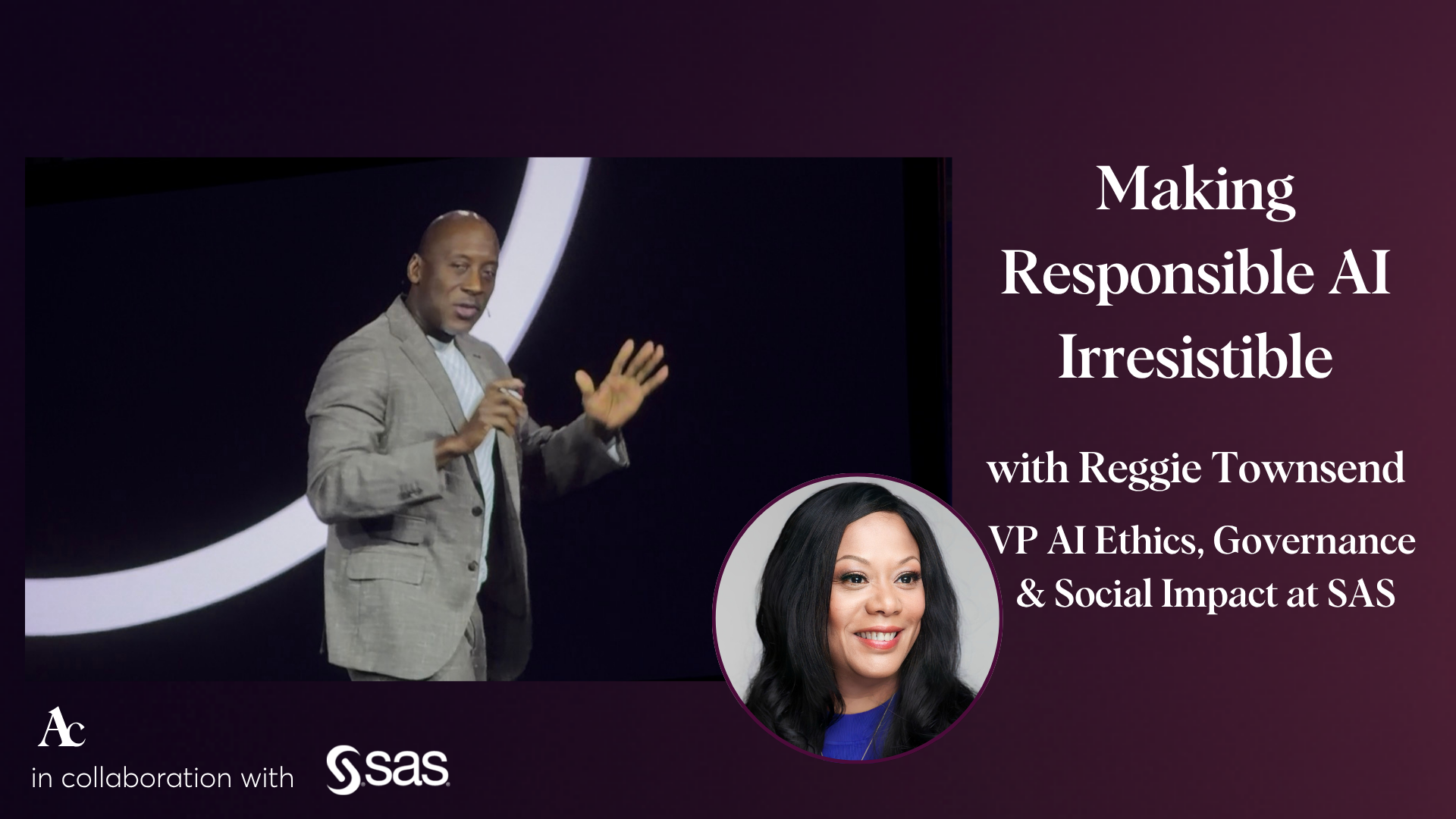
“Governance is often an afterthought. Innovation generally occurs, and then it’s like, okay, what can we do to get our arms around it? But when it’s bolted on at the end, when you’ve got processes that have already been established, it just feels like extra.” — Reggie Townsend, Vice President AI Ethics, Governance & Social Impact, SAS
His provocation to regulated-sector boards was equally direct: the conversation about culture is the most overlooked in AI governance right now. Not policy. Not regulation. Culture. Because organizations failing to industrialize agentic AI are not failing for regulatory reasons — they are failing because their culture still treats AI governance as a drag on innovation rather than as its architecture. The Trust Premium — the compounding economic advantage Frontier Firms generate by engineering AI governance into their architecture from day one — is inseparable from this dimension.
Townsend’s design philosophy for SAS AI Navigator is instructive: governance so intuitive and action-oriented that a senior leader completes a review in under five minutes and moves on. Making responsible AI irresistible is not a marketing line. It is a product design principle. And it is the right test for every governance process in every regulated-sector organization: would a senior leader use it willingly, or does it feel like compliance overhead?
The Actuarial Translator archetype — the appointed actuaries and underwriting consultants who carry the burden of evidence standards in regulated sectors — is the most powerful internal advocate for this dimension, and the most underused. Actuaries have spent decades making governance feel rigorous and precise. In the AI era, they are the natural architects of responsible transformation. The organizations that engage them early, as designers rather than reviewers, move faster and safer simultaneously.
The move: Run one internal governance design sprint — not a policy review, a design sprint — with your actuarial, legal, and AI teams in the same room. The goal is not a document. It is one governance process that a senior leader can complete in five minutes and find irresistible.
Dimension Four — AI Integration and Human-Agent Teaming
"From AI that informs to AI that acts — and the operating model that makes the transition real."
The architectural reveal of SAS Innovate 2026 was not a single product announcement. It was an operating model. SAS introduced a multi-agent supervisory system inside Customer Intelligence 360: one orchestrating agent coordinating a constellation of specialized agents — Journeys, Search, Audience, Emails — each with its own context, its own guardrails, its own zone of authority. The human stays in command. The agents execute the work that humans cannot do at scale. This is the Human-Agent Operating Model in production.
Marinela Profi, Global AI and GenAI Marketing Strategy Lead at SAS and a TEDx speaker with advanced degrees in Statistics and AI, named the architectural shift with precision:
“What we are seeing here is really a shift from AI that forms to AI that acts.”
And she named the gap that keeps regulated sectors in Pilot Purgatory:
“Companies are not struggling with access to models. They are struggling with everything around the model. If you leave governance as an afterthought, you will not be able to put it into production.”

The Human-Agent Ratio is the metric that makes this dimension measurable. In the same way headcount measured the industrial-era enterprise, the Human-Agent Ratio measures the agentic enterprise, capturing how much routine knowledge work has been delegated to digital labor under human supervision, with human accountability intact. Workers are interrupted every two minutes.
60% of meetings are ad hoc. 80% of the global workforce reports lacking the time or energy to complete their work. The capacity gap is mathematical. The Human-Agent Ratio is how the Frontier Firm closes it.
The Risk Sentinel archetype—your underwriters, AVP AML, or Director of Intelligence Production—operates in the regulated-sector use case, where the ROI on human-agent teaming is least ambiguous. Anti-money laundering and fraud detection are already automation-adjacent. Regulators are already comfortable with rules-based automation in these domains. The move to supervised agentic orchestration is architecturally straightforward and commercially unambiguous. Jared Peterson, SVP of Global Engineering at SAS, said it plainly:
“The role of human expertise in operationalizing agentic AI is not diminished by automation. It is elevated.”
That sentence is the operating philosophy of Dimension Four and the answer to every boardroom concern about AI replacing the workforce.
The move: Define one outcome — claims triage, AML alert review, underwriting pre-screening — and run it on a human-agent team with a named human owner, a supervised agent pattern, and an explicit Human-Agent Ratio target. One outcome. One owner. 90 days.
Dimension Five — Organizational Agility and Leadership Alignment
"The board that does not track AI as a KPI has governed a company for the last decade."
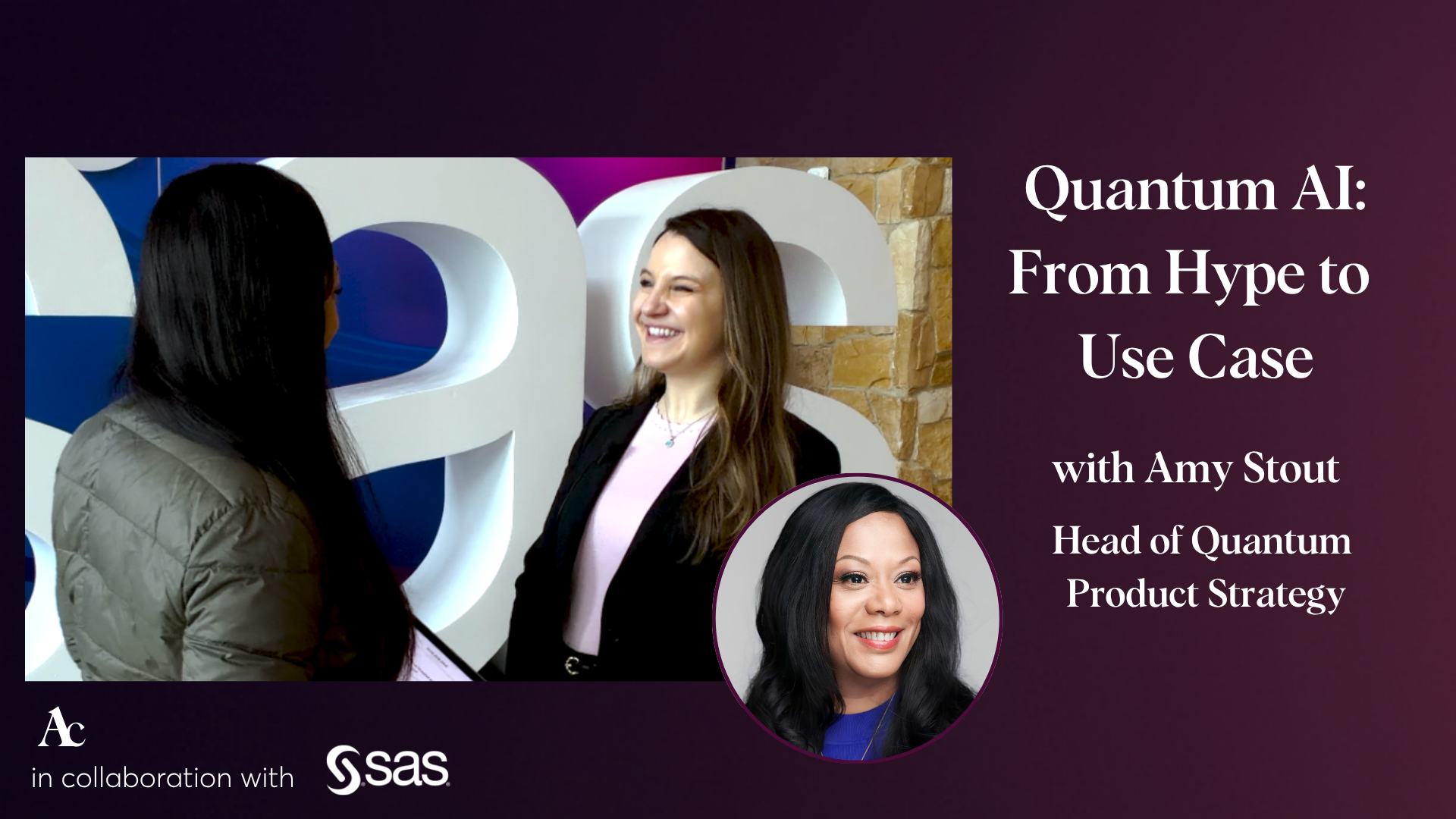
Amy Stout, Head of Quantum Product Strategy at SAS, brought the longest lens of the week. 60% of global enterprises are already exploring quantum AI, according to SAS research among 500 business leaders. The top barrier is no longer cost. There is uncertainty about the practical real-world value. That shift — from “we cannot afford it” to “we do not know what to do with it” — is the leading indicator of an organization approaching an organizational agility threshold: capable enough to experiment, not yet agile enough to act.
“Quantum AI is here, and it is coming very quickly. The time to invest is today.” — Amy Stout, Head of Quantum Product Strategy, SAS
That is a quantum argument. But the underlying principle is organizational. The regulated sector leader who treats AI as an IT initiative is already behind the one who has moved it onto the executive dashboard alongside revenue, capital, and risk. 82% of executives name 2026 the pivotal year to redesign the operating model around human-agent teams. The organization that waits for the proof before investing in the capability will find the proof has already been compounded elsewhere, in the Frontier Firm that started before it felt ready.
Leadership alignment is not a sentiment. It is a structural condition. Until the CEO, CFO, CRO, and CIO are looking at the same AI scorecard — the same Human-Agent Ratio targets, the same data governance indicators, the same Frontier Firm maturity scores — the transformation remains a program, not a company posture. The Frontier Firms scoring 22 or higher out of 25 on the Maturity Framework did not get there because they had better technology. They got there because every executive looked at the same numbers every quarter and held the same person accountable for moving them.
The Frontier Firm that builds quantum skills now — in portfolio optimization, supply chain coordination, and molecular simulation — will own the next layer of the Intelligence Layer when the hardware fully matures. The one who waits will start from behind, in a market where compounding has already happened.
The move: Put AI on the executive dashboard. Not as a project update. As a KPI, with a target, an owner, and a quarterly review cadence. The board that governs last decade’s company is already governing a smaller one.
The Frontier Firm Contrast: Architecture, Not Aspiration
Here is the reality the roundtable made visible. Twenty senior leaders from insurance, reinsurance, and financial services occupied every phase of Frontier Firm maturity simultaneously. The most mature organizations in the room — scoring at the upper end of the 25-point Maturity Framework — had already rebuilt their governance architecture, embedded human-agent teams, and industrialized the venture-client model at scale. The early-stage end of the spectrum showed up differently — multiple senior leaders from the same organization, every signature path represented in one room — because the architecture is being built now, not in three years.
The gap between them is not a technology gap. It is a sequencing gap. The mature organizations did five things simultaneously and started before the proof was fully in. The early-stage organizations are beginning the same sequence, deliberately and seriously, with every decision-maker in the room. The organizations not in that room are the ones waiting for regulation to clarify, for technology to mature, for a competitor to prove the ROI first.
By the time those conditions arrive, the compounding has already happened elsewhere. Pilot Purgatory is not a transition phase. For the organizations still in it by Q4 2026, it is a strategic position — and not a defensible one. Frontier Firms are not faster because they bought more AI. They are faster because they engineered five things at once, and started before they felt ready. That sequence — governance first, architecture next, operating model last — is the only one that holds under production conditions. The reverse sequence, which most regulated-sector organizations are running, produces compliance debt rather than competitive advantage.
The Next Ninety Days
The five dimensions are not sequential. They compound together, or they stall separately. Here is the ninety-day sequence that converts this framework from reading material into a move.
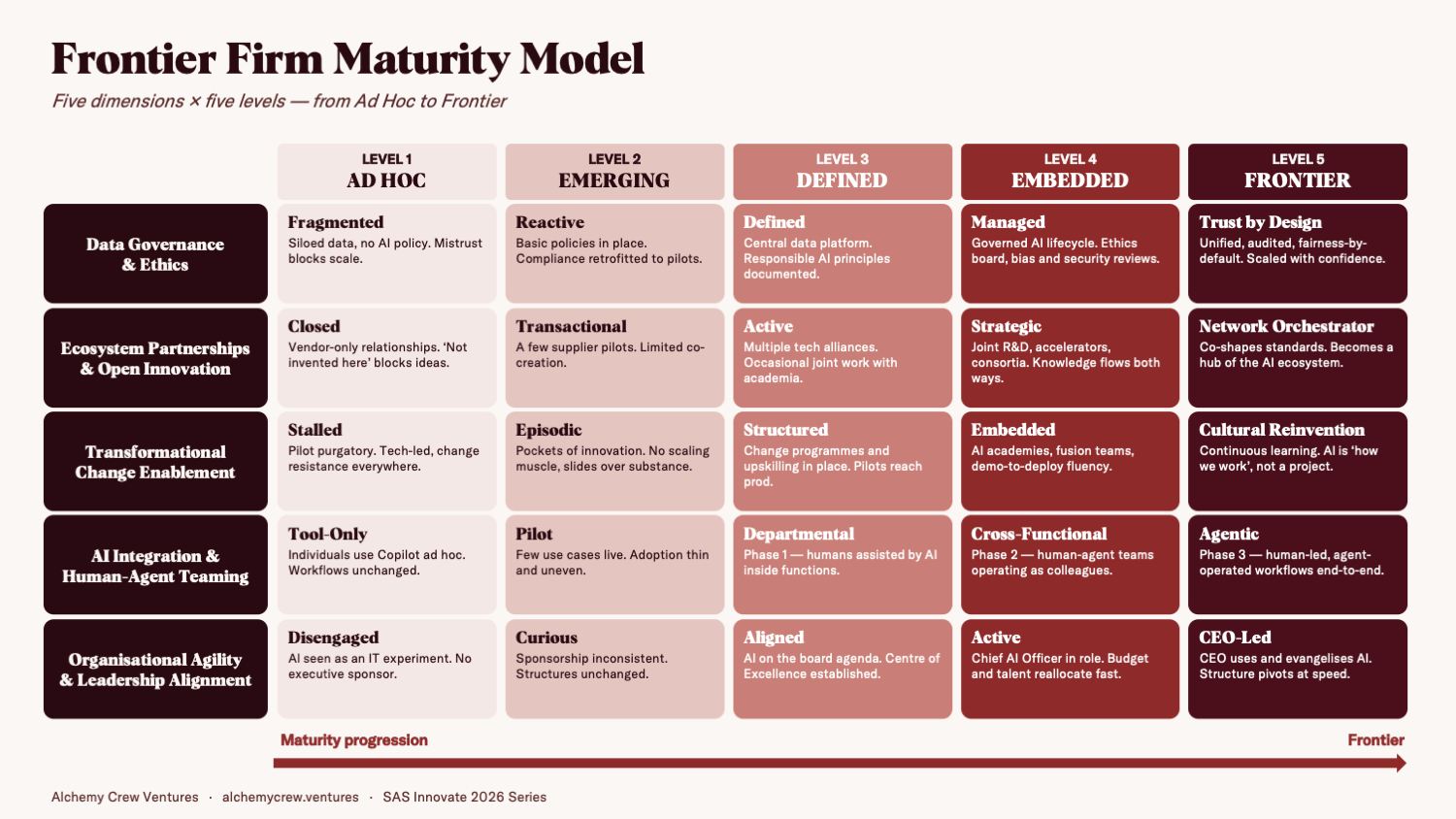
- Score honestly across all five dimensions. Most regulated sector organizations overscore Data Governance and underscore Leadership Alignment. That asymmetry is the gap map. Run the Frontier Firm Maturity Assessment with your senior team before the end of Q2.
- Name one wicked problem. Claims triage, fraud detection, AML alert review, and underwriting pre-screening. The vertical where the pain is highest pays back fastest and earns the internal mandate for everything that follows. One problem. Not five.
- Name the agent boss. A single human is accountable for the outcome produced by the human-agent team. No diffuse ownership. No steering committee. One person, one KPI, one Human-Agent Ratio target.
- Set and track the Human-Agent Ratio. Track it as deliberately as headcount. Review it quarterly. Let the number drive the next architectural and hiring decision. Digital labor, once configured, keeps compounding. Headcount does not.
- Make AI a board KPI. Until it sits on the executive dashboard alongside revenue and risk, no Frontier Firm is built. The board that governed last decade’s company is already governing a smaller one. This is the move that makes the other four permanent.
Pilot Purgatory is a choice. So is production. The regulated sector leaders who will be Frontier Firms by 2027 are sitting inside their organizations right now, running the Frontier Firm Maturity Assessment, naming their wicked problem, and setting the Human-Agent Ratio target for Q4. They started before they felt ready. In fifty years, SAS has never stopped writing the intelligence playbook. During SAS Innovate in Grapevine, Texas, the production chapter was written. The regulated sectors that read it — and act on it in the next ninety days — will be the ones still writing their own.
Frequently Asked Questions (FAQs)
What is a Frontier Firm?
A Frontier Firm is an enterprise that has rebuilt its operating model around human-agent teams, governed intelligence at production scale, and a data foundation engineered for both speed and accountability. Rather than deploying AI on top of existing structures, Frontier Firms redesign the structures first. In regulated sectors, they treat compliance architecture as competitive infrastructure rather than a constraint. They score 22 or higher across five transformation dimensions, and their 3× ROI advantage is the compound return on doing all five simultaneously.
Why do AI initiatives stall in regulated sectors like insurance, banking, and healthcare?
Not because the technology is wrong, but because the architecture is backward. When governance is bolted on after a model is deployed, every pilot faces a regulator, a compliance function, and a legal team that can pause it. Gartner finds 60% of AI initiatives fail due to a lack of AI-ready data, and 46% of companies face an AI trust deficit that leaves up to half of their AI potential unrealized. Frontier Firms sequence it the only way that holds in production: governance first, architecture next, operating model last.
What is the Human-Agent Ratio, and why does it matter?
The Human-Agent Ratio measures how much routine knowledge work an organization has delegated to digital labor under human supervision, with human accountability intact — the agentic-era equivalent of headcount. With workers interrupted every two minutes and 80% of the global workforce lacking time to finish their work, the capacity gap is mathematical. Tracking the Human-Agent Ratio as deliberately as headcount, against an explicit target with a single accountable owner, is how a Frontier Firm closes it.
What is the Trust Premium, and how is it different from Pilot Purgatory?
The Trust Premium is the compounding economic advantage that Frontier Firms generate by engineering AI governance into their architecture from day one — paying the governance cost once rather than every quarter. Pilot Purgatory is its opposite: the stalled state where AI never reaches production. By Q4 2026, it is no longer a transition phase but a strategic position — and not a defensible one, because the compounding has already happened elsewhere.
What are the first moves a regulated-sector leader should make in the next 90 days?
Five, run together rather than in sequence: (1) score honestly across all five Frontier Firm dimensions; (2) name one wicked problem — claims triage, fraud detection, AML alert review, or underwriting pre-screening; (3) name the "agent boss," a single human accountable for the human-agent team's outcome; (4) set and track a Human-Agent Ratio target quarterly; and (5) make AI a board KPI on the executive dashboard alongside revenue and risk — the move that makes the other four permanent.
References
SAS AI Navigator to bring order to AI chaos - April 28, 2026
SAS expands SAS Viya with governed AI assistants and agentic AI capabilities - April 28, 2026
SAS aims AI agents at industry’s toughest challenges - April 28, 2026
SAS survey: Industry leaders on the quantum AI cusp - April 28, 2026
SAS at 50 years: Built on trust, shaping the future of AI - April 28, 2026
Expanded agentic AI capabilities coming to SAS Customer Intelligence 360 - April 28, 2026
SAS Innovate 2026, Grapevine, Texas
Personalize every touchpoint in real time with SAS Customer Intelligence 360
Editor in Chief

Rebuilding Risk Resilience