Why Regulated Enterprises Chasing AI Are Hitting The Data Wall
Jul 21, 2026Written by Alchemy Crew Team
Regulated enterprises attempting to build AI-native operations on legacy data pipelines risk regulatory failure and miss the promise of the Frontier Firm.
Vaultspeed CEO Patrick Van Deven argues that true intelligence on tap requires a deterministic, automated data integration layer that AI can securely read. By automating the data engineering process, executives can solve horizontal data fragmentation across enterprise systems within months, rather than years.
Crucial Takeaways:
- Automating your deterministic data integration layer is a primary executive priority for 2026, reducing complex warehouse rebuilds from years to 8 months.
- AI struggles to decipher the implicit business logic buried in 25 years of manual code across Guidewire and SAP integrations.
- Compliance frameworks like BCBS 239 demand pristine data lineage that only machine-generated metadata from Vaultspeed can reliably provide to AI agents.
The Hidden Barrier To External Innovation In The Agentic Enterprise
AI-native ambitions crash when they meet the reality of 20-year-old data pipelines. Chief Digital Officers discover that bolting generative agents onto undocumented legacy systems scales confusion and compliance failures. Patrick Van Deven recently stepped out of venture capital to lead Vaultspeed as CEO after recognizing this precise bottleneck. In this episode of Scouting for Growth, we examine why regulated industries cannot achieve the Frontier Firm promise without completely overhauling how they stitch their data together. This conversation tackles the immediate crisis of data fragmentation within the enterprise innovation space. Sabine VanderLinden and Patrick Van Deven map out the exact steps required to transform an outdated digital infrastructure into a modern intelligence core.
The Data Crisis Demands Immediate Action
Leaders must fix horizontal data fragmentation today to survive the shift toward agentic AI. The gap between boardroom AI expectations and operational data reality continues to widen rapidly. Microsoft announced the birth of the Frontier Firm, pushing enterprises to adopt intelligence-on-tap and agentic workflows. Gartner research consistently highlights that data quality and integration complexities remain the primary blockers for scaling enterprise AI in production.
Regulated sectors face the harshest penalties for hallucinations and broken data lineage. Global regulators enforcing BCBS 239 and IFRS 17 standards require absolute transparency in how financial and risk reports are generated. Deploying digital labor to handle complex claims requires the underlying data logic to be transparent and accessible. InsurTech and traditional carriers alike must ensure every data point is audit-ready. This urgency connects directly to the Intelligent Layers architecture we advocate at Alchemy Crew Ventures. The intelligence core of any enterprise relies entirely on an uncompromised foundational data layer.
Essential Discoveries From The Conversation
Legacy Code Obscures The Business Logic AI Needs To Function
AI agents cannot extract meaning from horizontally distributed source systems without a modernized metadata layer. Decades of manual programming have buried essential definitions for policies and claims inside isolated platforms. When data is scattered across multiple legacy warehouses, the resulting integration code becomes incomprehensible to modern language models.
Enterprises historically relied on offshore teams to manually stitch this data together. This manual approach created a massive technical debt of implicit logic that no one fully documents today. When executives demand AI-driven dashboards, they assume the intelligence layer can simply read the underlying databases. The data integration process itself holds the key to how a customer or claim is defined. You cannot scale intelligence on a foundation of mystery. As Patrick notes:
"You'll have code that stitch the data together that is full of implicit business and data logic baked in. AI is not going to figure this out. You can't have AI read the whole source code of your data integration layer every time it needs to run a query."
Large insurers should adopt venture clienting to purchase startup solutions directly rather than building everything in-house, gaining strategic benefit without taking an equity stake. BMW Startup Garage pioneered the venture client model in 2015 and uses real-world testing of early-stage products to validate fit. Companies like NN Group manage 17 different source systems using highly efficient automated frameworks, which shows that a massive engineering team is unnecessary to solve data fragmentation. This approach reduces time-to-market by validating startup solutions through pilot projects before broader solution adoption.
Deterministic Automation Replaces Probabilistic Risk
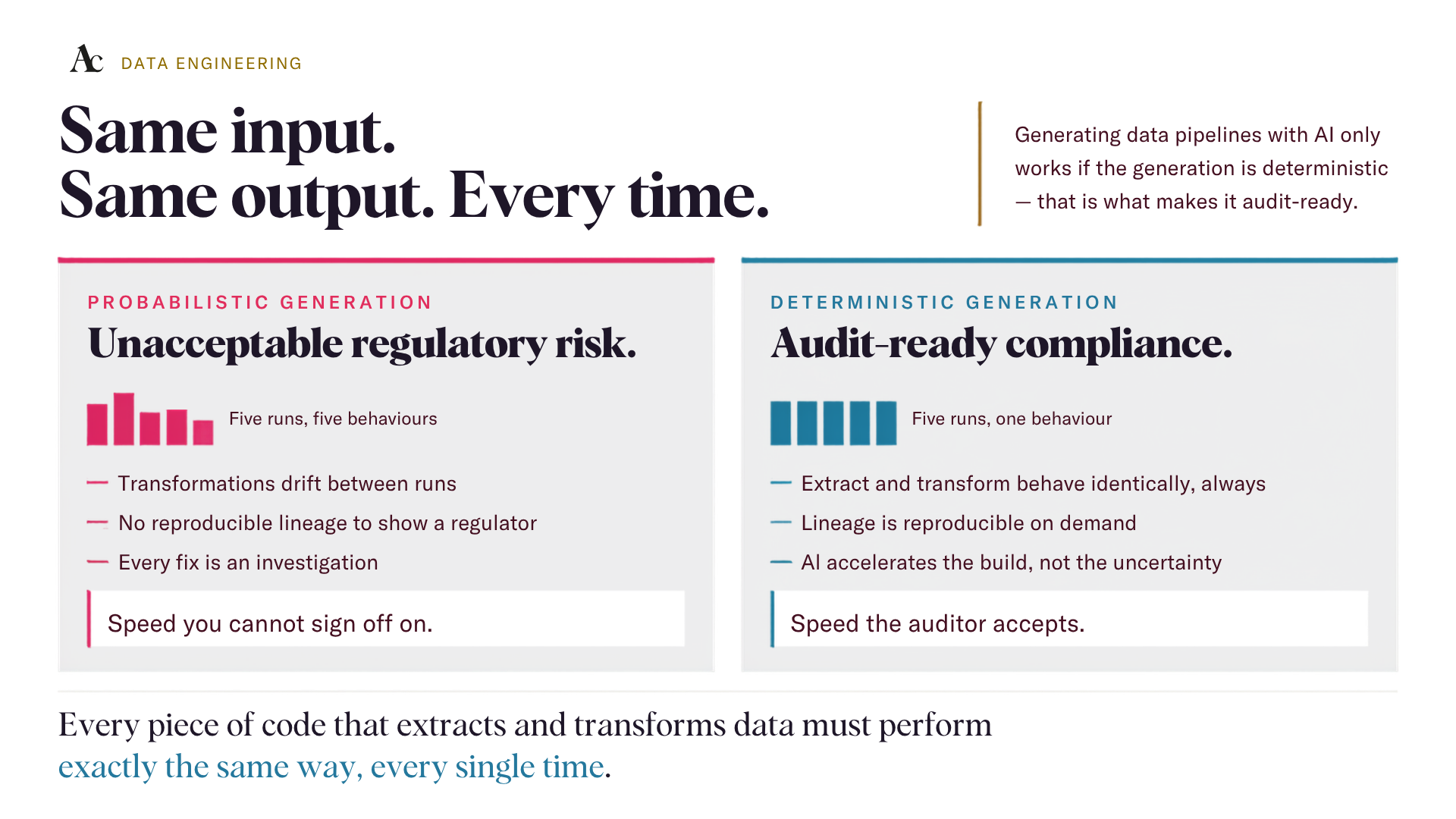
Generating data pipelines with AI requires a deterministic approach to guarantee audit-ready compliance. Allowing data engineers to generate integration code using probabilistic models introduces unacceptable regulatory risk. Every piece of code that extracts and transforms data must perform exactly the same way every single time. Vaultspeed uses AI to help configure pipeline creation without allowing the models to access operational data. The system writes the integration code deterministically. This separation ensures the resulting data structures remain completely reliable and free from hallucinations. It creates a pristine intelligence core for the enterprise.
"The code is pre written. It's going to be one hundred percent of the time exactly the same code every time. It's how you configure the system, how the system guides you, how the system learns from what you do. That is AI, and that stays inside, that doesn't touch the data."
This aligns with building the Intelligent Layers of a Frontier Firm. Human oversight is maintained while the heavy lifting of pipeline creation is automated. Large enterprises, including Thomson Reuters, have leveraged these deterministic frameworks to execute complex post-merger integrations. They rebuild massive legacy environments in a fraction of the time required by traditional manual methods.
Subject Matter Experts Govern Startup Solutions And The New Workflows
Automating the plumbing layer elevates business experts into essential governance roles. As routine coding tasks disappear, the professionals who truly understand the business context of the data become the most valuable assets. The focus shifts from writing scripts to modeling the business and ensuring the AI systems operate with correct definitions. This transformation empowers employees to become agent bosses who guide digital labor. Technical acumen must now combine with deep operational knowledge. The collaborative environment allows business users and technologists to define the data models together inside a single platform.
"My personal conviction is that this is a new era for subject matter experts, those who have a deep understanding of how the business works, because that is the thing that is unlocked now with AI engineering work like coding or data plumbing."
By adopting automated data engineering, companies free their best minds to amplify their impact across the organization. They actively shape the knowledge graphs that power the entire agentic enterprise.
Re-architecting Does Not Demand A Complete System Swap
Executives can solve data fragmentation without replacing their foundational operational software. The fear of disrupting massive core systems often paralyzes digital transformation efforts. Leaders can build an intelligent automated integration layer directly on top of their existing infrastructure. The secret involves selecting a tractable problem that impacts the business and solving it with automated integration. A chief digital officer might tackle broker commission reporting or regulatory lineage first. By isolating a specific issue and quickly integrating the necessary source systems, the data team proves the model works and delivers immediate value.
"What you do is take a tractable problem. By tractable I mean it is solvable. You have the data, you know where it is and you have people who can connect that data to a problem that is really impacting the business."
This approach accelerates the journey to becoming a Frontier Firm. A century-old data warehouse was recently rebuilt in just eight months by a team of two people using Vaultspeed. This proves that massive data overhauls can be achieved iteratively and safely without jeopardizing the company's daily operations.
Five Moves To Modernize Your Data Layer With The Venture Client Model
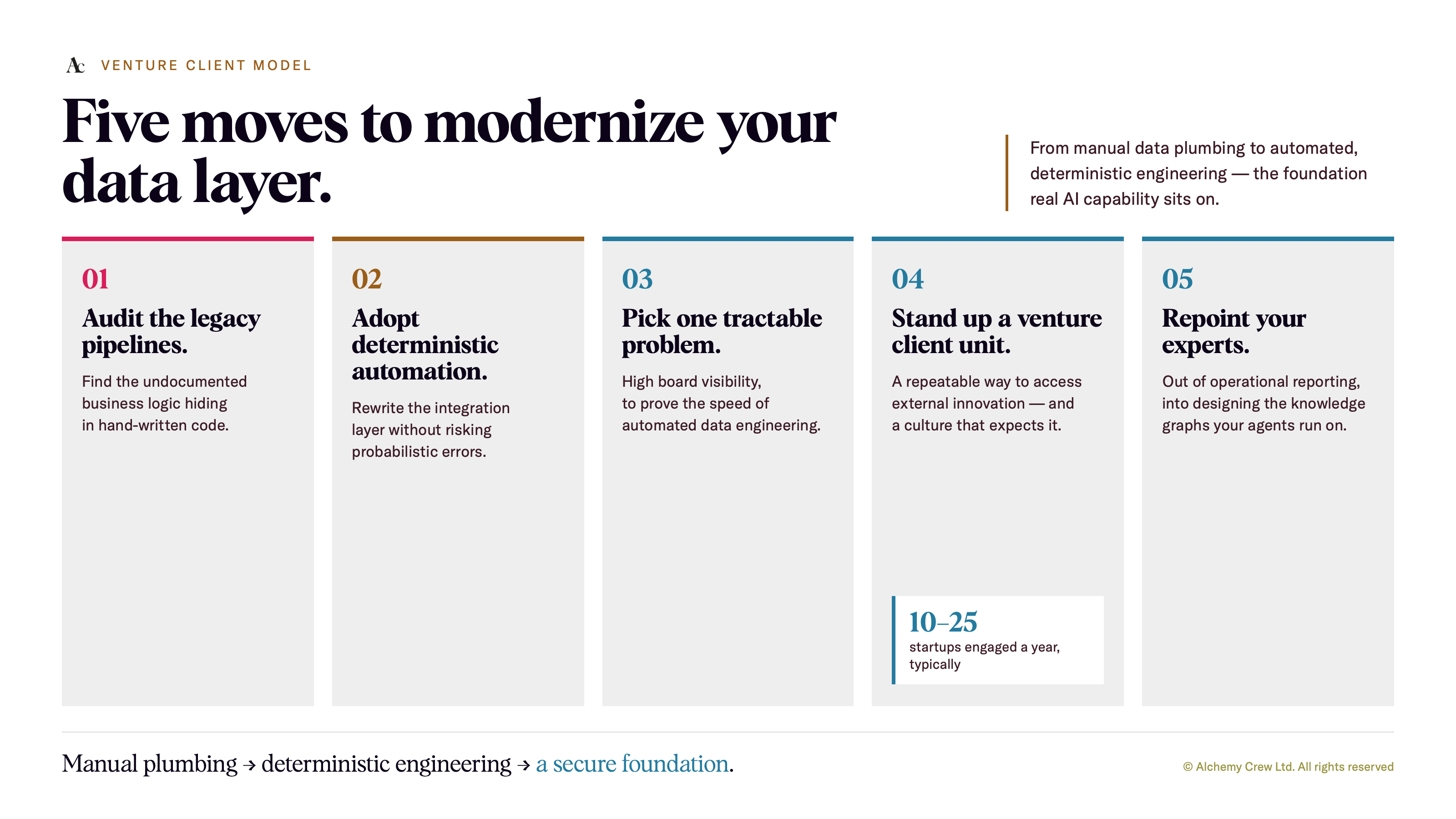
Leaders must transition from manual data plumbing to automated deterministic engineering to enable true AI capabilities. Execute these specific moves this quarter to build a secure foundation.
-
Audit your legacy data pipelines to identify undocumented business logic hidden in manual code.
-
Adopt deterministic automation platforms to rewrite your integration layer without risking probabilistic errors.
-
Identify one tractable data problem with high board visibility to prove the speed of automated data engineering.
-
Leverage the Venture Client Model by creating a dedicated venture client unit that gives corporations a repeatable way to access external innovation and build a culture of innovation. As a practical benchmark, companies with these teams typically engage 10–25 startups annually.
-
Empower your subject matter experts to transition from operational reporting to designing the knowledge graphs for your digital agents.
Frequently Asked Questions
What is a Frontier Firm?
A Frontier Firm is an AI native organization built on intelligent layers and human-agent collaboration. These companies treat intelligence as a utility and deploy digital labor to augment their human workforce. Microsoft champions this model as the future of the agile enterprise.
How does data integration block AI adoption?
AI agents cannot understand data that is horizontally distributed across legacy systems like SAP and Guidewire. The custom code stitching these systems together contains implicit business logic that language models cannot read. Automated data integration generates the explicit machine-readable metadata that AI requires.
What is the term Venture Client?
A Venture Client is a company that buys and tests startup solutions for strategic benefits before committing to deeper rollout, rather than taking equity stakes. Unlike corporate venture capital, this model focuses on operational value and adoption without ownership.
Why is deterministic code important for regulated industries?
Regulated entities must prove exactly how their data reports are generated for compliance frameworks. Deterministic code performs the exact same way every time and eliminates the risk of AI hallucinations. This guarantees accurate data lineage and ensures compliance during automated data engineering.
Can insurers modernize data without replacing core systems?
Insurers can deploy an automated data integration layer without replacing their primary policy or claims systems. Platforms extract and map the data from existing software to build a modernized warehouse. This approach avoids the massive operational risks associated with a total system swap.
Taming The Legacy Data Issue Through Corporate Startup Collaboration
You cannot achieve intelligence on tap until you fix the broken data pipelines hiding in your basement. The era of manual data engineering is definitely over. Now is the time to empower your subject matter experts and automate your deterministic data layer. Listen to the full conversation with Patrick Van Deven on Apple Podcasts and Spotify. Visit alchemycrew.ventures/amplifying-success to explore more frameworks for your AI transformation.
Sources and Citations
Microsoft: Defining the Frontier Firm and AI native enterprise structures.
Gartner: Research on data quality and integration as primary blockers for scaling enterprise AI.
International Financial Reporting Standards: IFRS 17 insurance contracts reporting requirements.
NN Group: Vaultspeed customer utilizing 17 source systems.
Thomson Reuters: Enterprise customer referenced for post-merger data integration.
Editor in Chief

Rebuilding Risk Resilience