Do You Know That The Agentic Frontier Won’t Close the Protection Gap
Jun 23, 2026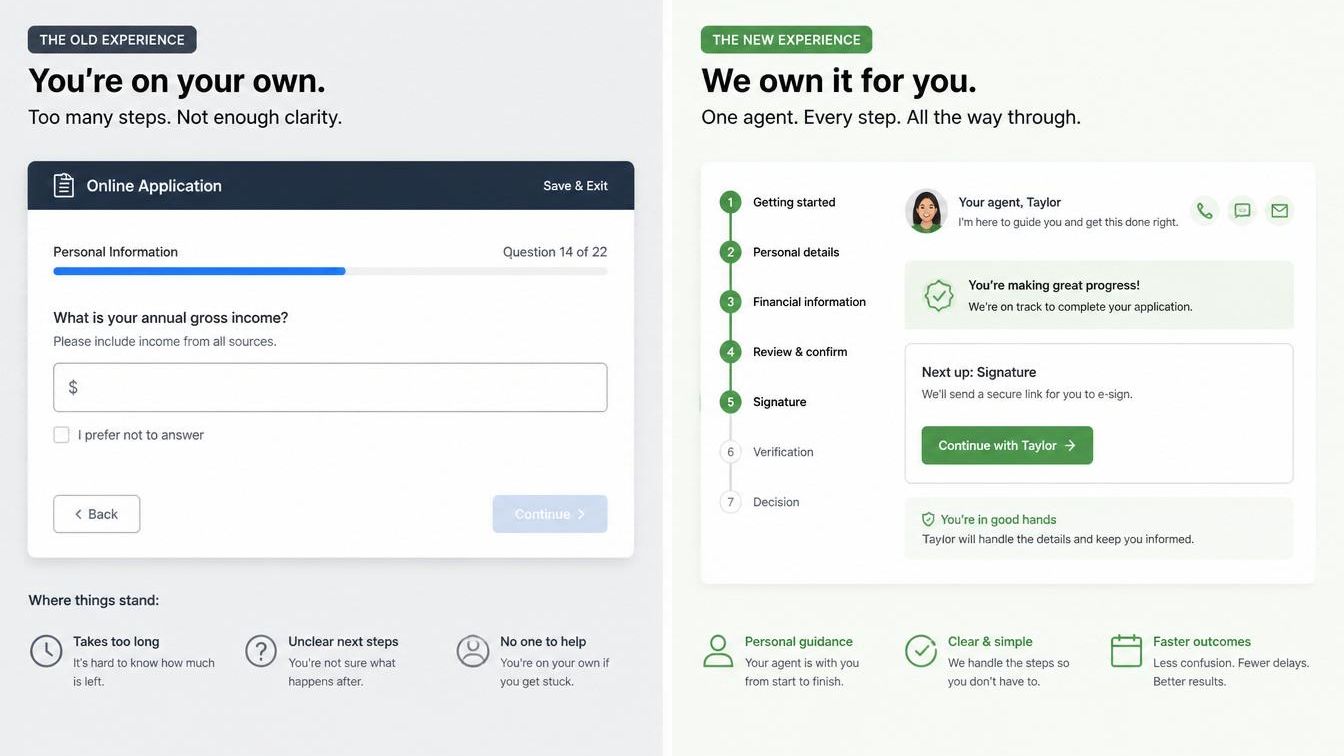
Written by Sabine VanderLinden
61% of carriers now run AI in production. Most are automating the distance, not closing it.
Key takeaways
-
The Agentic Frontier is widening the Protection Gap, not closing it. Carrier AI-in-production jumped from 37% to 61% in a single year — but most deployments automate broken processes instead of redesigning them, so customers get a faster wrong answer rather than coverage they couldn’t reach before.
-
The Human-Agent Ratio is the real scoreboard. The question that separates transformation from innovation theatre is not “how many agents have you deployed?” but “for every human still in the loop, how much of the loop runs without one?”
-
Only Frontier Firms close the gap, because they redesign the work, not the wrapper. The carriers that compound advantage fund agents against a P&L line with a named owner and a 90-day kill-or-scale gate — reaching the customers, settling the claims, and earning the trust that faster-but-unchanged processes never will.
The application she abandoned at question fourteen
Maria runs a two-van plumbing firm outside Lyon. In March, she opened the online application for the liability cover her new contracts demand, reached question fourteen, and closed the tab. Nobody called. Three months on, she is still uninsured, still bidding for work she can’t legally take, still standing inside the Protection Gap that carriers keep promising to close.
This year, an AI agent could have finished Maria’s application for her. John Hancock shipped Quick Quote, a generative underwriting tool that drafts a quote before a human has finished reading the application. Travelers put a fully agentic voice assistant — built with OpenAI — on its auto-claims line: it guides a customer from consultation through filing an auto damage claim, sends status updates, then hands off to a digital experience for photos, appraisals, and repairs, with a live specialist available at any point. The agents have arrived. They answer the phone, they price the risk, they move the file.
And here is the uncomfortable part: for Maria, and for most carriers out there, nothing underneath actually changed, really.
The headline number this quarter is seductive. According to Datos Insights, the share of carriers running AI in production climbed from 37% to 61% in a single year, insurance AI deployments grew 87% year over year, and generative AI is reshaping core insurance operations, and agentic systems now account for roughly one in five public launches. That looks like transformation. It is mostly migration — the same broken processes, now running faster, with a synthetic voice on top. Maria’s application would still die at question fourteen. The agent would just watch it happen sooner.
Speed on a broken process is not progress
Adoption is not transformation. A voice agent bolted onto a claims process that already loses files, double-keys data, and escalates by reflex, but does not close the Protection Gap. It automates the distance. The customer gets a faster wrong answer, the adjuster inherits a queue of agent-generated exceptions, and the carrier congratulates itself on a deployment that moved a metric without moving the outcome.
What is the Agentic Frontier? The Agentic Frontier is the operating frontier where AI agents stop assisting humans and start owning end-to-end work — initiating claims, drafting quotes, clearing exceptions — under defined guardrails. It is measured not by how many agents you deploy, but by how much real work they carry.
That definition matters because it reframes the scoreboard. Most carriers are counting agents. The ones who will compound advantage are counting the work those agents actually own — and whether the organization has designed those AI systems for scalability and adaptability so that ownership holds over time, not just in the pilot glow.
The Human-Agent Ratio with AI agents is the real scoreboard
Here is the number nobody is putting on a slide: the Human-Agent Ratio. Not “do you have agents?” but “for every human in the loop, how much of the loop runs without one?” A carrier where 61% of processes touch AI, yet every decision still routes through a tired adjuster at 4 p.m., has a Human-Agent Ratio of roughly zero. The agent is decoration. The headcount math hasn’t moved, the cycle time hasn’t moved, and the loss-adjustment expense hasn’t moved.
The Frontier Firm — the small cohort redesigning the operating model around agents rather than draping agents over it — treats the ratio as the design target. They ask a sharper question: which decisions can an agent own outright, which need a human veto, and which should disappear entirely? An organization has to manage agents with a clear focus on business processes and future operating goals, including which outcomes each agent should achieve and how it should plan work. Simple agents can trigger a task; more capable agents can carry end-to-end ownership without constant human intervention. You cannot buy a Human-Agent Ratio. You have to build one — process by process, decision by decision.
This is the work that exhausts people, and I want to name it honestly. Innovation theatre is draining. Across insurance transformation programs, the pattern is consistent: execution certainty and change management account for roughly 50% of transformation success. Orphan pilots — the agents that demo beautifully in March and die quietly by September — are demoralizing for the teams that poured months into them, and without careful selection and thorough training, they create little value for customers, clients, or the support team. The adjuster who has watched three “AI transformations” arrive and leave is right to be cynical. The fatigue is real, and when your AI strategy is failing, the missing success factors are usually in change management, not the technology. Pretending the next deployment will be different without changing the underlying process is how you earn another year of it.
Closing the gap in digital transformation means redesigning the work, not the wrapper
The Protection Gap — the chasm between the risk people carry and the cover they actually hold — does not close because a quote arrives faster. It closes when speed reaches people who were previously unreachable: the small business that abandoned the application at question fourteen, the gig worker priced out by a manual underwriting load, the flood-exposed household that never got a renewal call, especially as AI transforms insurance underwriting in 2025. Agents can reach those customers. But only if the carrier redesigns the journey as part of a broader insurance transformation so the agent owns the reach, not just the keystroke.
John Hancock’s Quick Quote is interesting precisely because underwriting is where reach and speed meet. Travelers’ claims agent is interesting because first-notice-of-loss is where trust is won or lost in the first ninety seconds — and Travelers paired the launch with a deliberate upskilling of its claim professionals, with change management doing the hard work of turning new tools into durable business processes, not a cull of them, underscoring the importance of combining AI with empathy in insurance claims. Both are real moves. The question for every other carrier watching them is not “can we buy the same tool?” It is “are we willing to rebuild the process the tool is supposed to run?” Faster claims, faster quotes, faster mistakes — the wrapper decides which one you get.
The playbook: four moves and key takeaways for this quarter
-
Measure your Human-Agent Ratio before you buy another agent. Pick one process — FNOL, quote-to-bind, renewals. Count the decisions a human still touches. That baseline is your real starting line, not the 61% adoption stat.
-
Redesign one journey end-to-end, not one task. Choose a single customer journey and treat the redesign as one of your transformation programs, with a clear plan for which outcomes the agent should achieve, which need a human veto, and which should be deleted, drawing on patterns from agentic AI automating strategic insurance work. Automate the redesigned journey, never the legacy one.
-
Kill the orphan-pilot pattern. Fund agents against a P&L line — loss-adjustment expense, quote conversion, retention — with a named owner to manage change management alongside deployment, because those are core success factors, and a 90-day kill-or-scale gate. No business metric, no deployment.
-
Score trust the way you score speed. Track agent decisions overturned by humans, complaints, and regulatory exceptions on the same dashboard as cycle time, because those trust metrics show whether agents are creating business value, not just moving faster. A faster process that erodes trust is widening the gap with a stopwatch running.
The next demo that ends in applause
The next time an agent demos beautifully and the room applauds, ask one question before you clap: whose work does it actually own, and who did it reach that you couldn’t reach yesterday? That question is your Human-Agent Ratio — and it is the only scoreboard that survives contact with a real quarter.
Spend the next ninety days adding agents to processes you refuse to redesign, and you won’t stand still. You’ll fall behind the carriers who used the same quarter to rewire the work underneath, building toward Agentic Frontier Firms powered by AI coworkers. They will price the risks you can’t, settle the claims you can’t clear, and earn the trust you keep automating away. The Agentic Frontier rewards redesign and punishes decoration — and the compounding starts now, not when the next budget cycle approves it.
Somewhere outside Lyon, Maria is still bidding for work she can’t insure. An agent reached her this year and let her go at question fourteen, exactly as the form always did. Whether the next one finishes her application — or just fails her faster — isn’t a technology decision. It’s yours. And the window to make it well is measured in quarters, not years.
Where do you actually stand? 15 minutes. One conversation. A clear-eyed read on your Human-Agent Ratio and the one journey worth redesigning first. Ping us an email: hello@alchemycrew.ventures or set up a call here.
Frequently Asked Questions
What is the Agentic Frontier in insurance?
The Agentic Frontier is the operating frontier where AI agents stop assisting humans and start owning end-to-end work — initiating claims, drafting quotes, clearing exceptions — under defined guardrails. It is measured not by how many agents a carrier deploys, but by how much real work those agents actually carry.
What is the Human-Agent Ratio?
The Human-Agent Ratio measures how much of a process runs without a human in the loop. Rather than asking “do you have agents?”, it asks: for every human still in the loop, how much of the loop runs without one? It is the clearest scoreboard for genuine agentic transformation versus innovation theatre.
Does AI adoption close the Protection Gap?
Not on its own. Carrier AI-in-production rose from 37% to 61% in a single year, but speed layered on a broken process just delivers a faster wrong answer. The Protection Gap only closes when redesigned journeys let agents reach people manual processes never could — underinsured small businesses, gig workers, and flood-exposed households.
What is a Frontier Firm?
A Frontier Firm is a carrier that redesigns its operating model around AI agents rather than draping agents over legacy processes. It treats the Human-Agent Ratio as a design target, deciding which decisions an agent can own outright, which need a human veto, and which should disappear entirely.
How can insurers avoid innovation theatre with agentic AI?
Fund agents against a P&L line — loss-adjustment expense, quote conversion, retention — with a named owner and a 90-day kill-or-scale gate. Measure your Human-Agent Ratio before buying another agent, redesign one customer journey end-to-end rather than automating a single task, and track trust signals (decisions overturned by humans, complaints, regulatory exceptions) alongside cycle time.
Editor in Chief

Rebuilding Risk Resilience