Agentic AI Trust Is Demonstrated, Not Designed: MAPFRE
Sep 01, 2026Written by Sabine VanderLinden
Agentic AI trust is demonstrated through repeated, consistent interactions, not engineered into a system once and for all, and it can be lost in a single exchange. MAPFRE did not put a technologist in front of the trust question. It put a behavioral lens on it. Bárbara Fernández, Deputy Director of Disruptive Innovation at MAPFRE, argues that trust in agentic AI cannot be designed, only demonstrated, interaction by interaction. For insurance leaders, innovation teams, and corporate decision-makers shaping AI governance, customer experience, and operational transformation, that changes what must be measured, governed, and improved.
Trust cannot be designed into agentic AI, only demonstrated. Fernández accepts governance by design but rejects trust by design as a category error. Trust takes years to build, one interaction to break, and is earned in every single exchange.
The restless agent breaks forty years of behavioral design. Customer journeys are engineered around human biases, and a personal agent does not tire: it finishes the cancellation. MIT CISR research from January 2026 finds ecosystem-driven business models grew from 12% of firms in 2013 to 58% in 2025; the most autonomous, the Orchestrator, acts on the customer's behalf.
Critical thinking is the premium human capability when intelligence becomes a utility. Stanford's AI Index 2025 records the cost of GPT-3.5-level intelligence falling 280-fold in two years, to 0.07 dollars per million tokens. When answers are that cheap, the scarce skill is challenging them.
Only 9% of insurers pair high trust in AI with strong trustworthy AI capability, and her harder warning lands on customer experience: your next customer may be a restless machine no friction can slow down. What follows examines how trust works when machine customers and human-agent teams reshape insurance operations: where behavioral design breaks, where human judgment should still override automation, and what insurers should do now to manage AI-driven interactions before these tireless intermediaries take business elsewhere.
Why Bárbara Fernández Says You Cannot Design Trust in Agentic AI Systems
Fernández separates what the industry conflates: trustworthy systems, which you can engineer, and trust itself, which you cannot.
I put the trust-by-design framing to her. She rejected the premise. Systems, yes: agentic AI carries biases that must be controlled, observed, refreshed and cleaned. Trust itself lives somewhere else.
"You cannot design trust. Talking about a company and customer relationship, you really need to demonstrate it."
Trust is slow to accumulate and instant to destroy:
"It takes one second and you lose it," she told me. "Break it completely."
Every single interaction, through a machine or through a person, is where trust is won or lost.
This is the hardest requirement of the Frontier Operating Model: trust as an operating output, not a design input. Governance by design gets you a trustworthy system. Only demonstrated behavior, compounded across thousands of interactions, gets you a trusted company.
The Restless Agent: Why Behavioral Design Fails When the Customer Is a Machine
The customer experience playbook insurers refined for a decade assumes the customer gets tired, and machine customers do not.
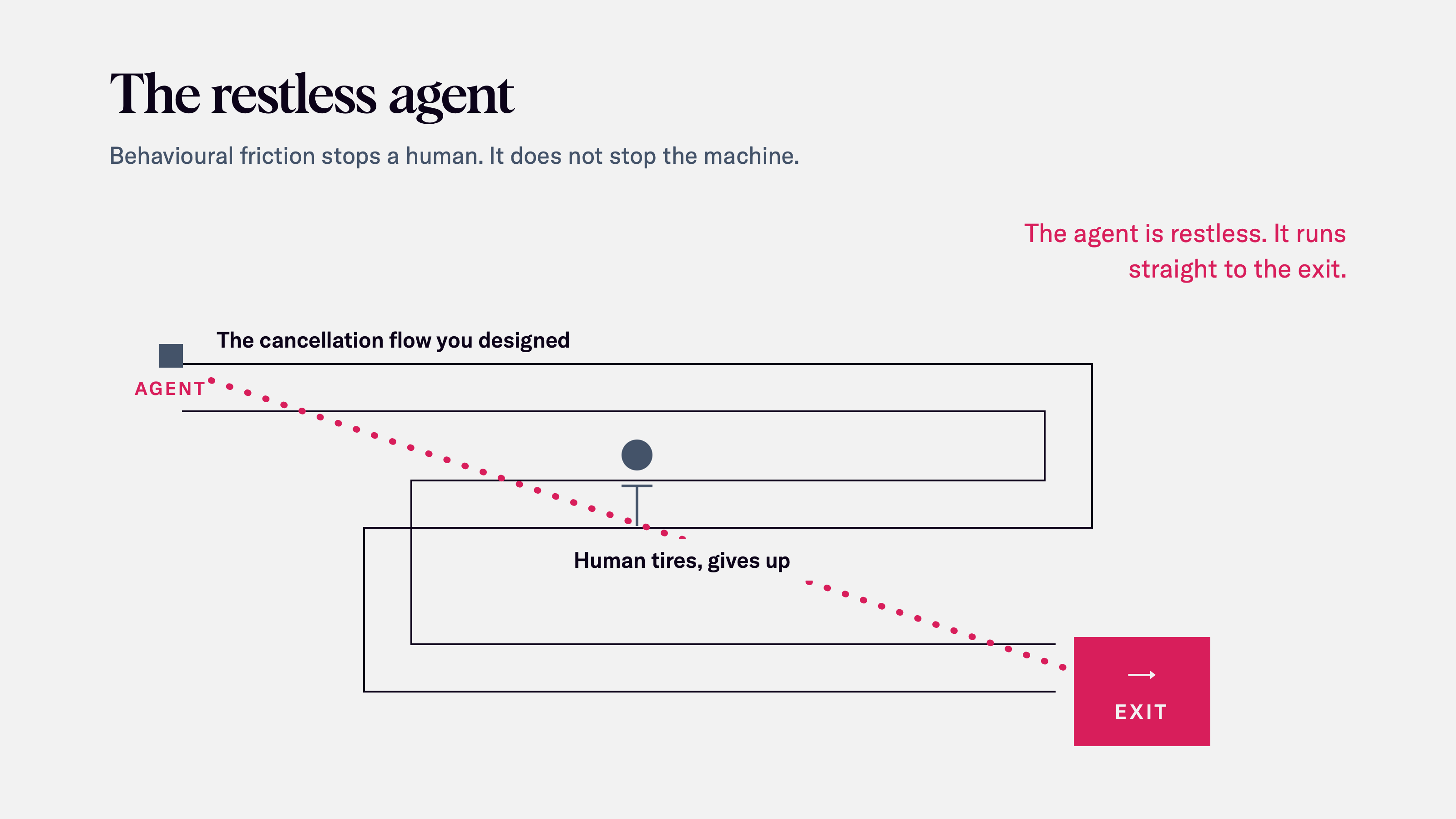
Fernández's team researches what happens to behavioural science when an intelligence layer sits between company and customer. User experience has run on behavioral economics for years: friction added where firms want you to give up (the telecommunications cancellation labyrinth), friction removed where they want you to buy. The design works because humans tire.
"If I have an agent, I have a personal agent dealing for me with that process, it's restless. It will happen."
A machine negotiating on the customer's behalf is immune to dark patterns, indifferent to interface polish, endlessly patient, and able to directly interact with software systems through APIs. As my previous guest, MAPFRE's Carlos Cendra, argued, systems built for humans browsing are not ready for machines transacting. Fernández adds the corollary: influence itself must be rethought when the decision maker is the agent the customer trained.
That capability lets the agent automate complex procedures with external tools rather than just browse interfaces.
This is the agentic frontier of customer experience. When persuasion by friction dies, the only retention strategy left is being demonstrably worth staying for.
The Four Insights That Reframe Human-Agent Collaboration for Insurers
1. The Trust Dilemma Is a Laziness Problem Before It Is a Technology Problem
Humans over-trust machine output because energy conservation is written into our biology, and agentic AI makes that shortcut cheaper than ever.
When a system produces an answer that is more or less okay, we take it and move fast, because the productivity curve always demands more.
"Human beings are lazy by default. I mean, and it's not bad because it's survival mode."
The Data and AI Impact Report, commissioned by SAS and discussed with Economist Impact in January 2026, finds that only 9% of insurers combine high trust in AI with strong, trustworthy AI capabilities. Over 40% sit in the trust dilemma, underusing reliable systems or overrelying on unproven ones. Her corrective: judge the output, question the process, verify the answer. Measure success with task success rates and consistency of outcomes.
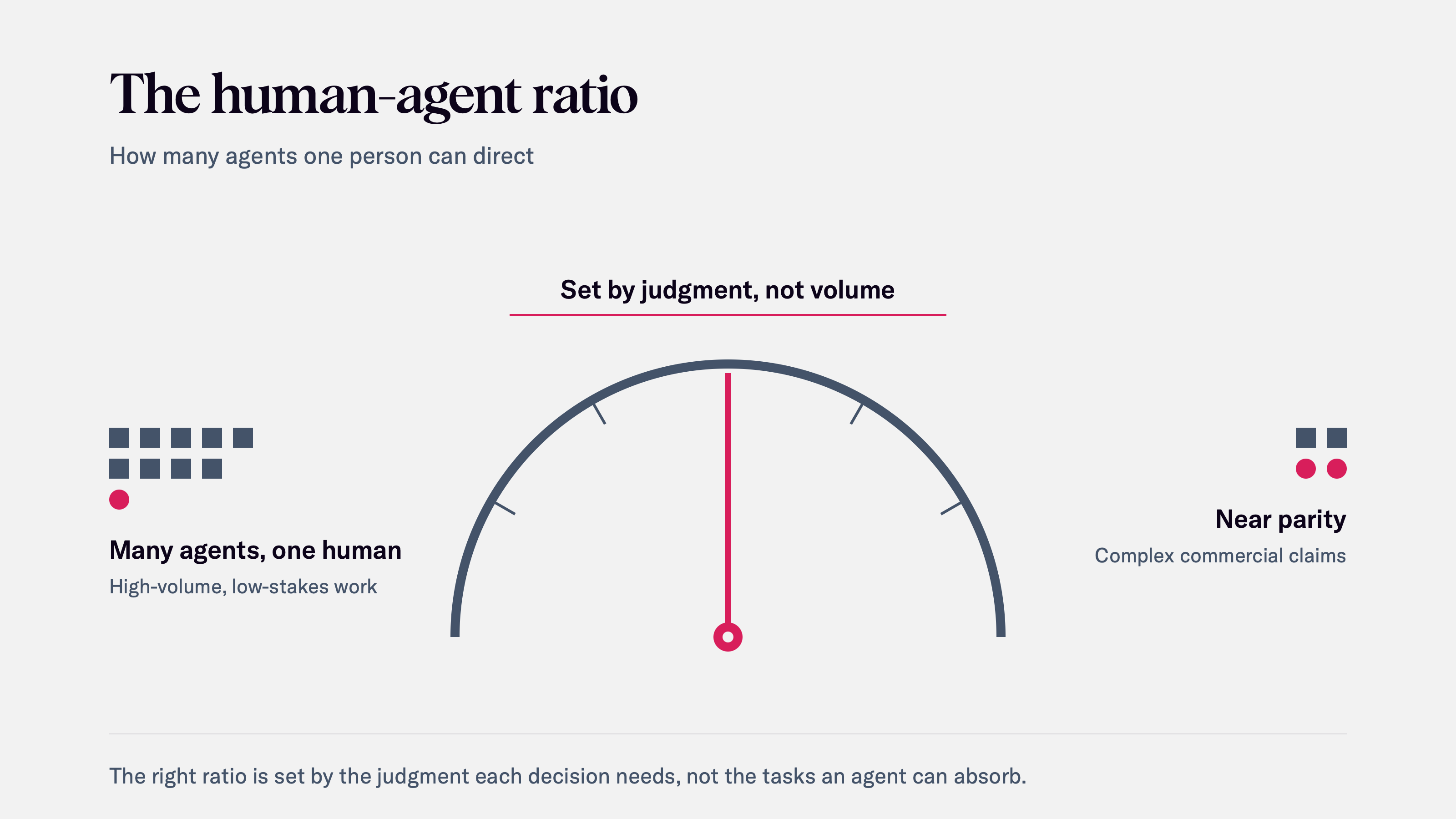
This is the Human-Agent Ratio question stated in behavioral terms. The right ratio for a workflow is determined by how much human judgment the decision requires, not by how many tasks the agent can absorb.
2. Your Personal Agent Inherits Your Biases Unless You Train It Otherwise
The biases insurers spent years detecting in humans are about to arrive pre-packaged inside the customer's agentic AI assistant.
Fernández poses the question customer strategies have not caught up with:
"Am I going to be training my own assistant? Is it going to have the same biases that I do have or am I going to train that in order to avoid those biases?"
Today humans keep the final decision: your agent searches, you choose. The direction of travel is delegation, the world MIT CISR's Customer Proxy and Orchestrator models describe. Insurers then face a double bias audit: their own models and the customer's agent, before a single quote is exchanged.
This is Intelligence Layer work, on both sides of the transaction. Whoever understands the machine's behavior, not only the human's, designs the interaction that wins.
3. Prediction Turns Insurance Into Prevention, and Prevention Breaks the Operating Model
Predictive, contextual, always-on insurance depends on AI systems that can monitor real-time data for anomalies, so it stops being indemnity and becomes prevention, which is why the industry keeps describing this future rather than building it.
If insurers are truly predictive, they act before the loss, turning the product into a prevention service and rewriting the operational model underneath it; to do that, these systems need reliable data foundations and connected data sources so they can act in context before a loss occurs.
"We've been discussing this for years. It's not happening really because it's tremendously difficult to change operational model."
The frontier is easy to describe, she says, and hard to make happen, because you are changing a very big structure that has worked extremely well for years.
This is Frontier transformation named from inside an incumbent. The obstacle is not imagination or technology; it is the excellence of the machine you already run.
4. When Intelligence Is a Utility, Critical Thinking, Decision Making, and Emotion Become the Premium
Abundant, near-free intelligence makes the ability to ask difficult questions the scarcest organizational resource, especially as Gen AI gives cheap answers while agentic systems take on more complex tasks.
Microsoft's 2025 Work Trend Index describes the consequences of intelligence on tap: Frontier Firms, where every employee becomes an agent-boss. Fernández names what humans must bring.
"We need to train a lot our critical thinking. We really need to find the proper questions, ask difficult questions."
Large language models can support the reasoning stage and help shape a plan, but humans still need to challenge the decision-making.
Orchestrating agents starts with why: you cannot direct a fleet of machines toward a goal you have not questioned. Her second premium is one machines only simulate: emotion. In Spain, she notes, with an unofficial caveat, that around 40% of users name their ChatGPT. People want to connect, even with machines. The machine feels nothing back.
This is workforce transformation measured in judgment, not headcount. The agent boss era pays for the questions humans ask, not the answers machines already sell for cents.
What Insurance Operators Should Do About Human-Agent Collaboration This Quarter
Four moves: audit your friction, set ratios by judgment, train the challenge habit, and pilot prevention on one risk line.
-
Run a friction audit in the next two weeks. Map every point where retention depends on customer fatigue: cancellation flows, claims chasing, renewal inertia. Then have an agentic AI assistant attempt each journey; whatever it completes effortlessly was revenue resting on friction.
-
Set a human-agent ratio per workflow, calibrated to judgment, before the next board cycle. High-volume, low-stakes tasks can run many agents per person; complex commercial claims may justify near parity, because judgment and empathy are the product, and autonomy should be bounded with approval required for high-impact actions.
-
Institute a weekly challenge hour this month. One hour, one team, one AI-produced decision, interrogated end to end: what data, what assumptions, what would make it wrong, with continuous feedback loops to preserve reliability over time. Critical thinking is trained, not assumed.
-
Pilot one prevention-led proposition on a single line this quarter. Pick a risk where prediction is credible (water damage, fleet telematics, cyber hygiene), act before the loss for a defined cohort, and measure loss frequency against control. Prevention arrives as a gated pilot with defined exit criteria, not a big-bang change. The same approach can also automate loan approvals in banking and reduce transaction costs, which helps justify enterprise investment beyond insurance.
Robust governance frameworks, reliable data foundations, and clear management account for most implementation work in organizations, with roughly 80% tied to governance tasks and to demonstrating the benefits.
The Passivity Question for Insurance Leaders
The gap Fernández exposes is not a technology gap. It is a passivity gap: the distance between using agentic AI and being used by it, between orchestrating machines toward a questioned goal and approving whatever comes back.
She feels the discomfort personally. Asked what her children should study, the woman whose job is to look at the future admits she does not have a clue. Years ago the answer was coding. Now nothing is sure, and the honest response is the one she practises: stay curious, keep learning fundamentals, and train the judgment to challenge what the machine asserts.
That posture, curious, critical, and demonstrably trustworthy, is what the next decade rewards, in people and companies alike.
When your customer sends a restless agent to deal with you, what will it find: demonstrated value, or designed friction?
Want to talk about it? Just set up a call with me here.
Frequently Asked Questions
What does it mean that trust in agentic AI cannot be designed?
Bárbara Fernández of MAPFRE distinguishes trustworthy systems from trust itself. Companies can engineer trustworthy agentic AI through bias control, observation, and guardrails, but trust between a company and a customer is only demonstrated, interaction by interaction. Trust takes years to build and one interaction to destroy.
Why do dark patterns and friction-based design fail against AI agents?
Friction-based design works because human customers get tired and give up: on cancellations, claims, comparisons. A personal agentic AI assistant acting for the customer is restless and completes the process regardless of how many steps a company adds. Fernández warns influence must be rethought when the customer's agent decides.
What is the human-agent ratio in insurance?
The human-agent ratio describes how many AI agents one person directs in a workflow, a concept popularised by Microsoft's 2025 Work Trend Index. Agentic AI typically begins with a perception stage focused on collecting data. Mundane workflows may run dozens of agents per person; complex commercial claims may need one person for every few agents, because judgment and empathy are the product. The reasoning stage uses LLMs to develop action plans, while the learning stage improves performance through reinforcement learning.
What is the premium human capability in an agentic AI world?
Critical thinking, according to Bárbara Fernández of MAPFRE: finding the proper questions and asking difficult ones, especially of machine output that seems good enough that people barely question it, which is why critical thinking matters. She pairs it with emotion, which machines simulate but never possess. Stanford's AI Index records inference costs down 280-fold in two years: answers are cheap, judgment is scarce.
How does predictive insurance change an insurer's operating model?
Prediction turns insurance from indemnity into prevention: acting before the loss rather than paying after it. Fernández argues this completely changes the operational model: the industry has discussed prevention for years without delivering it, because structures that have worked extremely well for decades are the hardest to rewire.
References
MAPFRE at Insurtech Insights Europe 2026 with Bárbara Fernández on disruptive innovation
MAPFRE's Navigating Tomorrow: four scenarios for a society embracing generative AI
SAS and Economist Impact on the insurance trust dilemma and the 9% finding
Stanford HAI AI Index 2025 on the 280-fold fall in inference costs
Microsoft 2025 Work Trend Index: the Frontier Firm, intelligence on tap, and the agent boss
MIT CISR research on AI-era business models, including the Orchestrator
Editor in Chief

Rebuilding Risk Resilience