Frontier Operating Model Risk Now Sits With Your Vendor: Majesco
Sep 07, 2026
Written by Sabine VanderLinden
Majesco did not put zombie InsurTechs on its 2026 trends list to win a competitive bake-off. Denise Garth, Majesco's Chief Strategy Officer, borrowed the term from private equity because the software partner beneath your Frontier Operating Model is now a risk line most boards never price. AutoRek research from March 2026 found 82% of insurers expect AI to dominate the industry's future, and 14% have integrated it. Under the NAIC's model bulletin, accountability for a vendor's AI never leaves the insurer.
Three things to take away
- A partner who stops investing takes your operating model down with them. Garth's old test was whether a supplier could implement and support. Her test now is whether they will still be funding architectural change in three years. Vendor irrelevance has replaced implementation failure as the primary technology risk.
- Buying more AI will not close the 68-point gap. Redesigning the business will. AutoRek's 2026 Insurance Report, built on 250 interviews across the UK and US, put belief at 82% and integration into financial operations at 14%. No insurer, in Garth's assessment, yet qualifies as a full orchestrator.
- Your vendor's AI failure lands on your examination report, not theirs. The NAIC's model bulletin requires written standards for third-party AI, due diligence records, and audit rights in contracts. Buying AI does not move the obligation.
Why Your Software Partner Is Now a Line of Risk on Your Balance Sheet
The riskiest thing in most insurers' AI programs is not a model that misbehaves. It is a core platform partner who can no longer afford to keep building.
Garth writes Majesco's annual trends paper. Through late 2025, she kept meeting the word zombie in private equity commentary, describing companies carrying debt they could no longer service, and translated it into insurance. Majesco's December 2025 trends report named zombie InsurTechs as one of eight disruptive trends: providers without the financial fortitude to invest in cloud and AI-native architectures. By the July 2026 halftime update, the language had hardened: InsurTechs selling at lower valuations, borrowing at higher rates, selling assets in fire sales.
"We always looked at risk as can they implement, can they continue to support? I think the risk today is are they even going to be relevant and then I become irrelevant and that becomes the insuretech zombie."
This is Risk Futures pointed at your own supplier list. Vendor solvency used to be a procurement footnote. Inside a Frontier Operating Model, it is a five-year strategic exposure.
The 68-Point Gap Is a Leadership Problem, and No Insurer Is Yet a Full Orchestrator
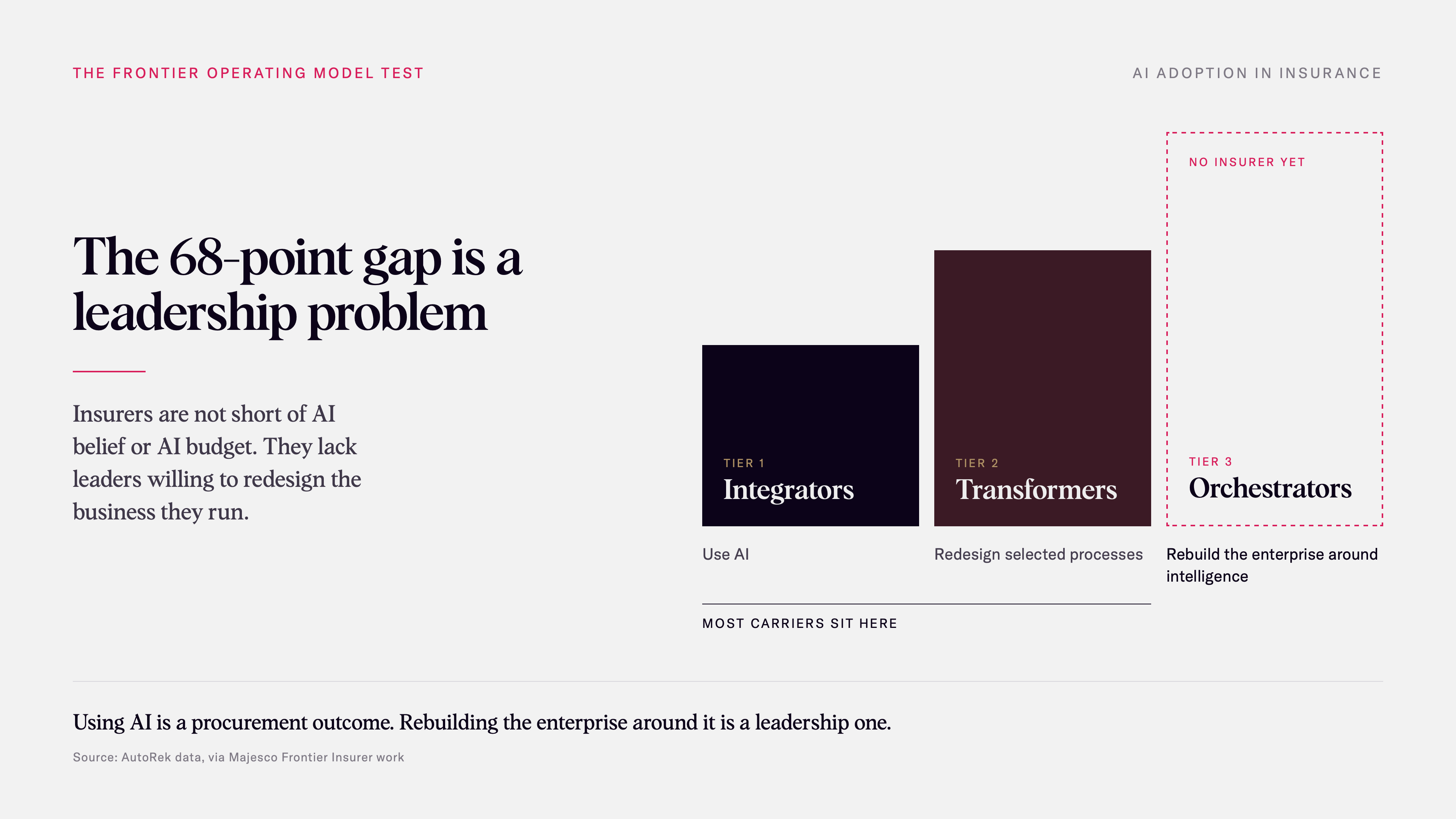
Insurers are not short of AI belief or AI budget. They lack leaders willing to redesign the business they run.
Majesco carries AutoRek's numbers into its own Frontier Insurer work. The framing Garth and I use on stage sorts carriers into three tiers: integrators who use AI, transformers who redesign selected processes, and orchestrators who rebuild the enterprise around intelligence. Most sit between the first two, and some expense-ratio gains announced to investors are headcount cuts rather than redesign.
"But over the long term, somebody else is going to jump ahead of you because they're going to look at it from an orchestration standpoint and rethink."
This is the Frontier Operating Model test, and almost nobody passes it yet. Using AI is a procurement outcome. Rebuilding the enterprise around it is a leadership one.
The Four Insights That Reframe Vendor Selection for a Frontier Operating Model
1. Four Kinds of InsurTech Are Running Out of Road
Garth's zombie category is a financial diagnosis, not a judgment on product quality.
Private-equity-backed firms bought at high multiples carry debt that became unaffordable as rates rose. Venture-backed InsurTechs raised when money was cheap, spent it, and now face investors demanding profit. Legacy providers never made the move to cloud. The fourth is the quiet one: founder-led companies with 20 to 40 customers, profitable for decades, now facing an AI bill for data scientists, data foundations, and a rebuild.
"So you've got to cut costs, you got to cut investment in R and D. You've got to cut a lot of different things."
This is the Intelligent Core question asked financially rather than technically. Whether a partner can build one depends on their capacity to fund it for a decade.
2. Feature Parity Is Dead as a Selection Criterion, and Procurement Has Not Noticed
Core platform vendors have reached rough feature parity, so a selection process built around best feature and function now selects for the wrong thing.
Garth's replacement criteria are financial strength, demonstrated R&D investment, and whether the customer can absorb upgrades fast enough to benefit. Why the old frame survives is behavioral. Garth calls it recreating the cow path: teams rebuild the route they know because it meets less resistance and people feel safer. A feature matrix feels objective and asks nobody to judge a supplier's next decade. She adds two seats rarely in the room: the Chief Strategy Officer and the Chief Risk Officer, because a cost-benefit frame prices neither.
"It's really what's their financial fortitude, what's their ability to invest? Are they demonstrating that investment? Are they demonstrating that innovation?"
The test is uncomfortable for the people proposing it. Majesco is a Thoma Bravo portfolio company and funded its November 2025 Vitech acquisition with a unitranche facility. Private equity ownership and debt do not make a supplier a zombie. They make it a test you run with numbers, on every partner, including hers.
This is venture clienting discipline in reverse. You are not scouting the best demo. You are underwriting a counterparty for the next decade.
3. An Intelligent Core Is an Audit Requirement Before It Is a Product Preference
Embedded and bolt-on stopped being an architecture preference the moment regulators began asking insurers to evidence each AI-assisted decision.
The NAIC model bulletin is live in roughly half of US states, and EU AI Act transparency obligations took effect on 2 August 2026. Garth recalls a panel with Jim DeMarco, Microsoft's Director of Insurance Strategy for Worldwide Financial Services, where an insurance executive named auditability as the real obstacle to AI. DeMarco asked whether he had it today, given how much of his organization ran on legacy and manual steps. The executive conceded.
"If you got a bolt on, they're going to come in and do something and go out. But then you don't have transparency."
This is the Intelligent Core earning its name. Governance inside the workflow produces a record. Governance beside it leaves a gap, and that's where Reggie Townsend of SAS comes in.
4. The Frontier Winners Will Be Mid-Tier, Mutual, and Private-Equity-Backed
The insurers most likely to rebuild around intelligence first are the carriers small enough to change and patient enough to try.
Very large groups carry complexity, politics, and silos, sometimes a dozen policy systems doing one job. Mid-tier carriers run one. Mutuals don't report quarterly earnings, so they have a longer horizon. Private-equity-backed carriers holding assets beyond the usual three-year flip think structurally too. One Majesco customer, a carrier with roughly $ 100 million in assets, rethought its operating model and saw its AM Best rating rise from B+ to A.
"In the next three to five years, there will be an insurance company that will reduce its expense ratio substantially, I think up to 20 points."
This is the Frontier Firm arriving from an unexpected direction. Scale buys resources, and it buys inertia, which a Frontier Operating Model cannot absorb.
What Insurance Operators Should Do About Vendor Risk This Quarter
Four moves: score your partners financially, put the Chief Risk Officer in the selection room, evidence your third-party AI, and rebuild one process.
- Run a financial health review of your top five software partners in the next two weeks. Ownership, debt position, published R&D investment, release cadence across eight quarters, and their last architectural change. One page per vendor, filed with your AI model inventory and refreshed annually, because a supplier's position moves.
- Add the Chief Risk Officer and the Chief Strategy Officer to platform selection before your next RFP closes. A cost-benefit frame prices implementation risk and ignores relevance risk. A supplier who cannot fund the next architecture is a strategic exposure, not a purchasing decision.
- Evidence your third-party AI before an examiner asks. Written standards, due diligence records, and audit rights must exist for every vendor-supplied model in production. If they do not, that gap is this quarter's work.
- Rebuild one process rather than automating it, and benchmark it with and without the agent. Majesco benchmarks each agent against the same workflow run without it, so a customer sees what their tokens buy. Pick a process where employees feel relief immediately, because cultural resistance kills the second pilot. Carlos Cendra of MAPFRE agrees.
The Solvency Question for Insurance Leaders
The gap Garth exposes is not technology or budget. It is a solvency gap on the other side of the contract: most insurers cannot say which partners can still afford to build.
She is not fatalistic. Asked for one word on the industry, she chose hope. Preparing for Majesco's customer conference she traced AM Best's top twenty carriers across four decades, through the mainframe era, the internet, the financial crisis, and cloud. The industry came through every one. Not every company did.
Her insistence throughout was that AI should elevate people into knowledge work rather than thin the payroll. That standard applies to suppliers as much as staff.
Listen to the full conversation with Denise Garth on Scouting for Growth.
When your board next reviews AI risk, will anyone be able to say which of your software partners can still afford to build?
Want to talk about it? Just set up a call with me here.
Frequently Asked Questions (FAQs)
What is a zombie InsurTech?
A zombie InsurTech is a provider that can no longer fund the investment to stay relevant. Majesco's 2026 trends research, authored by Denise Garth, names four types: indebted private-equity-backed firms, venture-backed InsurTechs without a path to profit, legacy providers that never moved to the cloud, and founder-led companies facing an AI bill they have never carried.
Who is accountable when an insurer uses a vendor's AI system?
The insurer. The NAIC model bulletin requires written standards for acquiring third-party AI, due diligence records, and contract terms covering audit rights and regulatory cooperation. Liability does not transfer through a procurement contract, so a vendor attestation covers their product, not your deployment.
What is the difference between an integrator, a transformer, and an orchestrator?
An integrator uses AI inside existing processes. A transformer redesigns selected processes around AI. An orchestrator rebuilds the enterprise around intelligence, connecting data, core platforms, people, and decisions. Garth argues most carriers sit between the first two tiers.
How should insurers change their software selection criteria for AI?
Move beyond feature and function comparison, close to parity across core platform vendors. Assess financial strength, R&D investment, release cadence, and whether your organization can absorb upgrades quickly. Bring the Chief Risk Officer and Chief Strategy Officer in.
Why does embedded AI matter more than bolt-on AI for insurance regulation?
Embedded AI sits at the platform level, so decisions, data, and agent actions land in one auditable record. Bolt-on AI runs beside the process and leaves gaps where evidence should be. That record is what examiners ask for.
References
Majesco 2026 trends on zombie InsurTechs
AutoRek 2026 Insurance Report on insurer AI adoption
Quarles on NAIC bulletin adoption and vendor diligence
Majesco closes the Vitech acquisition under Thoma Bravo
Editor in Chief

Rebuilding Risk Resilience