Frontier Operating Model: Why Brokers Are Beating Big Carriers
Aug 12, 2026
Written by Sabine VanderLinden
Carriers report implementation. Brokers report hours. In 2026, that difference is worth 43 points of revenue growth, and clients have started switching over it.
Key Takeaways
Key Takeaways
Brokers are beating big carriers because they adopted a Frontier Operating Model sooner: AI is embedded in live workflows, venture-client partnerships move from test to deployment within weeks, and governance runs at deployment speed rather than committee speed. For insurance executives, innovation leaders, CIOs, Chief Underwriting Officers, brokers, carriers, and venture-enabled firms seeking to turn AI spend into revenue growth, the gap is now evident in hours saved, client preferences, and market share.
- The gap is now measured, and it is not about spend. Grant Thornton’s 2026 AI Impact Survey, fielded to 950 business leaders from 23 February to 18 March 2026, with a 100-respondent insurance subgroup, found that organizations with AI fully integrated into live workflows are nearly four times more likely to report revenue growth than those still piloting: 58% versus 15%. Grant Thornton calls the shortfall the “AI proof gap.” Only 24% of insurance executives are very confident they could pass an independent AI governance review within 90 days.
- Brokers moved first, and the numbers are on a human scale. Marsh McLennan launched its internal assistant LenAI in November 2023, built by its Dublin Innovation Center with Oliver Wyman Digital, to 90,000+ employees. It now handles 700,000+ queries a week and saves an estimated one million hours a year; early adopters self-report about 8 hours back per week. Across the US agency market, 64% now run AI in at least one live workflow, up from 38% in 2024 (Perspective AI, May 2026), led by quoting at 71%.
- The market has started pricing the difference. Zywave’s 2026 Broker Services Survey of more than 1,400 US employers, released in late July 2026, found that “failure to leverage modern technology and AI-powered tools” entered the top reasons employers would change brokers for the first time. That shift is giving brokers and managing general agents a competitive advantage over large carriers because the Frontier Operating Model, decoupled workflows, venture-client partnerships, and governance that moves at the speed of deployment, turns AI capability into visible client value.
In November 2023, Marsh McLennan gave 90,000 people an AI assistant at once.
It was called LenAI, built in Dublin with Oliver Wyman Digital on privately hosted models, and it went to the whole firm: not a lab, not a cohort, not a center of excellence with a steering group and a quarterly readout. Everyone. Today, it handles more than 700,000 queries a week.
The number that matters, though, is much smaller than that. Early adopters within Oliver Wyman report getting back about 8 hours a week.
Eight hours. A full working day, returned to one person, every week, for three years now. Multiply that by the people around them, and you arrive at the firm’s own estimate: roughly 1 million hours a year. But start with the eight, because that is where the advantage actually lives: not in the license, not in the architecture diagram, in somebody’s Tuesday.
Now ask what your own people got back this year.
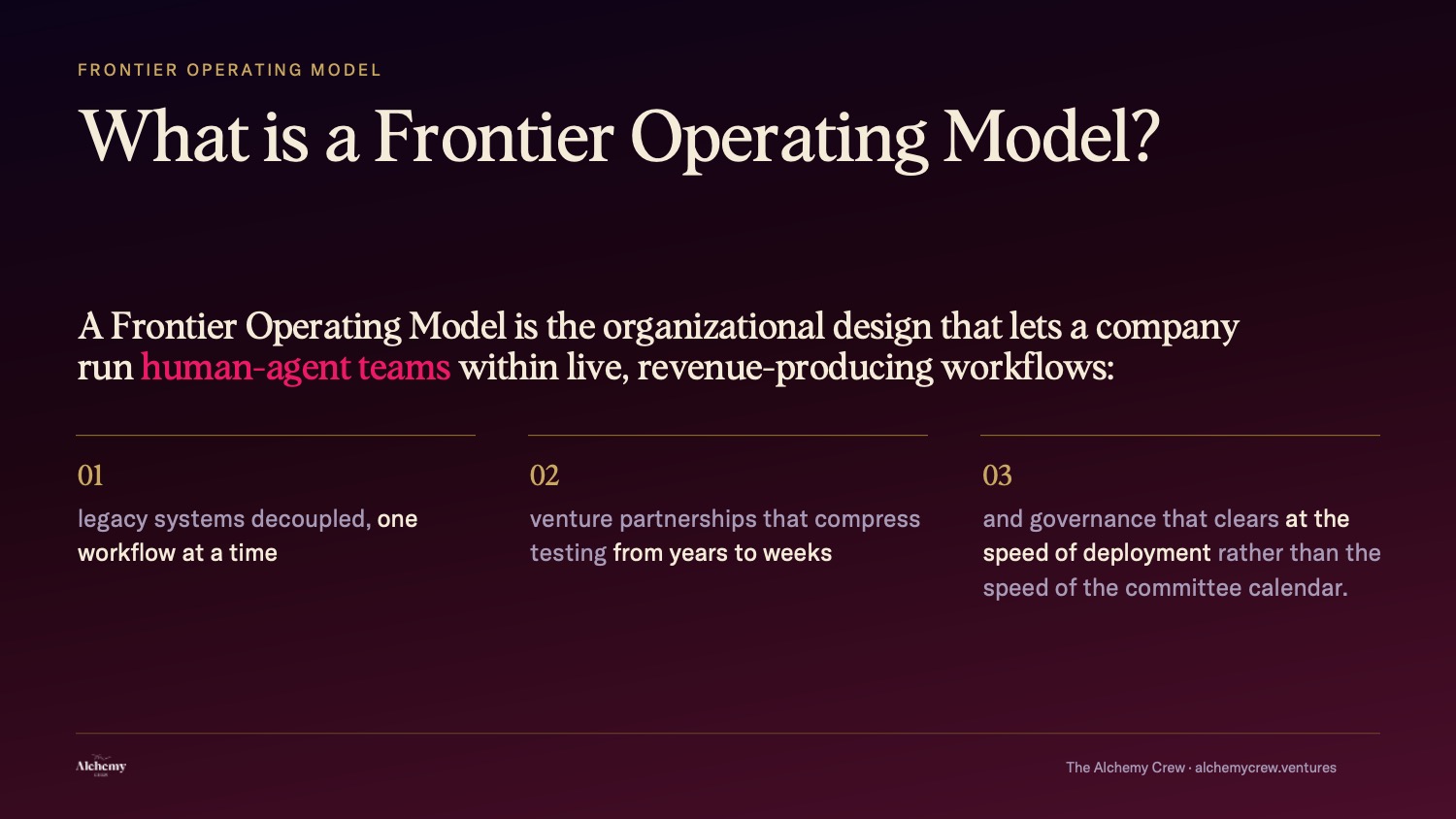
What is a Frontier Operating Model? A Frontier Operating Model is the organizational design that lets a company run human-agent teams within live, revenue-producing workflows: legacy systems decoupled, one workflow at a time; venture partnerships that compress testing from years to weeks; and governance that clears at the speed of deployment rather than the speed of the committee calendar.
This piece examines the model, the broker-carrier AI adoption gap, venture-clienting methods such as DIVAAA and our venture-clienting framework, governance friction, rising client pressure for modern tools, and the practical steps to move quickly without getting trapped in implementation theater. It is what converts AI spend into operating advantage. It is also measured in hours returned, not tools deployed.
The gap has a number now, and it is 43 points
For two years this argument has been made with adjectives. It no longer has to be.
Grant Thornton’s 2026 AI Impact Survey, 950 business leaders across ten industries, fielded between 23 February and 18 March 2026, with an insurance subgroup of 100, found that organizations which have fully integrated AI into their workflows are nearly four times more likely to report revenue growth than those still piloting: 58% against 15%. Grant Thornton named the condition the “AI proof gap.”
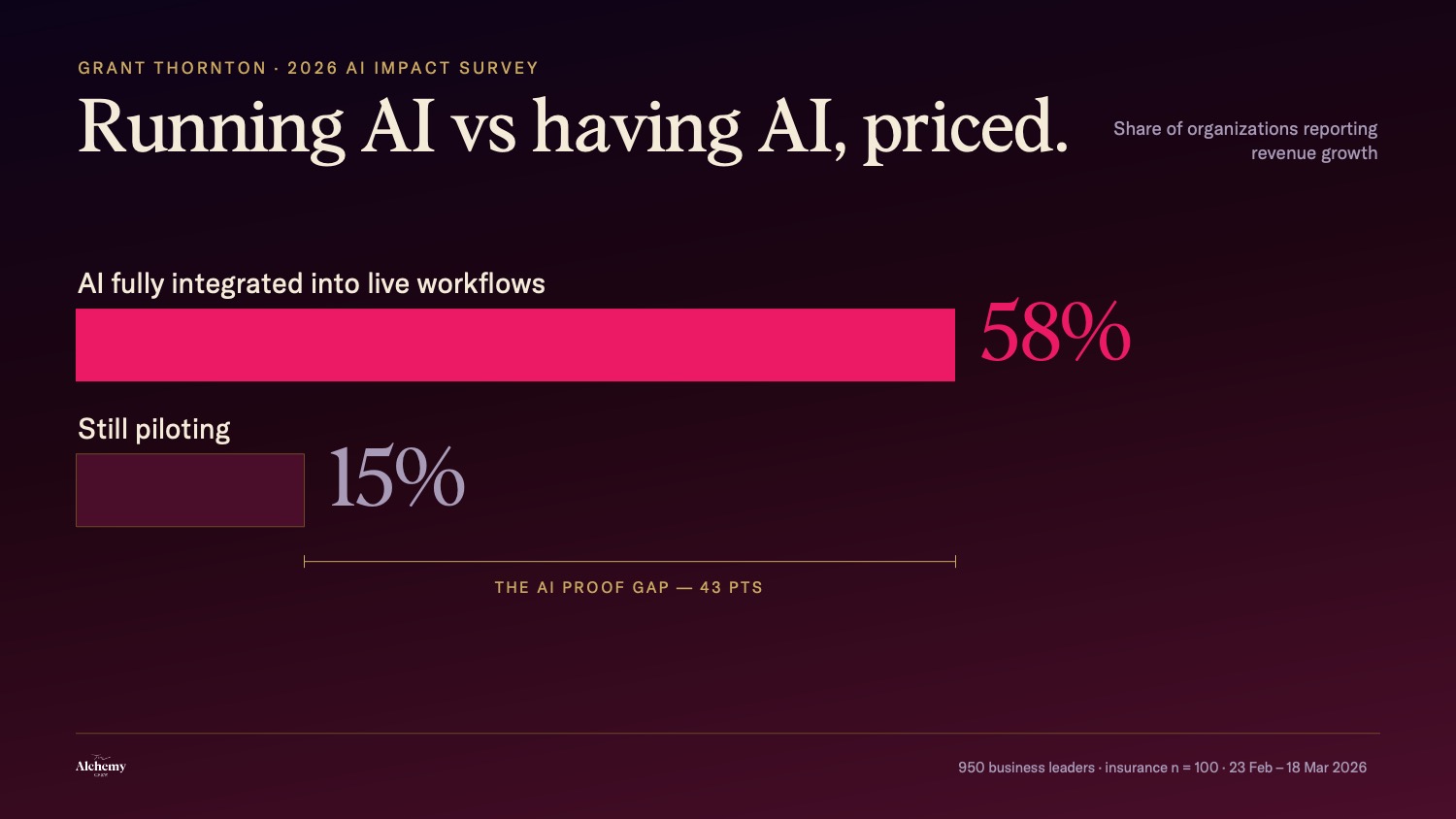
43 percentage points. That is the distance between adoption and implementation, priced.
And the governance finding underneath it is the one that should be read twice: 44% of insurance executives said governance or compliance problems had contributed to an AI project failing or underperforming, and only 24% were very confident they could pass an independent AI governance review within 90 days. Three-quarters of the industry is running AI it could not currently prove it controls.
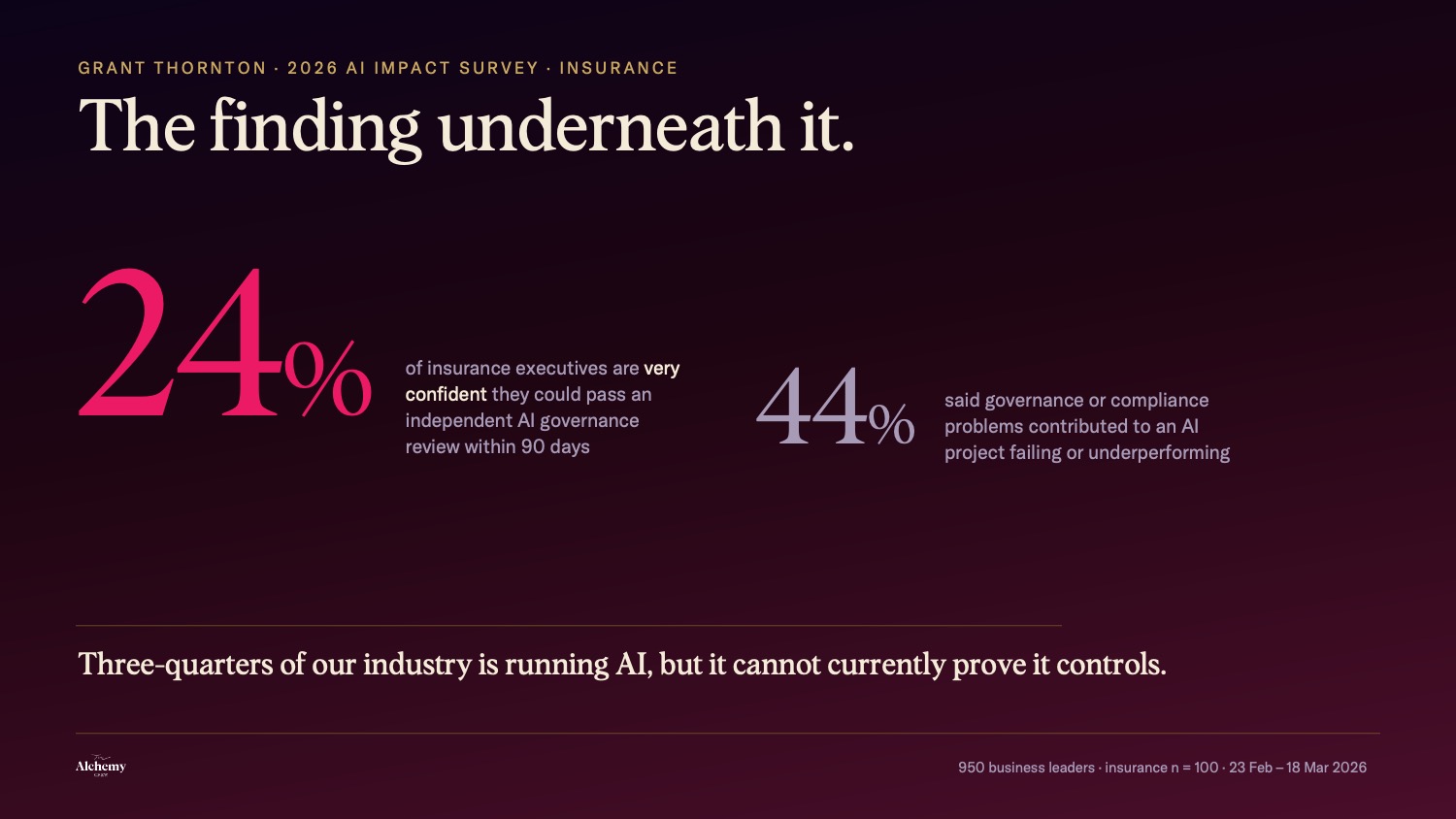
This is clearly an operating-model problem wearing a technology problem’s clothes.
Insurance carriers report implementation. Brokers report hours.
Look carefully at what each side is actually counting, because the two industries are answering different questions and reporting the answers as though they were the same.
Deloitte’s survey of 200 US insurance executives, fielded in June 2024, found 76% had implemented generative AI in at least one business function, rising to 91% among carriers above $10 billion in revenue and falling to 58% in the $100m to $500m band. Set that against Perspective AI’s May 2026 report: 64% of US agencies now run AI in at least one live workflow, up from around 38% in 2024, led by quoting at 71%, lead intake at 58%, claims handling at 49% and customer service at 44%.
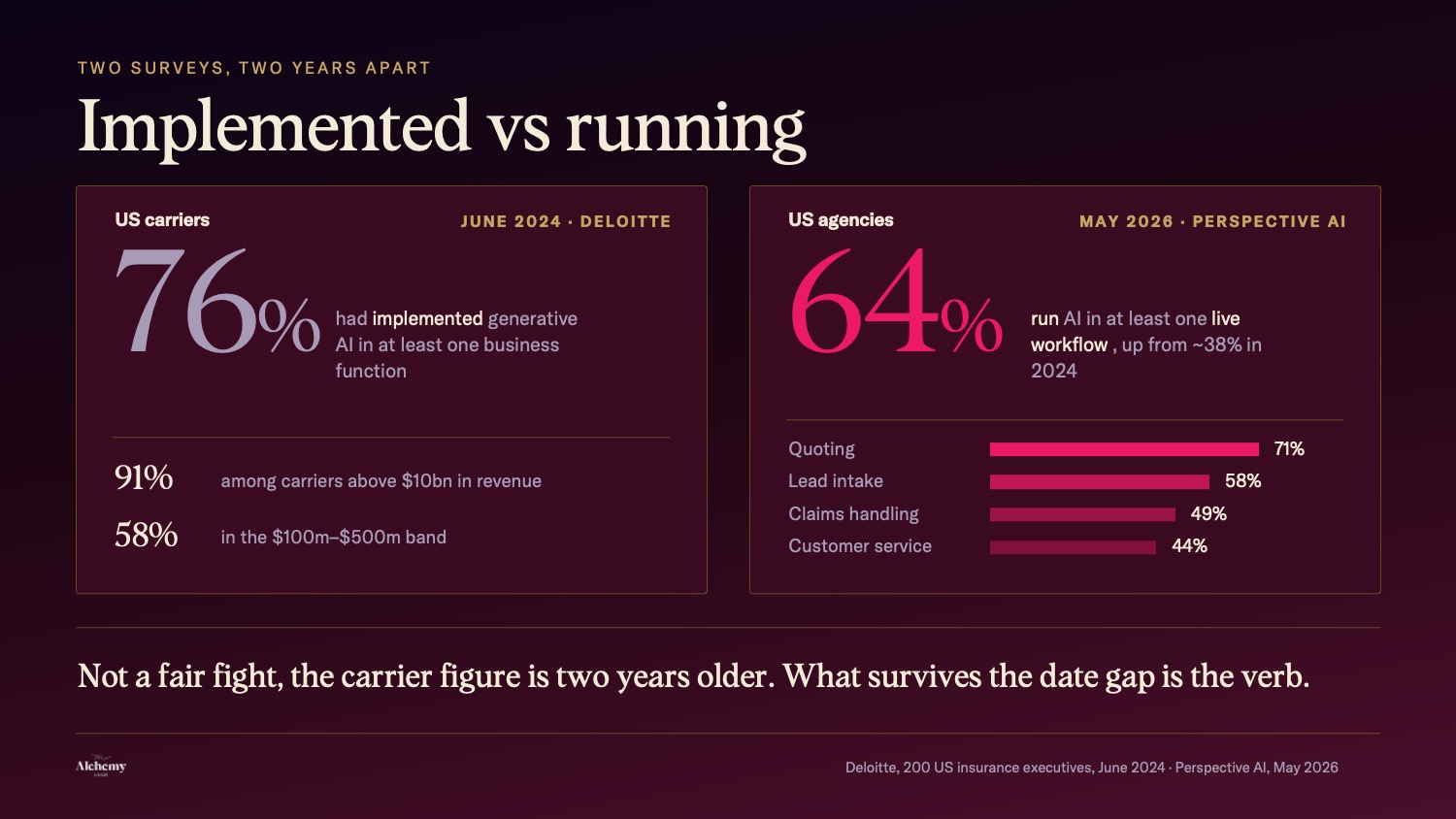
I am not going to pretend those two numbers are a fair fight. The carrier figure is two years older, and anyone setting them side by side as a snapshot is selling something. What survives the date gap is the verb.
“Implemented in at least one business function” is a status. It is satisfied by a proof of concept, a governance framework, a signed license, a completed pilot, a press release. “Running in at least one live workflow” is a location. It says where the thing is: inside quoting, inside intake, inside the work that produces revenue on a Tuesday afternoon.
One shows up on the expense report. The other shows up in the 58%.
And the size data kills the last comfortable excuse. Adoption among agencies with more than 25 producers runs at 91%: the same figure Deloitte recorded for $10bn+ carriers two years earlier. Scale is not the constraint. Nobody with a large balance sheet is being held back by the balance sheet.
If you lead innovation inside a carrier, none of this is news to you: it is your week. Innovation theater is exhausting. Orphan pilots are demoralizing. You have watched good ventures die in procurement and presented the same use case to three successive committees, each of which asked for the deck to be shortened. The conviction was never missing. What is missing is an operating model that does not treat every single deployment as an exception requiring its own act of parliament.
What Frontier transformation looks like at the renewal desk
Here is the shape of it, at the scale where it is actually felt.
A regional brokerage put an AI workflow across roughly 3,200 renewing commercial accounts. Standard renewal triage had scored the book and flagged the risky ones. The workflow read the same book and surfaced 287 accounts at risk that the triage had scored green, accounts nobody was going to call, because the process said they were fine. Producers called them. 71% were retained. Retention on the book rose 9 points.
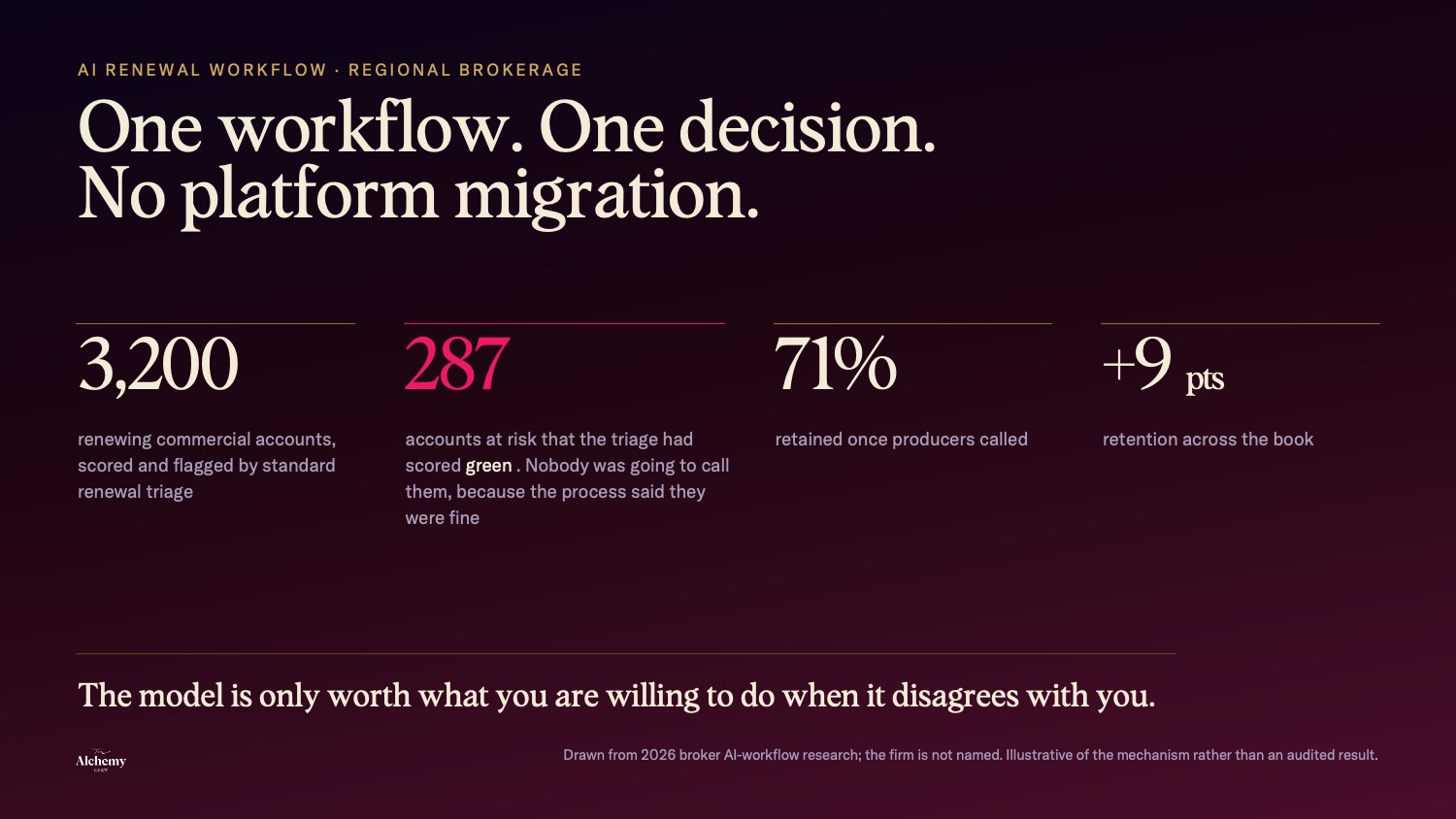
(Sourcing note: this case is drawn from 2026 broker AI-workflow research, and the firm is not named. Treat it as illustrative of the mechanism rather than as an audited result.)
Nothing in that story required a platform migration. It required one workflow, one decision to let a system read the book, and a willingness to act on an answer that contradicted the existing process. That last part is the whole Frontier Operating Model in a sentence: the model is only worth what you are willing to do when it disagrees with you.
Those 287 accounts existed inside every brokerage running the same triage. Most of them are still sitting there, still green.
The Frontier Firm route runs through the venture client model
Carriers do not need to become brokers. They need to borrow the broker’s operating logic, and there is a proven mechanism for doing exactly that without a transformation program.
The venture client model, taken to industrial scale by corporations such as BMW’s Startup Garage, Zurich Innovation Championship and ERGO ScaleHub, has one defining move: the corporate becomes a paying client of a young venture’s technology inside a real workflow, first and fast, before the strategic review, not after it. No equity, no committee, no 18-month integration. A purchase order and a problem.
Applied to insurance, that means decoupling one workflow from the legacy core and letting vetted ventures run AI microservices against it under production conditions, mirroring the venture-client and ecosystem plays highlighted at the Global Insurtech Summit on the industry’s digital future. This is the discipline our DIVAAA™ pathway enforces: validation gates that move a venture from pilot to production contract on evidence rather than enthusiasm, so pilots stop being theater and start being procurement.
The prize is the Frontier Firm profile, based on Microsoft’s 2025 Work Trend Index, measured across 31,000 workers in 31 countries: employees at Frontier Firms were 71% likely to say their company is thriving, compared with a 37% global average, and 55% likely to say they could take on more work, compared with 25% globally.
Human-agent teams handle triage, drafting, and reconciliation, allowing AI to take on routine tasks while humans provide empathy-led, high-value claims and service experiences. Underwriters and claims professionals concentrate judgment where it compounds, positioning their organizations to compete with agentic frontier firms powered by AI coworkers.
Firms structured this way test faster, learn faster, and compound faster. Firms that are not will discover that scale without speed is just weight, a pattern explored in depth in our analysis of why many AI strategies and startup collaborations stall.
The playbook: four moves this quarter
-
Pick one revenue-adjacent workflow and give it a 90-day production deadline. Quoting, submission triage, renewals. Not a sandbox. Production, with guardrails. Then hold the date as you would for a regulatory deadline.
-
Stand up a venture client lane. One page of terms, one accountable commercial owner, 30 days from first meeting to paid pilot. If procurement takes longer than the pilot, fix procurement first; that is the project.
-
Measure hours returned, not pilots launched. Ask your COO for one number every Friday: how many revenue workflows ran with agents in the loop this week, and how many hours came back. A number that arrives weekly changes behavior; a quarterly dashboard changes slides.
-
Book the governance review before you need it. Grant Thornton found only 24% of insurance executives are very confident they could pass an independent AI governance review inside 90 days. Find out which quarter you are in now, while the answer is still cheap and private.
What this costs, in the only currency clients use
The uncomfortable part of the Zywave finding is not the statistic. It is where the statistic gets delivered.
More than 1,400 US employers told Zywave in July 2026 what would make them change brokers. The top three are what they have always been: slow response times, inconsistent communication, and a lack of strategic advice. But for the first time, “failure to leverage modern technology and AI-powered tools” joined them on the list. As Zywave CEO Martin Simoncic put it: “AI is no longer optional infrastructure for brokers. It’s becoming a visible part of how clients judge value.”
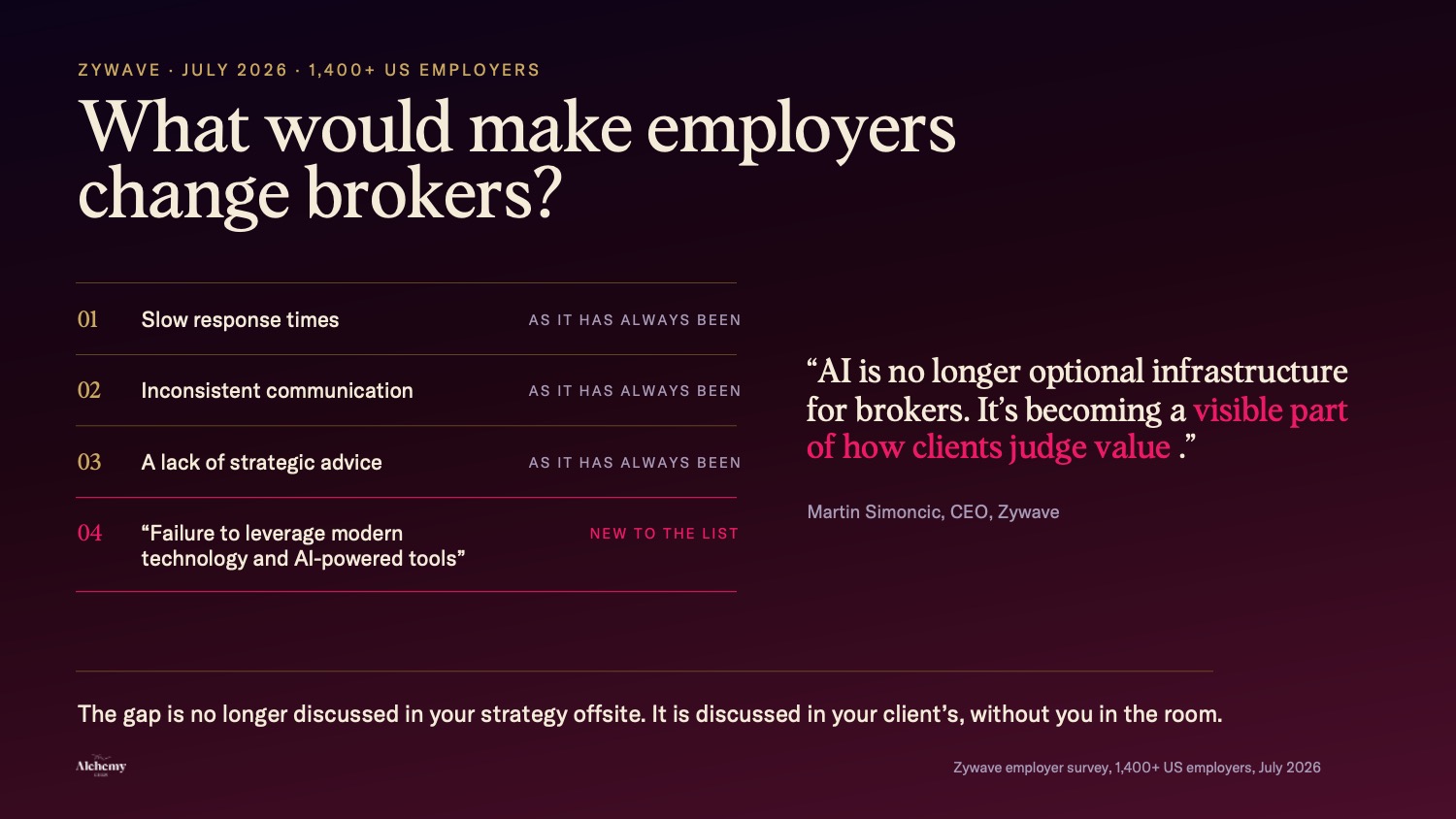
Read that as an operating fact rather than a survey result. It means the gap is no longer discussed in your strategy offsite. It is discussed in your client’s, without you in the room, in the sentence that begins “they still take four days to turn a quote around, and I don’t think they’ve moved on any of this.”
You will not hear that sentence. You will hear its consequence, at renewal, from an account you were confident about: one of the green ones.
That is the loss sitting behind the committee cycle. Not a market-share chart. A person you have known for nine years explaining, kindly, that they have moved.
Meanwhile somebody’s producer is walking into that meeting having got their eight hours back, and using every one of them on the account.
The Frontier Operating Model is not a destination the industry arrives at together. It is being built right now, quarter by quarter, by whoever is willing to put one workflow into production before the committee finishes deliberating. Brokers started early because the market gave them no choice. Carriers still have a choice, and choices expire.
The real question isn’t whether carriers can move at broker speed. It’s which carrier proves it first, and whether it’s yours.
Where does your organization actually stand on the path to a Frontier Operating Model? Connect with us to share your views at [email protected].
Frequently asked questions
What is a Frontier Operating Model, and how is it different from a digital transformation program?
A Frontier Operating Model is the organizational design that enables a firm to run human-agent teams within live, revenue-producing workflows rather than in pilots. It has three components: legacy systems decoupled one workflow at a time, venture-client partnerships that compress testing from years to weeks, and governance that clears at the speed of deployment. The difference from a digital transformation program is scope and proof. A transformation program replaces platforms over multi-year horizons and reports on milestones; this design changes one workflow at a time and reports on hours returned and revenue moved. Grant Thornton’s 2026 AI Impact Survey, fielded 23 February to 18 March 2026 across 950 business leaders, found firms with AI fully integrated into workflows were nearly four times more likely to report revenue growth than those still piloting: 58% against 15%.
Why are insurance brokers adopting AI faster than large carriers in 2026?
Because they are measuring a different thing and face a different risk. Perspective AI’s May 2026 report found 64% of US agencies run AI in at least one live workflow, up from around 38% in 2024, led by quoting (71%), lead intake (58%), claims handling (49%) and customer service (44%). By comparison, Deloitte’s June 2024 survey of 200 US insurance executives found 76% had implemented generative AI in at least one business function: a status measure rather than a location measure. Brokers also face demand-side pressure carriers do not: Zywave’s 2026 Broker Services Survey of more than 1,400 US employers found that failure to use modern technology and AI tools entered the top reasons employers would switch brokers for the first time. Firm size is not the explanatory variable: adoption runs at 91% among agencies with more than 25 producers.
What is the AI proof gap and how exposed is my organization?
The AI proof gap is a term coined by Grant Thornton in April 2026 for the distance between AI adoption and demonstrable, well-governed results. In its 2026 AI Impact Survey, which polled 950 business leaders across ten industries with an insurance subgroup of 100, 44% of insurance executives said governance or compliance problems had contributed to an AI project failing or underperforming, and only 24% were very confident they could pass an independent AI governance review within 90 days. Across all industries, 78% lacked full confidence in passing such a review. The practical test for a CIO or CRO is simple: if an external reviewer arrived tomorrow, could you produce, within 90 days, a complete inventory of AI running in production, the accountable human owner of each decision path, and the audit trail? Most cannot. Within a Frontier Operating Model, that evidence is a by-product of deployment rather than a retrofit.
What is the venture client model, and how do carriers use it to accelerate AI adoption?
The venture client model, scaled industrially first by BMW’s Startup Garage, has the corporate become a paying client of a young venture’s technology inside a real workflow, before a strategic review rather than after one. There is no equity stake, no accelerator cohort and no multi-year integration: a purchase order, a defined workflow, and a decision date. In insurance it means decoupling one workflow from the legacy core and letting vetted ventures run AI microservices against it under production conditions. Alchemy Crew’s DIVAAA™ pathway applies validation gates that move a venture from pilot to production contract on evidence rather than enthusiasm. It is the fastest route into a Frontier Operating Model for a carrier that cannot rebuild its core, because it borrows the broker’s testing speed without requiring the broker’s balance sheet, and it aligns with the hybrid build-buy-partner strategies highlighted in AI Horizons 2030 on reimagining insurance in an autonomous world.
What should a Chief Underwriting Officer or CIO do in the next 90 days to move toward a Frontier Operating Model?
Four moves, all executable within one quarter. One: take a single revenue-adjacent workflow (quoting, submission triage or renewals) and set a 90-day production deadline with guardrails, not a sandbox. Two: stand up a venture-client lane with one page of terms, one accountable commercial owner, and thirty days from first meeting to paid pilot; if procurement takes longer than the pilot, procurement is the project. Three: measure hours returned rather than pilots launched, one number from the COO every Friday, covering how many revenue workflows ran with agents in the loop. Four: commission the independent AI governance review now, given that Grant Thornton found only 24% of insurance executives confident of passing one inside 90 days. The benchmark to aim at is human-scale: Marsh McLennan’s LenAI, live since November 2023 across 90,000+ employees, returns early adopters roughly eight hours a week and an estimated one million hours a year firm-wide, illustrating the broader trajectory toward AI-powered insurers reshaping claims, underwriting and customer service.
References
- Marsh McLennan. "Marsh McLennan Develops New Generative AI Tool." November 2023
- Oliver Wyman. "LenAI: A Generative AI Tool By Marsh McLennan." September 2023
- Life Insurance International. "Marsh McLennan launches new generative AI tool for employees"
- Consulting.us. "Marsh McLennan launches AI tool LenAI"
- CIO Dive. "Marsh McLennan gears up for massive AWS migration"
- Predibase. "How Marsh McLennan saved over 1 million hours of team time with agentic AI"
- Grant Thornton. "Insurance insights: 2026 AI Impact Survey Report." 2026
- Grant Thornton. "A widening 'AI proof gap' is emerging, but well-governed AI is showing results." Press release, April 2026
- Grant Thornton. "2026 AI Impact Survey Report." 2026
- Businesswire. "Grant Thornton survey: A widening 'AI proof gap' is emerging, but well-governed AI is showing results." 13 April 2026
- Insurance Journal. "Grant Thornton: Insurers See AI Gains but Face Governance Gap." 30 April 2026
- Insurance Business. "Widening 'AI proof gap' exposes weak governance behind board-level enthusiasm"
- Deloitte Insights. "Scaling gen AI in insurance." Survey of 200 US insurance executives, fielded June 2024
- Perspective AI. "AI for Insurance Agents in 2026: Adoption Hit 64%. The Industry Data Report." May 2026
- Perspective AI. "AI for Insurance Agencies in 2026: From Lead Capture to Renewals." 2026
- Layer3 Labs. "AI Workflow Automation for Insurance Brokers (2026)"
- BMW Startup Garage. Venture client model
- Microsoft. "The 2025 Annual Work Trend Index: The Frontier Firm is born." Official Microsoft Blog, 23 April 2025
- Microsoft WorkLab. "2025: The year the Frontier Firm is born." April 2025
- Microsoft. "Executive Summary: Work Trend Index Annual Report." April 2025
- Zywave. "AI Emerges as a Defining Force in the Broker-Client Relationship, Zywave 2026 Broker Services Survey Finds." July 2026
- Insurance Business. "Clients now expect brokers to lead on AI, not just advice"
- Digital Insurance. "Employers would switch brokers because of AI, other tech: Zywave"
- Insurance Journal Research. "2026 Broker Services Survey Results"
- Insurance Edge. "Zywave Releases 2026 Broker Services Survey." 28 July 2026
- Microsoft. Jim DeMarco, author archive, Microsoft Industry Blog
Editor in Chief

Rebuilding Risk Resilience