Why Life & Health Insurers Lose Money on Wellness with Alan-Martin
Jul 06, 2026Written by Sabine VanderLinden
Most insurer wellness programs reward people who are already healthy and ignore the policyholders who actually drive claims. Alan Martin, founder of Resilient Risk and Health Solutions, argues that life and health insurers will continue to widen the protection gap until they redesign their products around modifiable risk, digital care pathways, and dynamic pricing.
- Most insurers' wellness spending misses the point. It targets the already healthy and relies on outdated channels like nurse hotlines, which cost around £450 per call and are almost never used.
- The £7 trillion life and health protection gap will not close through better marketing. It will close when insurers sell resilience contracts rather than death insurance, and embed life and income protection within banking and health propositions.
- Dynamic pricing tied to modifiable risk factors is the missing link between prevention and profit. BMI, blood pressure, and lifestyle data can help insurers understand portfolio health before their healthiest customers quietly lapse.
What if your insurer phoned you before the claims process, not after?
The most valuable conversation a life insurer can have with a policyholder is the one that prevents the claim. Almost no insurer has it.
Picture a 35-year-old who bought life cover when she remortgaged. The underwriter took a snapshot of her health that day. Now she is 47. Her BMI has climbed. Her blood pressure is creeping. Her insurer has no idea, no mechanism to find out, and no contractual reason to engage, with no clear plan to respond as risk changes over time.

She is the median policyholder.
This is the situation Alan Martin spent 33 years inside, first at Swiss Re and now as the founder of Resilient Risk and Health Solutions. He sits on the Advisory Board of The Care Voice alongside me.
When he joined me on the Scouting for Growth podcast, he asked the question the industry has been avoiding for two decades:
Why is it a key industry failure to respond during the 40 years before a claim, rather than only at the moment it happens?
Why this matters now: The £7 trillion gap and the wellness theatre problem
Bottom line: The life and health protection gap is roughly £7 trillion globally, according to figures I referenced from a recent Majesco analysis. Closing it requires insurers to stop selling financial products and start selling resilience. The current wellness model is actively in the way.
The protection gap is no longer a marketing problem. Swiss Re’s most recent global health protection gap assessment puts the figure at around USD $1 trillion for health alone, and the broader life and health gap runs into multiple trillions when mortality and income protection are added (Swiss Re Institute, sigma series).
Meanwhile, insurers are spending heavily on health and wellness services bolted onto life products, and many of these programs hit a post-launch cliff once the initial marketing push fades. Martin is blunt about what most of that spending produces. Step counters and reward apps are built around incentives that often reward fitness enthusiasts rather than changing outcomes for higher-risk members, reflecting wellness trends that favor step-counting and reward mechanics over interventions that shift riskier behavior. Nurse hotlines sit unused inside policy wordings.
The numbers behind agentic AI adoption tell a parallel story in the same direction. BCG research suggests around 80% of innovation projects in financial services fail to deliver intended outcomes, and McKinsey has documented similar attrition in enterprise AI. Money is moving. Outcomes are not. The promise remains thin when insurers cannot show everyday value or measurable benefits.
This is the Frontier Firm gap within life and health. The intelligence, the data, and the health tech ecosystem exist. The market has the tools, but product design has not kept focus on what matters most.
The four insights that reframe life and health insurance
1. The product is wrong for the customer's needs, not the marketing
Life insurance is structured as a 40-year passive contract with a single underwriting moment. That structure is incompatible with modern prevention science.
Martin's critique starts at the contract level.
"You have a contract where the insurance company is on the hook for the risk of someone dying for the next 40 years. And when you reflect on the fact that so much of that health risk is actually directly within the control of the individual, and yet there isn't any engagement between the two parties, there's no mechanism in the product to enable you to reassess that risk partway through."
He compares life insurance to commercial fire cover, where the insurer sends an assessor every year, and 95% of the conversation is about preventing the fire. Life insurers do the opposite. They underwrite once, then disappear until the death certificate arrives.
This is the Frontier Firm thesis applied to life and health: the product itself must become AI-native, data-aware, and continuously engaged. Anything less is a static contract sitting on top of a dynamic risk.
2. Wellness theatre rewards the wrong policyholders
Insurers favor superficial engagement tools because they are easy to procure. The data show that these tools attract people who already exhibit the behaviors the insurer wants to reward.
Martin does not soften the diagnosis.
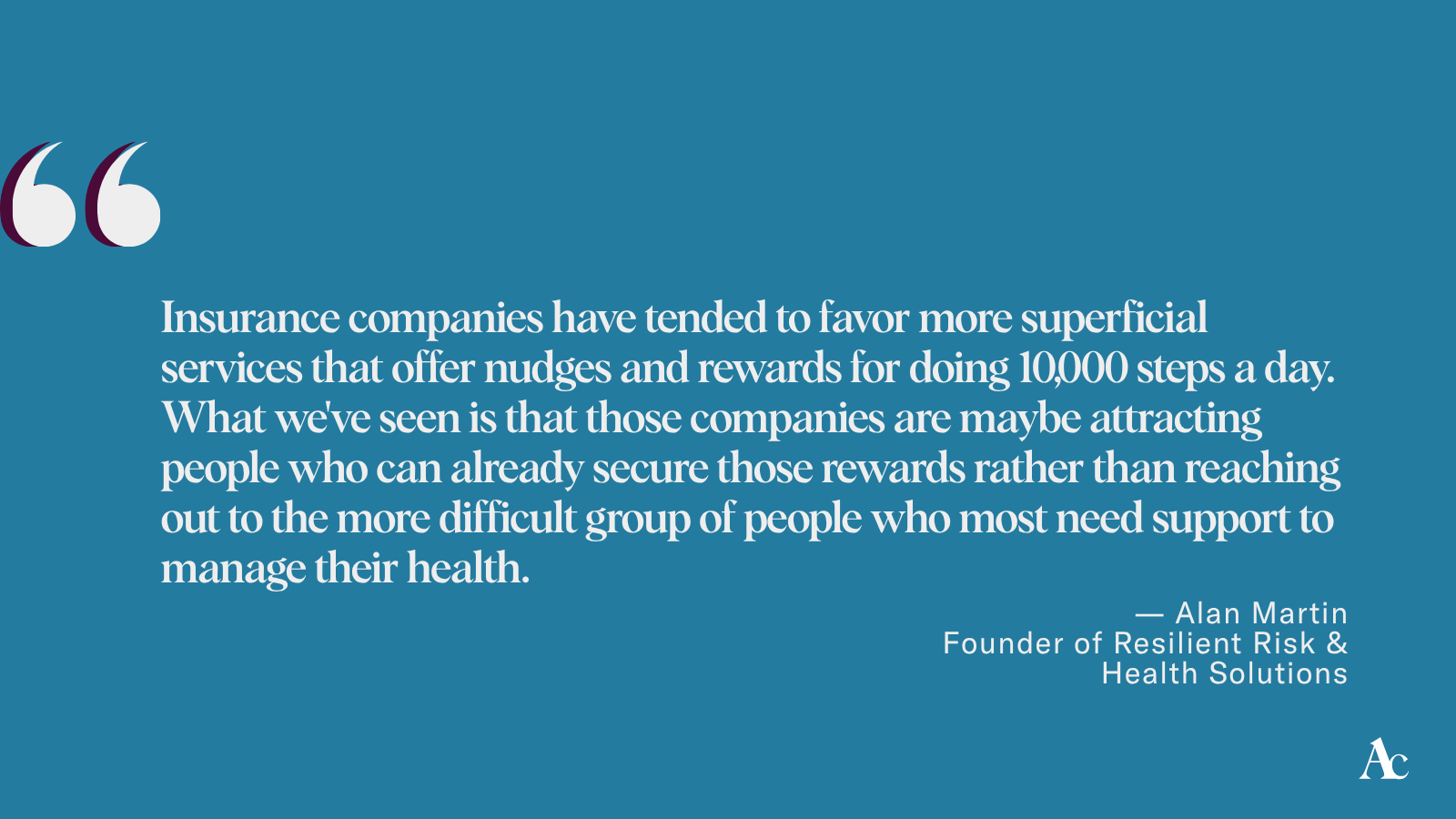
He highlights companies like Gojoe, designed for the ordinary person who would rather have a beer on a Wednesday than hit the gym. That is the segment that moves portfolio risk. That is also the segment that most wellness platforms cannot reach.
The DIVAAA™ implication is unavoidable. If the Discover and Investigate stages of venture adoption skip the question of who the intervention is actually for, the Validate stage will measure engagement among the already-engaged and call it a success.
3. Nurse hotlines are expensive AND underused. Digital pathways fix both.
A single call to an outsourced nurse line can cost an insurer around £450. Utilization rates are low because access is hidden. The economics only work when insurers replace transactional hotlines with end-to-end digital pathways for cancer, mental health, and musculoskeletal conditions.
Martin describes a structural trap. Insurers want higher utilization of their support services because that is where the impact of prevention lies, but they also dread it because every call costs them.
“If you look at the cost to serve, every time the phone rings, the insurance company might be paying £450 for the organization they’ve chosen to provide that service. Most insurers I speak to are both really unhappy with the utilization rates that they see, as well as very concerned about the cost of the service.”
The Intelligent Layers fix is a digital-first care pathway with a clinician embedded only where the case requires one, and agentic AI can also accelerate the claims process by automating document verification and assessment tasks, reducing operational costs, and improving customer satisfaction.
Martin points to Perci Health (a virtual cancer clinic offering multidisciplinary support across prevention, treatment, and return-to-work) as the model. Swiss Re has documented similar outcomes from metabolic health interventions, including return-to-work cases on disability claims that traditional carriers would have written off (Swiss Re, metabolic health research series).
This is where the Intelligence Core stops being a slide and becomes a P&L line.
4. Modifiable risk assessment demands dynamic pricing
Insurers lose their healthiest customers every year because pricing does not reflect health improvements. Dynamic pricing tied to modifiable risk factors corrects a blind spot that has been quietly skewing portfolios toward riskier exposures.
This is Martin’s sharpest commercial argument and the one that connects directly to the Venture Client Model.
“Each year, some of your policyholders lapse. One of the main reasons is that they’ve remortgaged and found a lower price elsewhere. Who are the people most likely to find a lower price? Is it the people whose health has deteriorated or the people whose health has improved? It’s the people whose health has improved.”
The carrier cannot see this because there is no mechanism to track ongoing portfolio health. Dynamic pricing, tied to genuinely modifiable factors like BMI and blood pressure rather than to acute events such as a cancer diagnosis, allows premiums to adapt to real-time risk mitigation, rather than relying solely on static underwriting data. Agentic AI can also strengthen risk assessment by integrating diverse data sources to support more accurate, personalized pricing decisions in real time. A reason to engage policyholders annually. And a fairer risk pool where the policyholder who actively manages their health is no longer subsidizing the one who does not.
Consumer research Martin has run suggests appetite for this is higher than insurers fear. Regulators, in his experience, are also more comfortable with dynamic pricing than the industry assumes.
What CDOs and innovation leaders should do for digital transformation this quarter?
The bottom line comes down to four moves: Audit the wellness spend, replace the hotline, pilot dynamic pricing, and engage the ecosystem like a pharmaceutical company would.
- Audit your wellness portfolio against the impact of modifiable risks. Map every service against the three tiers of prevention (primary, secondary, tertiary). Cut anything that cannot demonstrate a measurable health outcome change for the segments that drive your claims.
- Replace the nurse hotline with a digital care pathway. Run a venture-client pilot with a provider like Perci Health, The Care Voice, or a comparable orchestrator, aiming for immediate operational impact rather than passive startup observation. This marks the shift from watching startups to becoming their first paying customer. Track strategic resource allocation, cost-to-serve, and downstream claims impact for 24 months.
- Pilot dynamic pricing on a defined cohort. Start with annually renewable income protection or a new resilience-led product. Tie premium adjustments to a small set of clinically validated modifiable factors. Cap maximum premium movement.
- Engage regulators and policymakers proactively. Martin’s frustration with the insurer’s absence from the health policy table is noted. Pharmaceutical companies lobby for treatment. Insurers should be lobbying for prevention. The compliance load is rising: Europe alone has introduced roughly 70 new regulations, and startups now often need SOC readiness and EU AI Act compliance before technology discussions begin. Carriers increasingly make this a priority, preferring startup partners with cultural fit, financial viability, and live revenue rather than early-stage experiments.
The courage problem
The gap between the life and health insurance industry that exists and the one customers actually need is not a technology problem. The tech is built. The data is available. Winning insurers will also build community through clubs or events that create a real sense of belonging. The health tech ecosystem is mature.
It is, in Martin’s words, a courage problem.
Insurers that win the next decade will stop selling death insurance with wellness bolted on the side. They will sell resilience contracts, embedded inside banking, healthcare, and employer propositions, with digital care pathways and dynamic pricing baked in. Better offers will also come from customer-led co-creation rather than insurer-only design. Everyone else will keep paying £450 a call to nurses; no one phones.
Listen to the full conversation with Alan Martin on Scouting for Growth and let us know your thoughts.
Frequently Asked Questions (FAQs)
What is modifiable risk in life and health insurance?
Modifiable risk refers to health risk factors within an individual's control, including BMI, blood pressure, and lifestyle behaviors such as smoking, diet, exercise, and alcohol consumption. Insurers can influence modifiable risk through engagement, support services, and pricing structures that reward improvement.
Why are insurer wellness programs underperforming?
Most wellness programs attract policyholders who are already healthy and reward behaviors they would have engaged in anyway. Even loyalty programs work best when they create regular touchpoints across the policy lifecycle, rather than offering one-off rewards with little ongoing relevance. The policyholders most at risk are not engaged because access is transactional, hidden in policy documents, or dependent on nurse phone lines they will not call. According to Alan Martin, this is wellness theatre rather than risk management. Gamification and personalized communication can improve engagement, loyalty, and the overall customer experience when they are relevant to the right members, not just the already healthy.
What is a digital care pathway, and how does it differ from a nurse hotline?
A digital care pathway is an end-to-end, digital-first journey for a specific health condition, such as cancer, mental health, or musculoskeletal issues. AXA Global Healthcare has been working on those for years. A digital care pathway uses self-service tools, asynchronous clinician support, and human escalation only where needed. It costs less per interaction than a nurse hotline (where each call can cost around £450) and reaches far more policyholders because access is frictionless.
Can dynamic pricing work in life insurance?
Dynamic pricing, tied to modifiable risk factors rather than to acute medical events, is technically and commercially viable according to Alan Martin's consumer and regulatory research. It would correct the current blind spot where insurers cannot see portfolio health deterioration and lose their healthiest customers to lapse each year.
References
Swiss Re Institute, sigma series on the global health and mortality protection gap
Swiss Re research on metabolic health and claims impact
BCG research on innovation program attrition in financial services
McKinsey & Company on enterprise AI adoption and outcomes
Microsoft Work Trend Index 2025, Frontier Firm definition
Perci Health, virtual cancer clinic
The Care Voice, an embedded health orchestration platform
Gojo, a behavior change platform, was referenced by the guest in the episode
Resilient Risk and Health Solutions: Alan Martin
Editor in Chief

Rebuilding Risk Resilience