Frontier Firms: Here is How AI Becomes The Most Important Bet as Insurance Underwriting
Mar 31, 2026Written by Sabine VanderLinden
Three things that matter
-
A third of all European insurtech investment rounds in 2024 were AI-first companies, signalling a structural shift from incremental process digitisation to native intelligence embedded in the risk value chain.
-
Frontier Firms that embed agent-human teams and AI-native decisioning into their core operating model will build an 18–36 month competitive advantage over peers who delay, according to Florian Graillot, Founding Partner at astorya.vc.
-
The most important battleground in the next five years of insurance is AI underwriting, firms that redesign how risk is assessed, modelled, and priced using real-time intelligence will define the next generation of the industry.
What If the Gap Is Already Opening?
Imagine it’s 2028. Two insurers of roughly equal size stand at opposite ends of the same market.
One spent the last three years debating which AI projects to prioritise. The other spent the same period building AI-native decisioning into its underwriting core, deploying agent-human teams across claims and distribution, and treating intelligence as a utility, not a competitive luxury.
The gap between them is not a technology gap. It is an operating model gap. Increasingly, organizations are facing a widening capacity gap, as they are asked to do more with less and employees are forced to switch tasks across multiple systems, increasing workload and risk. One firm assesses a risk in minutes; the other still takes days. One adapts pricing in real time as climate data shifts; the other still relies on actuarial assumptions built for a different era. And crucially, one is attracting the talent that will define the next decade of insurance. The other is wondering why its best people keep leaving.
For the AI-native insurer, integrating AI into business operations transforms and optimizes core activities, enabling greater agility, faster innovation, and a more adaptive response to market changes.
This is not a hypothetical. It is the trajectory Florian Graillot, Founding Partner at astorya.vc, sees taking shape right now, and he has ten years of insurtech investment pattern recognition to back it up. What it actually takes to become a Frontier Firm, what breaks first for those who wait, and why the AI underwriter may be the single most important bet in insurance over the next five years?
Frontier Firms address the growing capacity gap by delegating repeatable, cross-system work to AI agents, which are managed through a centralized control plane. This approach improves productivity and resource management, helping organizations overcome operational bottlenecks and scale innovation beyond pilot phases.
Why Competitive Advantage Matters Now
The numbers are already moving. According to Florian, a third of all insurtech investment rounds announced in Europe in 2024 went to AI-first companies, not firms layering AI onto existing processes, but startups built entirely around artificial intelligence as their primary value delivery mechanism. That is not a trend. That is a structural shift in how the industry is being rebuilt from the outside in. External innovation, through collaboration with startups and external partners, is driving this transformation, enabling insurers to rapidly access and integrate cutting-edge capabilities.
At the same time, the cost of intelligence itself has collapsed. As noted during my conversation with Florian, the price of accessing large language model inference has dropped from approximately $4 per million tokens to under $1, making intelligence, in her words, ‘on tap.’ When intelligence becomes a utility rather than a scarce resource, the firms that have built operating models to exploit it at scale will separate decisively from those still treating AI as an experiment.
The protection gap adds urgency. Swiss Re estimates the global protection gap at $1.8 trillion in premium-equivalent terms. Traditional underwriting models, built on historical datasets, linear actuarial assumptions, and quarterly pricing cycles, are structurally ill-equipped to close it. Emerging risks, from climate volatility to cyber exposure to the liability dimensions of agentic AI, did not exist in the historical data.
They are growing fast, evolving faster, and they require a fundamentally different approach to risk assessment. Accessing new solutions and innovative technologies is essential for insurers to address these emerging risks effectively and stay ahead of the curve. The incumbent operating model is not broken. It is misaligned with the speed of the risk environment it now faces.
Key Insights from Florian Graillot
1. Risk Assessment Is the Core Engine Under Threat
When asked which part of the insurance operating model incumbents most underestimate, Florian did not hesitate: risk assessment.
“This is obviously the core engine of the insurance industry, better understanding, modelling, pricing the risks. And I think that the historical way insurance players have tackled this risk is under threat due to emerging risks… they didn’t exist in the past or were very limited. They are growing very fast, meaning that the challenge for insurance players is increasing over time.”
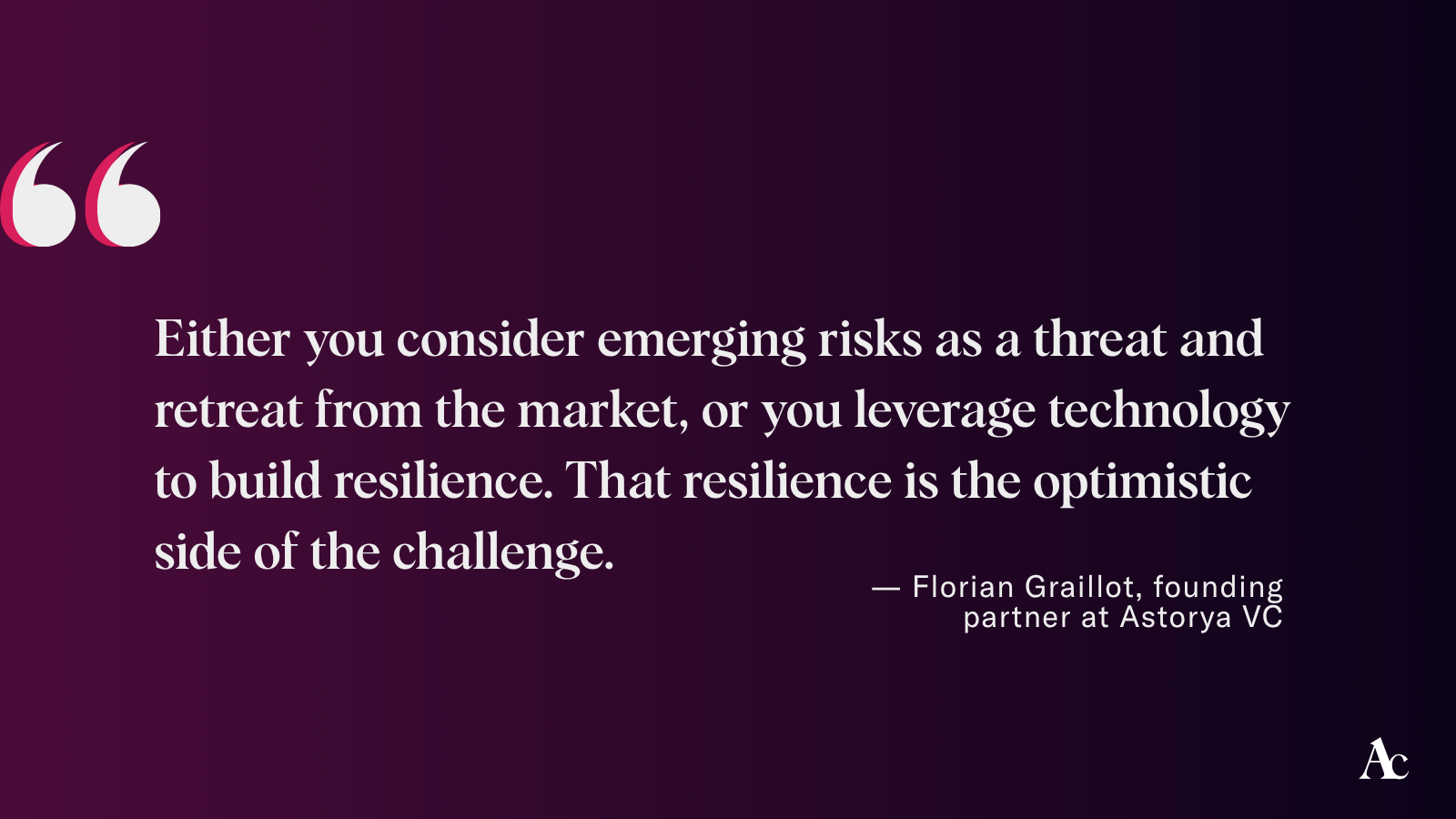
The implications are significant. The AXA CEO, Thomas Buberl, framed the industry’s dilemma starkly: retreat from markets or build resilience. Florian sees resilience as the optimistic side of the emerging risk challenge. Building it requires rethinking the entire risk value chain, not just the insurance value chain, but upstream prevention, real-time risk assessment, and dynamic claims management. Access to deep industry knowledge is crucial for understanding and addressing these emerging risks effectively.
This is precisely the territory the Frontier Firm occupies: a firm designed not to react to risk events, but to sense, model, and respond to them continuously, often by deploying agentic AI coworkers within underwriting and claims workflows. For innovation leaders, our DIVAAA methodology offers a structured pathway, discovering and investigating emerging risk categories, from climate parametrics to cyber behavioural signals, before they become underwriting emergencies. The innovation process involves developing, testing, and validating new solutions, and is accelerated by real-world validation, enabling faster adoption and impact.
The venture client model has been particularly successful in industries such as manufacturing, automotive, healthcare, energy, and financial services.
2. The Make-vs-Buy Question Has a Clear Answer: Both
One of the episode’s sharpest insights concerns how incumbents actually succeed and fail at technology adoption. Florian identifies three patterns that distinguish projects that survive from those that get quietly discontinued:
“Be very clear on the roadmap itself — what is the pain point that you are trying to address? If it’s just ‘let’s do an AI project,’ by design it will be tough to measure the ROI. You should be open for real change. If you just want to improve things or keep doing things the same way with another tech layer, most probably you will be disappointed. And insurance players should mix the make and buy initiatives.”
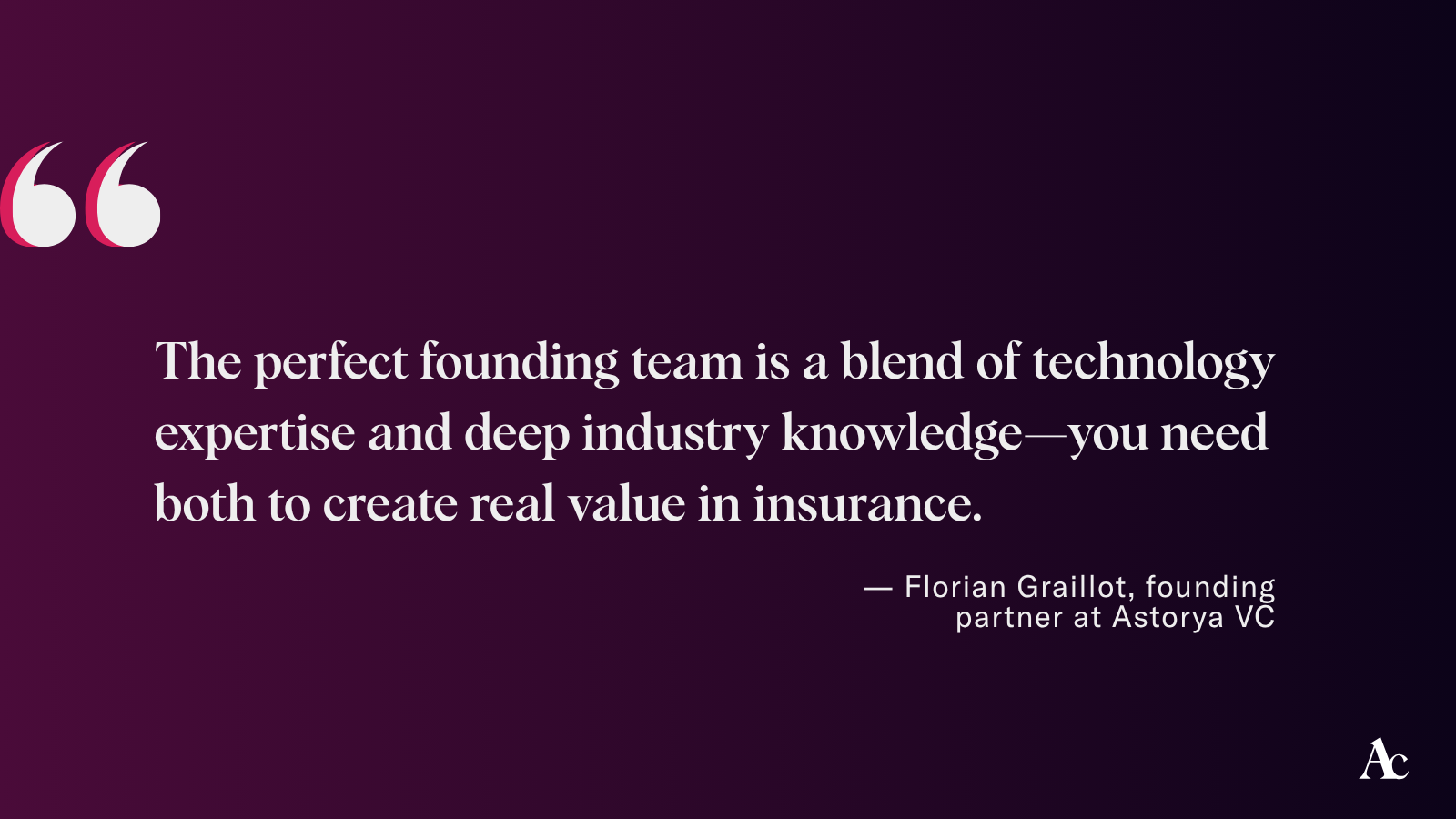
This last point matters enormously for Venture Client Model adoption. Understanding venture clienting as a corporate strategy clarifies why Florian is direct: incumbents have a structural weakness in attracting and retaining technology talent. That means AI-first projects built entirely internally carry significant execution risk. The firms that will build an 18–36 month competitive edge are those that identify where their internal capabilities are genuinely strong, and where an AI-first startup has technology capabilities they cannot replicate in-house.
This is the Venture Client Model operating in practice: corporates as early customers of startups, not investors, deploying focused external capabilities against specific, ROI-measurable pain points while maintaining internal accountability for outcomes. A venture client company leverages startup innovations to address strategic technology gaps and solve complex business challenges more efficiently than traditional methods. Venture clienting focuses on operational value, quick deployment, and pragmatic engagement with startups, enabling solution adoption and real-world validation of new startup solutions.
Companies like BMW and Bosch have successfully implemented venture clienting to enhance their innovation strategies and engage with the startup ecosystem. The model enables large corporations and smaller companies alike to test innovative solutions before making significant investments or commitments, allowing startups to earn revenue much earlier while still developing their product or service, increasing their chances of long-term success. Venture clienting also helps foster an entrepreneurial culture within large corporations by exposing employees to the startup mindset and ways of working.
Researching the startup ecosystem is essential for identifying potential startup partners, and developing a screening process helps evaluate these partners efficiently. Establishing a venture client unit and appointing a venture client leader are crucial steps for managing the process and connecting innovation teams with business units and startups. Creating a clear value proposition attracts new startups to the program, and a structured approach ensures consistency and momentum in solution adoption. Identifying and collaborating with new startups is a key part of a successful venture client strategy.
3. Trust Is Not an Asset. It Is an Active Design Challenge
As AI agents begin shaping insurance decisions, trust can no longer be assumed from institutional legacy or brand heritage. Florian challenges a belief many incumbents hold closely:
"Insurance carriers usually refer to their brand as an asset, a competitive edge, a way to build trust. But I'm wondering how much the incumbent can rely on this asset only... explaining how things work could be one way. And another way to build trust in the AI environment is being very clear on the value added for the end user, the customer, the partner, the employee. Because in that case, it's a deal."
This reframes trust as a design problem, not a communications problem. When AI agents influence underwriting decisions, claims routing, or pricing, customers and regulators need to understand why a decision was made, and what value they received in exchange for their data. This is the Intelligent Layers challenge: building governance, explainability, and accountability into the architecture of the firm, not as a compliance overlay, but as a foundational design principle.
4. The Board Belief That Must Be Challenged
Florian reserves his sharpest observation for boardrooms. When asked what belief he would challenge most aggressively to prepare an insurer for frontier transformation, his answer is unambiguous:
"Having a real wish and plan to change things is the only way to succeed. Because most of the time we hear, 'yes, we need to change, yes, we are trying to innovate.' But behind the scenes, they have unrealistic plans or fake willingness to move and do things in a different way."
He illustrates with a striking example: a major reinsurer that discontinued its embedded insurance initiative after five to six years — citing the project as "too small" — despite the programme having generated over one billion euros in policies. The expectation mismatch killed a genuinely successful programme. Florian's prescription is direct: redesign the roadmap for longer timescales, more realistic early milestones, and genuine commitment to structural change — not a proof-of-concept mentality dressed up as transformation.
Real-World Applications of AI in Underwriting
AI tools are ripping apart the old underwriting playbook, and honestly it's about time. We're not talking about incremental improvements here. We're talking about a complete shift from gut-feel guesswork to real-time, data-driven precision that lets companies make decisions at the speed of opportunity. Today's AI-powered platforms? They're devouring datasets that would make your head spin, historical claims, medical records, satellite imagery, IoT sensor feeds, processing it all at a scale that makes traditional methods look like counting on your fingers.
The result? Underwriters can now spot risk patterns that human eyes would miss in a lifetime, detect anomalies before they become disasters, and price policies with surgical precision using advanced algorithmic underwriting approaches.
Here's the thing: for insurers, this isn't just a nice-to-have upgrade. It's a competitive lifeline. AI-enabled underwriting doesn't just speed things up, it unlocks entirely new business models that were previously too complex or expensive to even dream about, as AI transforms underwriting across automation, fraud detection, and dynamic pricing. Parametric insurance? Micro-policies? Suddenly possible. And that's just the beginning. Companies can now offer coverage that actually fits their customers, adjust pricing as fresh data rolls in, and get ahead of emerging risks instead of reacting to yesterday's disasters. This kind of operational agility? It's what separates the companies that thrive from the ones that get left behind holding yesterday's playbook.
But here's where it gets really interesting: we're watching underwriting evolve from a backward-looking process into something that actually thinks ahead. Static risk assessment is dead. What we have now is dynamic, intelligence-driven decision-making that anticipates problems before they become expensive surprises. The impact? It's showing up in the bottom line and customer satisfaction scores. Generative AI in underwriting accelerates this shift, and AI-powered underwriters aren't just keeping up anymore. They're becoming the cornerstone of competitive advantage in an industry that's being rewritten from the ground up.
AI and Customer Experience
The integration of AI into customer experience is a rewrite the entire playbook. AI-powered chatbots, virtual assistants, and digital platforms now deliver seamless, 24/7 support that makes traditional models look like they're running on dial-up.
Speed? Check. Accuracy? Double check. And here's the kicker: by leveraging AI tools to analyze customer data and behavior, you're not just serving customers, you're anticipating their moves before they even know what they need. Hyper-personalized recommendations, tailored products, individual risk profiles, that's not customer service. That's customer prophecy.
This shift improves servicing and fundamentally rewrites the relationship contract between insurer and insured. Let's be honest: AI-driven personalization can foster trust, manufactures loyalty and enhances retention while your company scales customer operations without sacrificing an ounce of quality. That's not improvement. That's multiplication. As more insurers adopt these solutions, AI-powered customer experience becomes the great separator: the thing that lets leading corporations stand out in a crowded market and build strategic advantages that stick.
Ultimately, leveraging AI for customer experience isn't about technology. It is indeed about reimagining the entire customer journey. From onboarding to claims, you're delivering value at every single touchpoint. And in a world where customer expectations are rising faster than your quarterly targets? AI-enabled insurers aren't just meeting the new standard for service excellence. They're setting it.
AI and Operational Efficiency
AI isn't just becoming the engine of operational efficiency for insurers and financial services firms. It's becoming their operational DNA. Because here's the thing: when you automate the routine stuff, document processing, fraud detection, claims triage, you're not just cutting costs. You're unleashing human potential. Machine learning algorithms don't just sift through operational data. They become your operational intelligence, spotting inefficiencies you didn't even know existed and recommending process improvements that don't just save millions, they accelerate everything.
But wait. This transformation isn't about cost savings anymore, is it? It's about capacity infrastructure. AI-powered operational efficiency means you can expand workforce capacity without the headcount headache. You can pivot when markets shift. You can deliver consistent, high-quality outcomes across your entire organization while your competitors are still figuring out their spreadsheets. Why? Because the companies that leverage AI to streamline core processes aren't just staying competitive. They're defining what competitive means.
As AI adoption spreads like wildfire, something interesting happens. The focus shifts from those isolated pilot projects, you know, the ones that looked great in PowerPoint, to broad adoption that actually moves the needle.
The result? Measurable impact on productivity, quality, and profitability that doesn't just align with long-term strategic goals. It transforms what those goals can be. And suddenly, you're not just another insurance company. You're a frontier firm in the global insurance ecosystem, setting the pace instead of scrambling to keep up.
Actionable Takeaways for Leaders
Audit your risk value chain, not just your insurance value chain
Prevention, real-time risk sensing, and dynamic claims management are all under pressure from emerging risks. Identify which parts of your model rely on historical data that no longer reflects today's risk environment.
Define your make-and-buy boundary for startup solutions explicitly
Be honest about where internal teams have a genuine edge — and where an AI-first startup has capabilities you cannot replicate in 18 months. Apply the Venture Client Model: bring external partners in as solution providers against specific, ROI-measurable pain points.
Build trust by design, not by assumption
For every AI system that influences a customer-facing or underwriting decision, define how it will be explained — to the customer, the regulator, and the employee. Explainability is an architectural requirement, not a communications fix.
Reset board expectations on innovation timescales
Embedded insurance is expected to grow to a ~$700B+ Gross Written Premium (GWP) market in Property & Casualty (P&C) by 2030. AI underwriting will take time. If your board discontinues pilots because early figures look "too small," you are measuring the wrong thing at the wrong moment.
Start treating AI agents and the AI underwriter as a ten-year strategic bet, beginning now
Florian's single prediction for the defining Frontier Firm capability is the AI underwriter. Begin building toward it through data partnerships, AI-first collaborations, and DIVAAA adoption frameworks, before the risk environment makes it mandatory.
Creating a Culture of Innovation
Building a culture of innovation isn't just essential for insurers, it's survival maths. This starts with a mindset shift that's not about feel-good workshops or innovation theater. We're talking about encouraging employees to experiment, embrace new technologies, and collaborate across those dusty traditional boundaries that exist mainly on org charts.
Innovation hubs, incubators, and accelerators further amplify this effect, creating an environment where new ideas can be tested, refined, and scaled across the entire company. By leveraging startup solutions and venture clienting, insurers can unlock strategic advantages, expand their capacity for change, and position themselves as frontier firms ready to lead in the new world of insurance, echoing the long-term perspectives shared at AI Horizons 2030 on autonomous, AI-shaped insurance. The real question isn't whether innovation culture will become the default. It's whether you'll design that culture… or watch competitors hire the people who did.
Measuring Success and ROI
For insurers diving headfirst into AI, startup collaboration, and venture clienting, measuring success is survival mathematics. Because without rigorous ROI tracking, even the most brilliant innovation initiatives become expensive experiments that fizzle out when the CFO starts asking hard questions. Clear key performance indicators: cost savings that actually show up on the balance sheet, revenue growth you can point to, customer satisfaction that translates to retention, and startup partnerships that deliver tangible business outcomes, these aren't just metrics. They're your license to operate in the innovation space.
Here's where it gets interesting: a dedicated venture client unit becomes your intelligence command center, wielding AI tools and data analytics like a precision instrument to monitor startup-powered projects and ensure they're actually moving the needle on business outcomes. Think of it as your innovation reality check, because without measurable impact (whether that's operational efficiency that shows up in your processes, customer experience improvements that customers actually notice, or new business models that generate real revenue), you're just playing with expensive toys. Companies that focus on measurable impact make informed decisions about where to double down, where to scale, and crucially, where to cut their losses.
The frontier firm approach doesn't just talk about continuous learning, it architects it into the operating model. This means leveraging AI agents and startup solutions not as bolt-on experiments, but as capacity infrastructure that drives operational excellence and unlocks entirely new sources of value.
And here's the plot twist: rigorously measuring ROI isn't about justifying innovation spending is about demonstrating strategic value, securing the executive buy-in you desperately need, and building an unshakeable foundation for long-term success that survives leadership changes and budget cycles.
The bottom line? The combination of AI, startup solutions, and venture clienting is about reshaping and rewriting the rules of competitive advantage. Companies that embed these capabilities into their organizational DNA and measure their impact with surgical precision don't just achieve sustainable growth. They establish themselves as leaders in the emerging landscape of intelligent, agent-powered insurance.
Because in this new world, the question is whether you'll lead that innovation… or be forced to buy a roadmap from the company that did — a pattern that often emerges when AI strategies stall and startup collaborations lack evidence and structure.
FAQ
What is a Frontier Firm in insurance?
A Frontier Firm in insurance is an organisation built around AI-native decisioning and agent-human collaboration rather than legacy workflow automation. According to Florian Graillot of astorya.vc on the Scouting for Growth podcast, Frontier Firms treat intelligence as a utility, deploy AI agents alongside human teams in real-time risk assessment, and are designed to sense and respond to emerging risks rather than react to historical loss patterns.
What breaks first if insurers don't adopt AI in the next three years?
Florian Graillot identifies talent attraction as the first fracture point. Insurers already struggle to attract and retain technology talent. Firms that do not embrace AI-native initiatives will fall further behind in their ability to build competitive underwriting capabilities, while Frontier Firms that move now will compound an 18–36 month head start into a structural advantage that becomes increasingly difficult to close.
Why is AI underwriting the most important frontier for insurance?
Underwriting — risk assessment, modelling, and pricing — is the core engine of the insurance industry. Emerging risks such as climate volatility, cyber exposure, and agentic liability are growing faster than historical data can model them. AI underwriting allows firms to assess and price risks using real-time and alternative data, making it the capability most likely to determine which insurers lead, and which retreat, in markets where traditional models are already failing.
The Question That Should Keep Boards Awake
Insurance is not being asked to digitise harder. It is being asked to think differently about what it means to manage risk in a world where intelligence is on tap, agents work alongside humans, and emerging risks evolve faster than legacy models can track them.
The Frontier Firm is not a destination. It is a discipline — built through deliberate choices about operating models, technology partnerships, and the courage to challenge internal assumptions that have calcified over decades.
The AI underwriter is coming. The question, as Florian puts it, is not whether the shift will happen. It is happening. The only question is who leads it.
Sources & Citations
Editor in Chief

Rebuilding Risk Resilience