You Know This Already. AI Is Not a Strategy. Here Is What the Winners Build Instead
Aug 28, 2026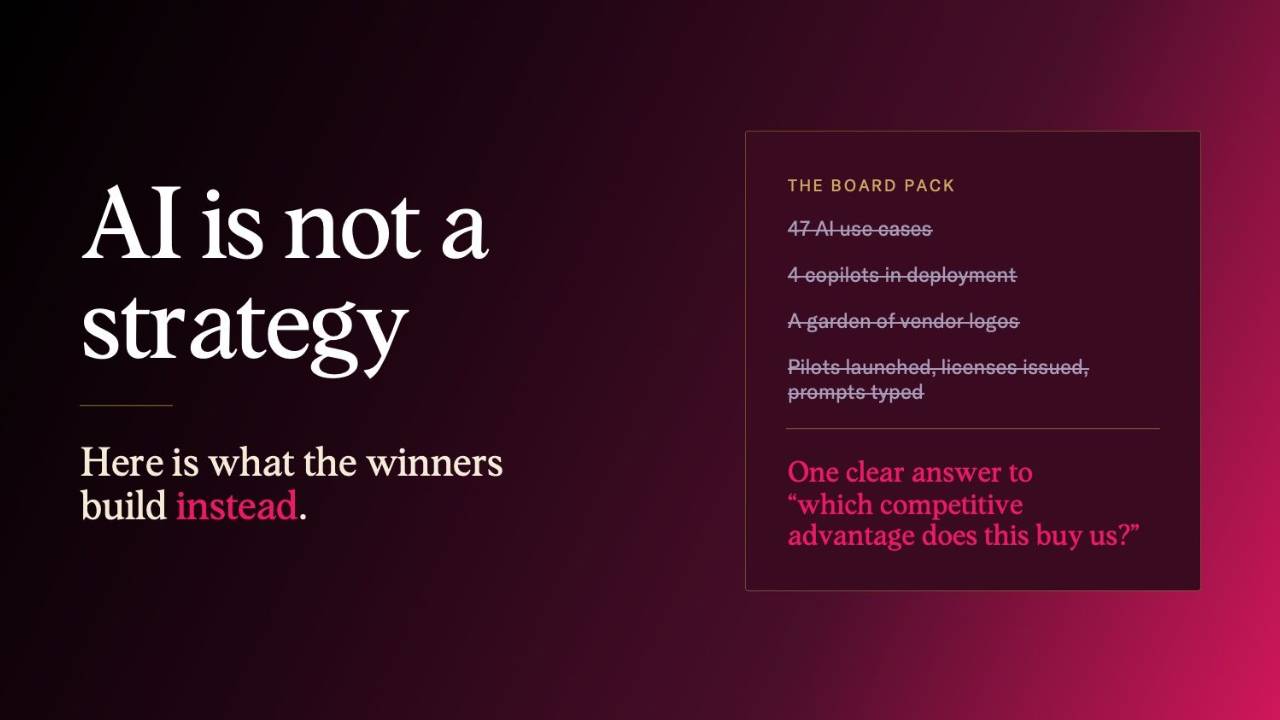
Written by Sabine VanderLinden
Nearly every carrier claims an AI strategy. Very few can explain what that strategy wins. Our 2026 research shows the failure is structural, not technological.
Three answers before we begin
Three answers before we begin
AI is not a strategy. It is a general-purpose capability that becomes strategic only when it changes where a company competes, how it wins, and what it deliberately stops doing. For executives, board members, and senior leaders in insurance, financial services, and other regulated industries, the distinction now separates the firms compounding advantage from the firms collecting pilots.
- Most corporate AI strategies are not strategies. In August 2025, MIT’s NANDA research on the GenAI Divide found that 95% of enterprise generative AI pilots deliver no measurable profit-and-loss impact. That number did not change in 2026. IBM’s Institute for Business Value study of 2,000 CEOs found only 25% of AI initiatives deliver their expected return on investment, and just 16% scale across the enterprise. McKinsey reports that roughly 1% of leaders describe their AI deployment as mature.
- Our team at Alchemy Crew found the failure is structural, not technological. Five operational dimensions break between pilot and production: data, integration, measurement, ownership, and graduation criteria. The single strongest predictor of a pilot reaching production is whether anyone wrote down what “ready to ship” meant before the pilot began. We call the trap pilot purgatory.
- The way out is an operating model, not a longer use-case list. The F.R.O.N.T.I.E.R. framework maps the eight sequential moves of the structurally ready insurer, the Frontier Firm: from framing agentic AI as a workforce and calibrating the Human-Agent Ratio, to integrating a proprietary Intelligence Layer competitors cannot rent. Value is then measured in loss ratio, expense ratio, cycle time, and retention, never in pilot counts.
Read this story... which may not be unfamiliar for many of you.
The board pack was immaculate. Slide 14 listed 47 AI use cases. Slide 15 showed four copilots in deployment and a garden of vendor logos for experimentation. Then the quietest non-executive director in the room asked one question.
Which competitive advantage does all of this buy us?
For a few moments, you could hear the noise of the air conditioning.
That is, for me, the real answer to the claim that AI is not a strategy: on its own, it is not.
The winning companies out there build AI-enabled business strategies that make clear where they will compete, how they will win, and which customers they will serve, using AI to change economics, operations, and market position rather than simply collecting tools and pilots.
I have watched versions of that scene play out in insurance boardrooms from London to Riyadh to New York this year. For executives, board members, and senior leaders in insurance, financial services, and other regulated industries, the gap is now hard to ignore.
Nearly every carrier claims an AI strategy. Very few can explain what that strategy wins. Most of these programs are technology roadmaps wearing a strategy badge, and this year we set out to understand exactly why, tracking transformation programs across insurance and financial services to find where they break.
What follows examines the difference between AI activity and AI-enabled strategy, why so many firms get stuck in pilot purgatory, and how leaders can use the F.R.O.N.T.I.E.R. framework, key strategic questions, and practical next steps to operationalize AI for durable advantage. That matters because in regulated markets, vague AI ambition rarely produces business outcomes and can just as easily create cost, complexity, and regulatory exposure without changing the competitive position at all.
Most AI strategies are technology roadmaps wearing a strategy badge.
Why this matters now
Intelligence is becoming cheaper, faster, and increasingly autonomous. Zack Kass, the former Head of Go-to-Market at OpenAI, describes two lines on a chart that every executive should memorize.
The technological threshold, what AI can actually do, rises exponentially. The societal threshold, what people will let it do, crawls upward in a straight line. The distance between them is the adoption gap (a concept dear to my heart!), and it is where the next decade of competitive advantage will be made and lost.
Regulators have already moved. The EU AI Act and DORA now treat governance of automated decisions as a design requirement, not a post-deployment patch. A pilot built for a steering committee demo cannot be retrofitted into that world. Waiting is a choice. It is simply not a strategy.
Is AI a strategy? The 40-word answer
No. AI is a general-purpose capability. A strategy defines where your organization competes, how it wins, which customers it serves first, and what it deliberately stops doing. AI becomes strategic only when it changes those answers: your economics, your operating model, your market position.
Why “what is our AI strategy?” is the wrong question
When executives say “AI strategy,” they usually mean a portfolio of use cases, a vendor roadmap, a data modernization program, or a productivity initiative.
Each is valuable. None is a strategy. Organizations call the collection an AI strategy because the word confers coherence and seniority on a set of pilots. But a catalogue of use cases is not a strategy. It is a shopping list.
Here is the test. No serious company would describe “using cloud” as its corporate strategy. Cloud enabled speed, scale, and new business models, and those outcomes were the strategy. Oxford’s Jonathan Trevor puts it plainly: AI is a resource, and treating a resource as a purpose guarantees misalignment. Brian Solis goes further. Pointing AI at broken workflows does not transform anything. It simply scales dysfunction.
What the failure data actually says about AI challenges
The external evidence is uncomfortable reading. We all saw August 2025 MIT’s research on the GenAI Divide. It found that 95% of enterprise generative AI pilots delivered no measurable profit and loss impact. McKinsey and BCG’s numbers did not differ much. IBM’s survey of 2,000 CEOs found that only 25% of AI initiatives delivered their expected ROI, and just 16% scaled across the enterprise. Unsurprisingly, McKinsey further reports that only about 1% of leaders describe their AI deployment as mature.
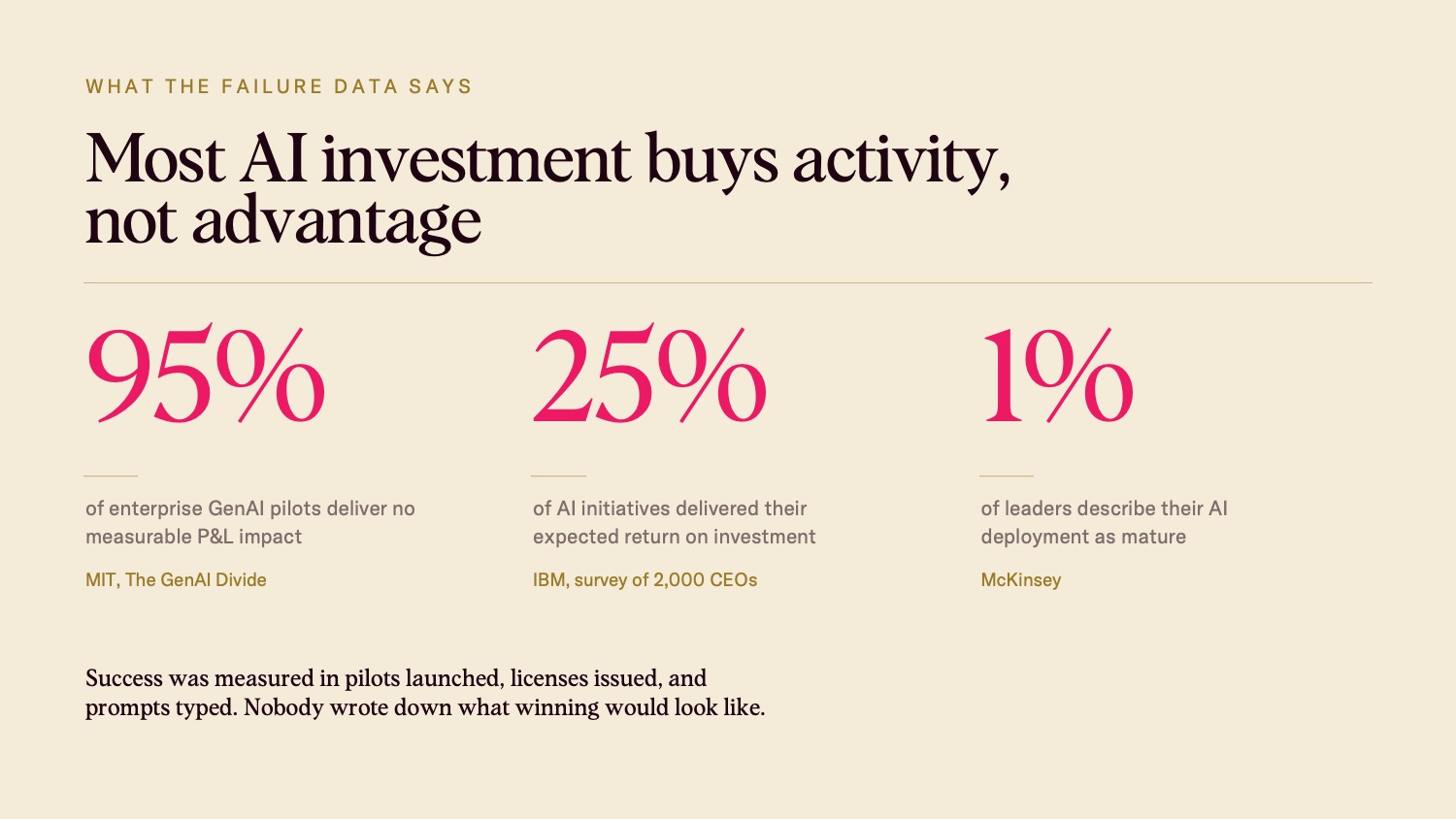
Here is the twist. Kass looks at that 95% figure and shrugs. Who cares? The cost of failure has collapsed, and one success in 19 cheap experiments is a bargain when the upside is asymmetric. The real scandal is not that pilots fail. It is that most organizations cannot say what winning would have looked like, because success was measured in pilots launched, licenses issued, and prompts typed.
Our research goes one layer deeper: the failures are not random. They are structural, and the structure repeats.
What our research found inside pilot purgatory
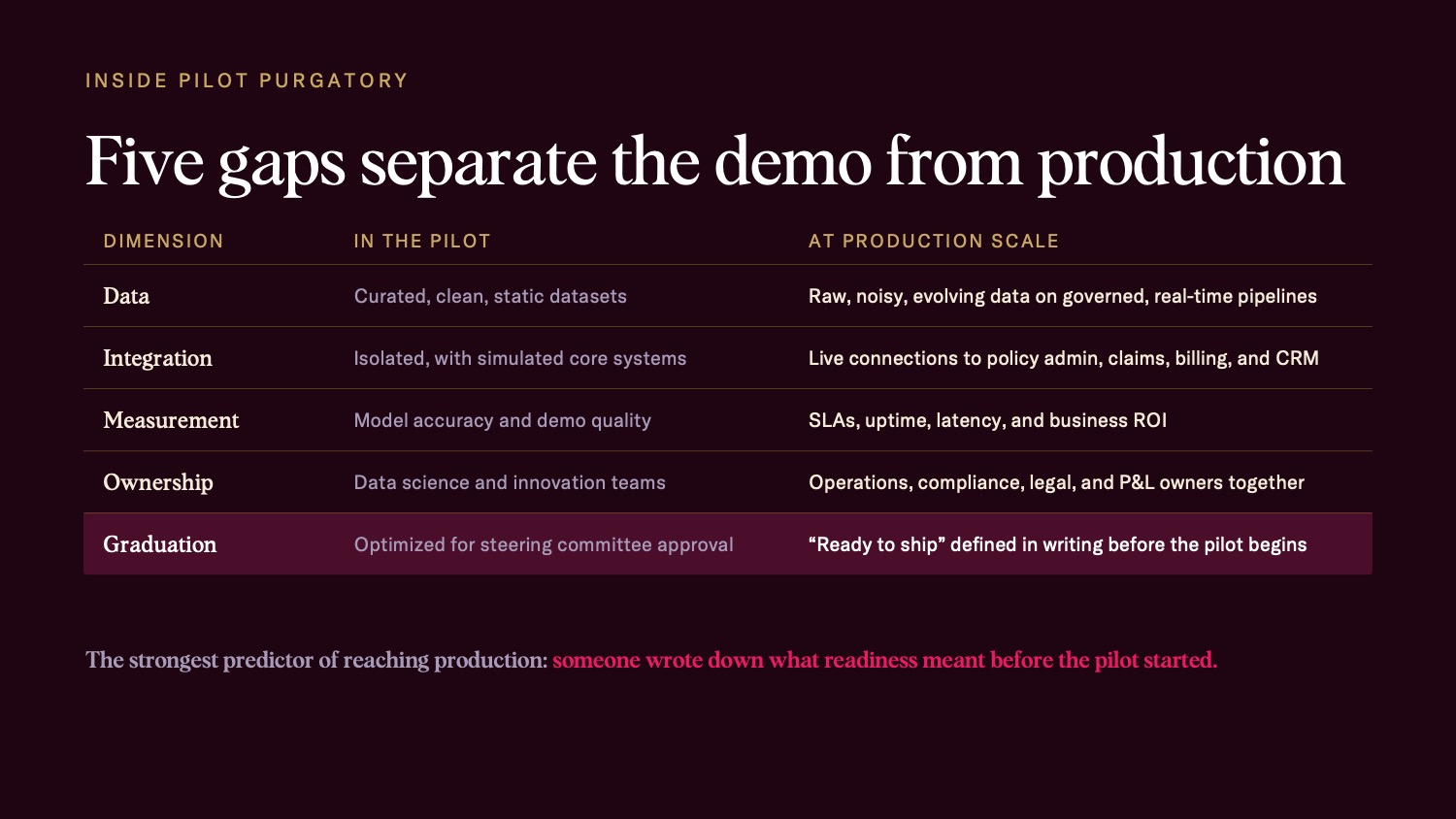
What is pilot purgatory? Pilot purgatory is the state where technically successful AI pilots never reach production. Alchemy Crew research attributes it to five structural gaps between the pilot environment and production scale, spanning data, integration, measurement, ownership, and graduation criteria, rather than to any weakness in the underlying models.
Across the programs we tracked in 2026, five operational dimensions behave one way in a pilot environment and a completely different way at production scale, and programs that never planned for the second state get trapped between them. We call that trap pilot purgatory, and it looks like this.
|
Dimension |
In the pilot |
At production scale |
|---|---|---|
|
Data |
Curated, clean, static datasets |
Raw, noisy, evolving data needing governed, real-time pipelines |
|
Integration |
Isolated, with simulated core systems |
Live connections to policy admin, claims, billing, and CRM |
|
Measurement |
Model accuracy and demo quality |
SLAs, uptime, latency, and business ROI |
|
Ownership |
Data science and innovation teams |
Operations, compliance, legal, and P&L owners together |
|
Graduation |
Optimized for steering committee approval |
“Ready to ship” defined in writing before the pilot begins |
Read that last row twice. In our analysis, the single strongest predictor of a pilot reaching production is whether anyone wrote down what production readiness meant before the pilot started.
The organizations that escape purgatory share three behaviors:
- they treat AI outputs as governed data products,
- they embed intelligence directly into operational workflows rather than parking it in dashboards, and
- they define the business metric a deployment must move before a single license is bought.
The pilots are not dying because the models are weak. They are dying because nobody made a choice.
What should boards chase instead? Kass’s answer
Kass’s formula deserves a place in every strategy offsite: better products plus empowered employees equals lower costs and broader access. Not efficiency. Access. Kass shares that Duolingo used generative AI to launch 148 new language courses in roughly a year, after producing about 100 in its entire first decade. Shopify’s internal Scout tool lets thousands of employees interrogate merchant feedback daily. In both cases, the question was never “what can AI do?” It was “what can we now do that we could not do before?”
And one warning made for regulated industries. People forgive human error and punish machine error. Society tolerates 1.3 million road deaths a year, yet one bad AI experience can kill an entire enterprise program.
In insurance, where trust is the product, governance is not a compliance afterthought. It is the adoption strategy.
“As intelligence becomes unmetered, human qualities become the true competitive edge,” Kass argues. Over-invest in what AI cannot replace: judgment, empathy, trust, and the courage to choose.
Notice that none of this requires a thicker AI strategy document. It just requires “choices.”
What does an AI-enabled strategy look like for an insurer?
An AI-enabled strategy for an insurer is a decision about competitive position, not a tool deployment. It names the advantage the insurer intends to build, such as becoming the market’s fastest and most accurate specialist risk selector, then redesigns appetite, authority levels, submission workflows, pricing consistency, portfolio monitoring, and incentives around that single ambition.
Deploying an underwriting copilot is not a strategy. Automating claims intake is not a strategy. A strategy is to decide to become the market’s fastest and most accurate specialist risk selector through Algorithmic Underwriting (or agentic underwriting), then redesign the organization around that ambition: appetite, authority levels, submission workflows, pricing consistency, portfolio monitoring, and the incentives that hold it all together.

Our research keeps returning to one corner of insurance where that difference is measured in millions: casualty claims under social inflation. A routine $25,000 auto claim can now spiral into a $7 million jury verdict, and the decisive window to manage a severe claim is typically the first 90 to 180 days.

Blending AI with empathetic human claims handling becomes decisive here. An AI activity answers that threat with a document summarizer. An AI-enabled strategy deploys a risk intelligence layer that detects catastrophic exposure early and routes the right human adjuster in while the window is still open.
Generali shows the same logic on the ground. By shifting claims assessment from a document-centric mindset to structured data orchestration, the insurer cut claims report processing time from days to seconds and, in commercial cyber underwriting, shifted expert time from data gathering to risk judgment through a single structured dashboard.
The tools mattered. The choice to compete on speed and precision mattered more.
What is the F.R.O.N.T.I.E.R. framework? The operating model behind the choice
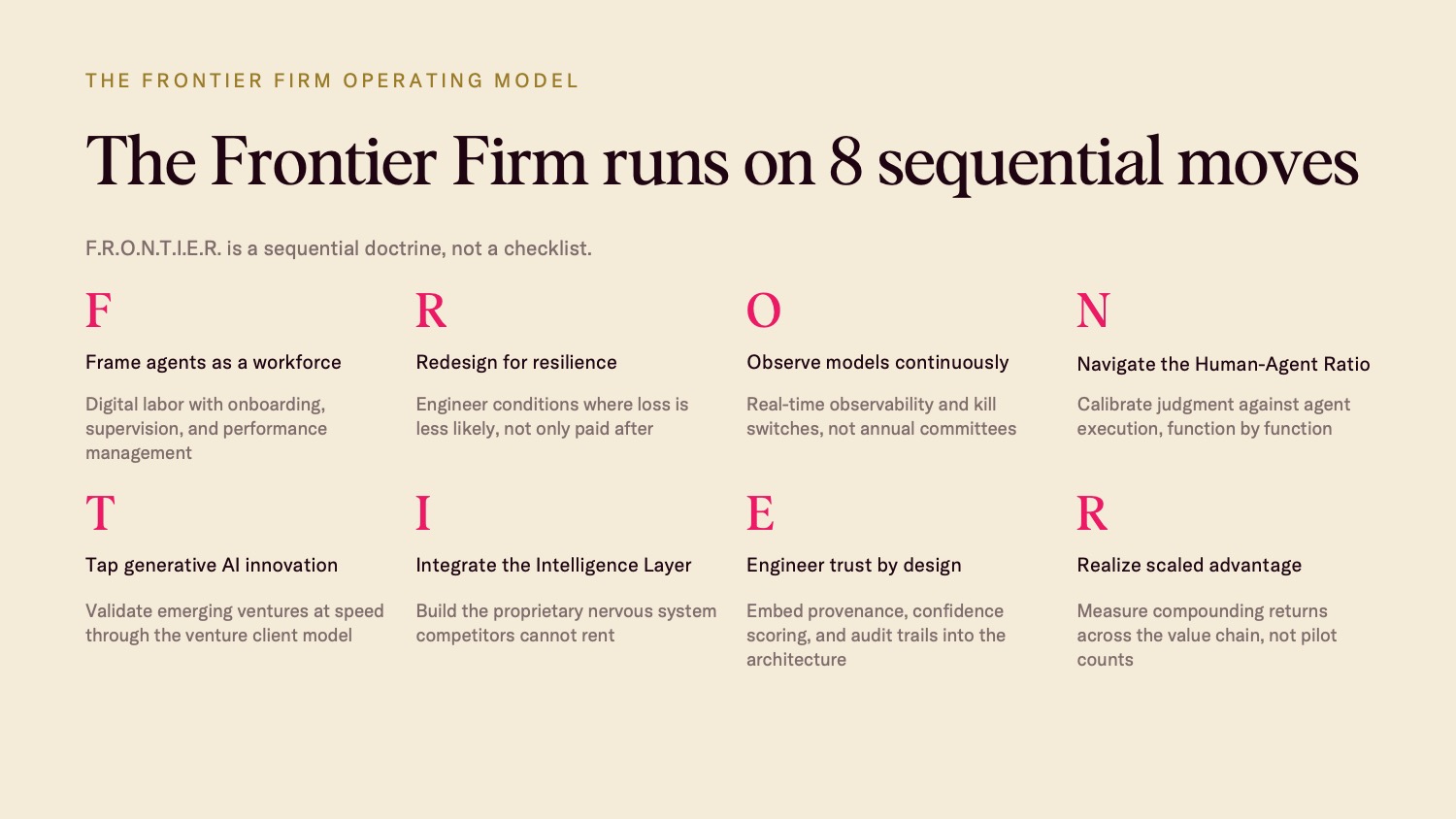
F.R.O.N.T.I.E.R. is Alchemy Crew Ventures’ eight-element map of the Frontier Insurer’s operating model: frame agentic AI as a workforce, redesign operations around resilience, observe AI models continuously, navigate the Human-Agent Ratio, tap generative AI innovation, integrate the Intelligence Layer, engineer trust by design, and realize scaled advantage. It is a sequential doctrine, not a checklist.
From this research, we have distilled the operating model of the structurally ready insurer, the Frontier Firm, into eight elements, closely related to the rise of agentic AI coworkers in insurance.
|
Element |
The move |
|---|---|
|
F – Frame agentic AI as a workforce |
Treat agents as digital labor with onboarding, supervision, and performance management |
|
R – Redesign operations around resilience |
Engineer conditions where loss is less likely, rather than only paying after it |
|
O – Observe AI models continuously |
Replace annual governance committees with real-time observability and kill switches |
|
N – Navigate the Human-Agent Ratio |
Calibrate human judgment against agent execution, function by function, anticipating the autonomous world outlined in AI Horizons 2030 |
|
T – Tap generative AI innovation |
Validate emerging ventures at speed through the venture client model, while the platforms race into the same enterprise ground we mapped in AI Titans Double Down on Enterprise |
|
I – Integrate the Intelligence Layer |
Build the proprietary nervous system competitors cannot rent |
|
E – Engineer trust by design |
Embed provenance, confidence scoring, and audit trails into the architecture, because the AI trust imperative can make or break the business |
|
R – Realize scaled advantage |
Measure compounding returns across the value chain, not pilot counts |
Two elements deserve the board’s particular attention.
- The Human-Agent Ratio forces the question every function must answer: which decisions do agents execute, which do they recommend, and where must humans own the outcome? Underwriters in this model become Agent Bosses, orchestrating a portfolio of digital workers rather than drowning in submissions.
- The Intelligence Layer is where durable advantage lives, because renting the same foundation models as every competitor buys capability without ever buying advantage, as outlined in broader views of the AI-powered insurer.
A third element is quietly doing more work than its position suggests. Engineer trust by design is not the soft item on the list. As we argued in In GenAI We Trust, 78% of organizations claim to trust AI fully while only 40% have invested in demonstrable trustworthiness, and the organizations that close that gap are 60% more likely to double their AI ROI.
Trust is not the compliance line item. It is the multiplier.
The six questions every AI-enabled strategy must answer
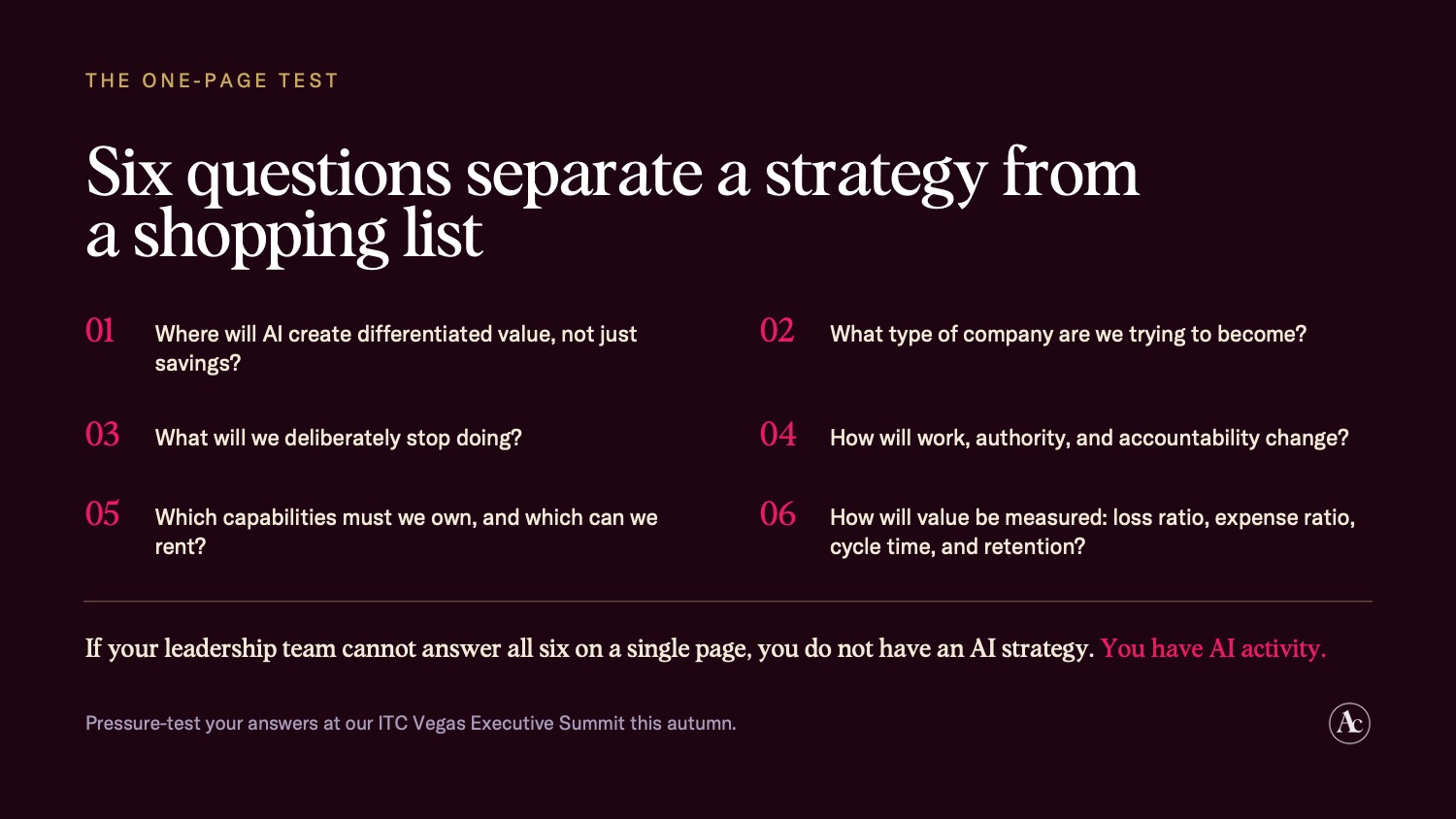
- Where will AI create differentiated value, not just savings, for example in AI-transformed insurance underwriting?
- What type of company are we trying to become in a world of generative AI-enabled underwriting?
- What will we deliberately stop doing?
- How will work, authority, and accountability change?
- Which capabilities must we own, and which can we rent?
- How will value be measured: loss ratio, expense ratio, cycle time, and retention, not pilot counts?
If your leadership team cannot answer all six on a single page, you do not have an AI strategy. You have AI activity.
Your next 90 days
-
Retire the phrase “AI strategy.” Replace it with the sharper question: what is our business strategy in a world where intelligence is cheap, fast, and increasingly autonomous?
-
Write the production definition first. Before the next pilot is authorized, define “ready to ship” in measurable terms, with the P&L owner in the room.
-
Pick one profit and loss metric per business line. Then delete activity metrics from the board pack. As we all know, “busy” is not a KPI.
-
Score your operating model against the eight F.R.O.N.T.I.E.R. elements. Publish the two weakest internal elements, then close the gap through venture-validated adoption.
This is what our DIVAAA pathway, from Discover through Investigate, Validate, Adopt, Activate, and Amplify, was built to industrialize, especially for organizations where the current AI strategy is failing.
Do nothing, and in 90 days you will own more pilots, more licenses, and the same loss ratio. The compounding gap does not pause while you deliberate.
AI is not the strategy. The strategy is the competitive and organizational transformation AI makes possible.
Want to see where you actually stand? If you are heading to ITC Vegas this autumn, join us at our pre-conference executive summit, where we will be pressure-testing exactly these questions with the carriers who intend to answer them first. 2.45 hours. One conversation. A clear view of your two weakest F.R.O.N.T.I.E.R. elements and whether you have a strategy or a shopping list.
Frequently Asked Questions (FAQs)
What is the difference between an AI strategy and an AI-enabled business strategy?
The first typically describes tools, vendors, and use cases. An AI-enabled business strategy starts from where the company chooses to compete and how it intends to win, then explains how intelligence changes those choices, the economics behind them, and the operating model that delivers them. The practical test is whether the organization can name the competitive advantage the AI investment is intended to create. A catalogue of use cases cannot answer that question; a strategy can.
What is pilot purgatory?
Pilot purgatory is the state where technically successful AI pilots never reach production. Alchemy Crew research attributes it to five structural gaps between pilot and production environments, spanning data, integration, measurement, ownership, and graduation criteria, rather than to any weakness in the underlying models. The strongest single predictor of escape is whether the organization defined “ready to ship” in measurable terms before the pilot began. A pilot built as a demo cannot survive contact with real traffic; a pilot built as the first de-risked phase of a production system can.
What is the F.R.O.N.T.I.E.R. framework?
F.R.O.N.T.I.E.R. is Alchemy Crew Ventures’ eight-element map of the Frontier Insurer’s operating model: framing agents as a workforce, redesigning for resilience, observing models continuously, navigating the Human-Agent Ratio, tapping venture innovation, integrating the Intelligence Layer, engineering trust by design, and realizing scaled advantage. It is a sequential doctrine rather than a checklist, which means the later elements depend on the earlier ones being in place. Most organizations we assess are strong on two or three elements and silent on the rest.
What is the Human-Agent Ratio?
The Human-Agent Ratio describes the balance between human judgment and agent execution within each function. Frontier Firms calibrate it deliberately, deciding which decisions agents execute, which they recommend, and where humans must intervene, own outcomes, and escalate. It replaces headcount as the operating metric that matters, because it asks where authority sits rather than how many people are employed. In underwriting, it turns underwriters into Agent Bosses who orchestrate a portfolio of digital workers rather than processing submissions manually.
How should insurers measure AI value?
In business outcomes, not activity. Loss ratio, expense ratio, pricing accuracy, cycle time, conversion, and retention reveal whether AI is changing competitiveness. Pilot counts, license counts, and prompt volumes only reveal how busy everyone is. The discipline that makes this work is defining the metric a deployment must move before the license is bought, so the business case is written while it can still change the design rather than after it can only justify the spend.
Why do most enterprise AI pilots fail to create value?
Rarely because of the technology. MIT’s GenAI Divide research (August 2025) found 95% of enterprise generative AI pilots deliver no measurable P&L impact, and IBM’s study of 2,000 CEOs found only 25% hit expected ROI. Our own 2026 research points to missing strategic foundations rather than model weakness: an AI strategy that stops at a use-case list, no written production definition, no P&L metric, unchanged workflows, fragmented ownership, and governance added after deployment instead of designed in from the start.
About the author
Sabine VanderLinden is CEO of Alchemy Crew Ventures, where she helps insurers and financial institutions convert AI capability into competitive advantage through the venture client model. She is the creator of the DIVAAA™ commercialization pathway and the F.R.O.N.T.I.E.R. operating model, host of the Scouting for Growth podcast, and a recognized voice on Frontier Firm transformation in regulated industries. The research summarized in this article draws on transformation programs tracked across insurance and financial services in 2026.
References
- Alchemy Crew Ventures. “2026 research on enterprise AI adoption, pilot-to-production structural gaps, and the Frontier Insurer operating model.” Proprietary; summarized in this article.
- MIT NANDA. “The GenAI Divide: State of AI in Business 2025.” Reported by Fortune, August 2025
- IBM Institute for Business Value. “CEO Study 2025.” Survey of 2,000 CEOs, May 2025
- McKinsey & Company. “The State of AI.” QuantumBlack
- Zack Kass, former Head of Go-to-Market, OpenAI. AI strategy executive sessions on adoption and value creation, August 2026
- Duolingo. “Duolingo Launches 148 New Language Courses.” April 2025
- Jonathan Trevor, Saïd Business School, University of Oxford. “AI Is Everywhere. Competitive Advantage Is Not”
- Brian Solis. “AI Is Not a Strategy: The Where, Why, and How Framework Shaping AI Business Reinvention”
- Generali case examples. AI-enabled underwriting and claims transformation, 2026
- Alchemy Crew Ventures. “In GenAI We Trust: Why the AI Trust Imperative Could Make or Break Your Business”
- Alchemy Crew Ventures. “AI Titans Double Down on Enterprise: Key Moves from April to June 2025”
Editor in Chief

Rebuilding Risk Resilience