Architecting the Agentic Frontier: The Rise of the Non-Financial Frontier Firm
Mar 16, 2026
Written by Sabine VanderLinden
- The Frontier Firm is no longer a concept. Telstra, Mercedes-Benz, and Nestlé are operating as human-led, agent-operated enterprises in 2026, embedding a Digital Intelligence Layer across their entire value chains to achieve 3x higher returns on AI investments than slower-moving peers. These non-financial Frontier Firms are proving that digital transformation at scale requires redesigning the operating model around intelligence — not bolting AI onto legacy structures.
- The Protection Gap is widening to $59+ billion in uninsured losses annually in the EU alone/ $64 billion in the US, and only Digital Risk Intelligence can close it, combining an Insurance Intelligence Layer with real-time operational data to enable dynamic risk pricing, claims prevention, and proactive resilience. For non-financial sectors facing supply chain disruptions and cyber threats, this represents a fundamental shift from reactive insurance purchasing to prevention as a financial stability tool.
- Workforce transformation is redefining every role through the Human-Agent Ratio, the metric that replaces headcount in the Agentic Frontier, as digital labor scales from 40% of enterprise applications today to a new business model where companies pay for outcomes, not seats. The DIVAAA™ methodology provides a six-phase roadmap for organisations to move from pilot purgatory to enterprise-wide activation, training employees as Agent Bosses who orchestrate, rather than perform, the work.
The Frontier Firm isn’t coming. It’s here.
And it isn’t emerging where most people expected. While financial services dominated the early AI conversation, the most profound digital transformation stories of 2026 are unfolding in telecommunications, automotive, and consumer goods industries, where bits meet atoms, where a Digital Intelligence Layer reshapes physical supply chains, factory floors, and the products in your hand.
This isn’t about adding AI to an existing business model. It’s about redesigning the business around intelligence for a new world.
We’re crossing the threshold of the Agentic Frontier: a structural shift as significant as the industrial revolution or the rise of the internet. Just as digital native companies a generation ago set the benchmark for innovation and productivity, today’s frontier firms are leading the way in adopting emerging digital tools and AI to maintain a competitive edge. The fundamental unit of economic value is moving from software tool access to measurable outcomes: jobs completed, invoices collected, risks mitigated. In this new reality, the organisations that win are those constructing a Digital Intelligence Layer as the central nervous system for end-to-end value chains. In insurance and risk-intensive sectors, this same architecture is emerging as an Insurance Intelligence Layer — translating real-time operational data into AI-powered underwriting insight, claims prevention, and dynamic risk pricing.
The numbers tell the story. The productivity crisis has been taking shape over decades and has become more apparent in recent years. Frontier Firms are realising 3x higher returns on AI investments than their slower-moving peers. Not because they have better technology, but because they’ve embedded intelligence directly into their core workflows rather than bolting it on as an afterthought. 71% of leaders at Frontier Firms say their company is thriving, compared to just 39% at other firms. These efficiency gains and the resulting competitive advantage are driving organizations to rethink their approach. 82% of business leaders consider 2026 the pivotal year to rethink operations for this new reality. The experimental era is over.

What Defines a Frontier Firm in the Age of Agentic AI?
Microsoft’s research defines the Frontier Firm by three capabilities: providing “intelligence on tap,” fostering hybrid “human-agent teams” (hybrid teams), and empowering every employee to function as an “Agent Boss.”
A Frontier Firm is an entirely new organization compared to traditional companies, fundamentally built around hybrid intelligence and the integration of humans and AI agents. But behind that definition lies a maturity journey.
Most organisations are still in Phase 1 — humans with AI assistance.
The Frontier Firm operates in Phase 3: human-led, agent-operated.
The difference between these phases relates to technical capability and organizational structure. The traditional org chart is evolving into more dynamic, outcome-focused models that enable flexible collaboration between humans and AI, accelerating the shift toward Frontier Firms built on agentic AI.
Humans set the strategy. Agents execute the work.
The mechanism driving this shift is what we call the “Intelligence Core:” a foundational Digital Intelligence Layer that enables graduated autonomy across core business functions. This core is increasingly powered by multi-agent systems and multi-agent workflows, which allow multiple AI agents to collaborate and enhance complex operations. Organisations that fail to institutionalise this core find themselves trapped in what I call “legacy behavioural debt”: the technical capabilities are available, but the organisational structures remain too rigid to leverage them. The technology isn’t the constraint. The culture is. And culture is the operating model made visible.
AI talent is now a critical component of workforce composition, as organizations need individuals with core AI skills to build, manage, and scale these systems. The presence and mobility of AI talent directly impact an organization’s AI maturity and competitive positioning.
AI fluency varies depending on your skills and your career stage. It’s not just about technicalities. AI fluency is about understanding why and how to build AI capabilities and how to integrate them into business strategy. The evolution of a Frontier Firm will happen over time as people gain AI fluency, moving from being AI consumers to curators of Hybrid Intelligence. This ongoing shift is essential for organizations aiming to fully realize the benefits of hybrid teams and multi-agent systems.
|
Frontier Firm Maturity Dimension |
Level 5 (Frontier) Characteristics |
Implications for Non-Financial Sectors |
|---|---|---|
|
Data Governance & Ethics |
Unified data estate; “Trust by Design”; Robust AI ethics committee |
Essential for managing “farm to fork” supply chains and network security |
|
Ecosystem & Innovation |
Network orchestrator; strategic alliances (Microsoft, SAP, NVIDIA) |
Accelerates R&D and reduces time-to-market for complex manufacturing |
|
Change Enablement |
Cultural shift over tech project; AI Academies; “Agent Boss” mindset |
Overcomes workforce resistance and promotes human-machine collaboration |
|
AI Integration & Teaming |
Mission-critical AI; autonomous workflows; hybrid human-agent swarms |
Drives 20%+ improvements in productivity and cycle times |
|
Agility & Leadership |
Board-level priority; CEO-led strategy; rapid reallocation of capital |
Allows for real-time strategic adaptation in disrupted global markets |
Telstra: The Architectural Blueprint of the Agentic Telco
Imagine a network outage detected, diagnosed, and resolved... not in hours, but in minutes. No human intervention. No customer impact. That’s not a future scenario. That’s what Telstra is doing right now.
As one of the early adopters of agentic AI in its sector, Telstra began rebuilding its business operations around AI to drive its transformation. Driven by its “Connected Future 30” strategy, Telstra has pivoted from being a traditional connectivity provider to an AI-first technology company and now relies heavily on agentic AI to optimize and modernize its business operations. This is a complete reimagining of the operating model. Successful implementation of AI strategies at Telstra required focusing on specific workflows and building from proven wins. The transformation is CEO-led, which matters because without board-level alignment between business objectives and technological execution, agentic ambitions stall in middle management.

Self-Healing Networks and the Digital Intelligence Layer
In collaboration with Red Hat, Dell, and Cisco, Telstra has built one of the world’s most advanced autonomous networks: a Digital Intelligence Layer for telecommunications infrastructure. The technical breakthrough? Adopting the Model Context Protocol (MCP) alongside a Retrieval Augmented Generation (RAG) framework to solve the “multi-vendor silo” problem, the historical barrier where disparate technology platforms couldn’t communicate. By embedding background AI agents and integrating various AI systems that enable seamless data flow and interpretation across all platforms in a single view, Telstra’s teams now receive on-demand intelligence through context-aware recommendations that resolve faults before customers even notice.
Prevention precedes protection. Even in network infrastructure.
Workforce Transformation: Scaling the Agent Boss
But technology without people is just expensive infrastructure. What makes Telstra a genuine Frontier Firm is how it’s navigating workforce transformation. The company launched an AI Academy providing hands-on training to nearly 9,000 employees, not as a compliance exercise, but as a career accelerator. Today, approximately 21,000 Telstra knowledge workers use Microsoft 365 Copilot for their daily knowledge work, making it one of the most significant enterprise-wide generative AI deployments to date. By leveraging digital labor and automation, Telstra is able to expand workforce capacity, scale operations, and improve overall workforce capacity, enabling the company to operate more efficiently and agilely in a competitive environment.
The transition hasn’t been painless. Telstra has moved to cut roughly 650 roles while offshoring others, reflecting a broader truth: digital labor enables leaner core functions, and leaders who pretend otherwise lose credibility. The honest conversation isn’t whether jobs will change, actually. It’s really about ensuring the people behind them are equipped for what comes next. At Telstra, staff are transitioning from performing repetitive tasks to supervising autonomous agents. The Human-Agent Ratio is being actively calibrated, not as a headcount metric, but as a measure of how effectively human judgment and agent execution are balanced. The integration of AI agents allows human workers to focus on strategic thinking and creativity, while AI agents handle routine inquiries, freeing up humans for complex relationship-building. The role changes. The human doesn’t disappear.
According to the Microsoft Work Trend Index, over 80% of leaders expect AI agents to become extensively integrated within 12–18 months. Furthermore, 82% of global leaders say they are confident they will use digital labor to expand workforce capacity within the next 12–18 months.
Mercedes-Benz: Where Bits Meet Atoms
In Stuttgart, an engineer runs a physics-perfect simulation of an entire factory retooling, testing every variable before a single piece of hardware moves.
In Beijing, a driver’s Mercedes adjusts the cabin temperature and reroutes the journey after detecting fatigue from biometric data before the driver even noticing.
Two moments. One company. Both powered by the same Digital Intelligence Layer built on advanced ai technology.
Mercedes-Benz exemplifies the Frontier Firm through its integration of AI into both manufacturing and the customer experience. The foundation of its transformation is advanced AI technology, enabling hybrid intelligence and orchestrating AI tools across operations. The strategic shift toward “Software-Defined Vehicle” monetisation represents a fundamental business model transformation: in the electric vehicle era, software and data — not just engineering — will drive differentiation and recurring revenue. These AI-driven improvements help save millions by increasing logistics accuracy and operational efficiency during initial implementation.

The Industrial Metaverse as a Killer App
Through its MO360 digital ecosystem, Mercedes-Benz connects over 30 factories worldwide, creating a Digital Twin of its entire production lifecycle. Using Siemens’ Digital Twin Composer, the company simulates factory upgrades and model changes in virtual environments before execution.
The result? A 15% reduction in CAPEX through predictive simulation. Compressed engineering cycles, from 60 months down to 24–36. Stable model changes with dramatically reduced start-up losses.
The role of AI on the factory floor has shifted from purely physical automation to cognitive support. AI assistants serve as voice-based interfaces to the MO360 data, automating routine data collection to support real-time analysis. This enables employees to focus on higher-level analysis and insight generation, leveraging data science techniques to analyse quality data and simulation results more effectively. Mercedes-Benz is also actively testing humanoid robotics, the Apptronik system, for assembly tasks, signalling a move toward a full-stack robotics ecosystem where digital labor directly orchestrates physical output.
The Agentic Cabin
At the consumer level, the 2026 Mercedes-Benz Operating System (MB.OS), powered by NVIDIA’s full-stack drive software, transforms the car into a co-pilot and introduces AI-powered services as digital colleagues that support the driver. These digital colleagues monitor biometrics, cross-reference external data, and proactively adjust settings or reroute the driver before a command is ever given. In this collaborative driving experience, the AI acts as a team member, working alongside the human driver to enhance safety, comfort, and decision-making. In markets like China, AI-powered services using ByteDance’s Doubao achieve a 97% monthly active user rate.
The car doesn’t wait for instructions. It anticipates.
|
Automotive Maturity Indicator |
Status (2025–2026) |
Strategic Outcome |
|---|---|---|
|
Digital Engineering Cycles |
Compressed from 60 to 24–36 months |
Shorter development times for new EV models |
|
In-Car AI Integration |
97% monthly active user rate |
Elevated brand appeal and deepened loyalty |
|
Production Efficiency |
15% CAPEX reduction via predictive simulation |
Leaner, more resilient manufacturing |
|
Software Monetisation |
Strategic shift to OTA updates for revenue |
Higher net-revenue quality through continuous delivery |
Nestlé: “Farm to Fork” Intelligence
Here’s a number that stopped me: what used to take Nestlé 18 months... developing a new food formulation, testing it with virtual taste models, refining it against consumer data, now takes six weeks.
Five times faster. Not by cutting corners, but by deploying an AI-powered recipe optimisation tool that automates low-value tasks, such as routine data analysis and repetitive formulation adjustments, while simultaneously balancing taste expectations with nutrition, cost, and sustainability parameters.
Nestlé represents the consumer packaged goods frontier, demonstrating that even traditional, multi-national manufacturing firms can achieve high digital maturity through disciplined digital transformation.
The foundation? A single global ERP system and a comprehensive data architecture that eliminates the fragmentation plaguing most CPG companies. This is what a Digital Intelligence Layer looks like in consumer goods, not a single platform, but an integrated data estate that makes intelligence available at every decision point.
By pairing irreplaceable human insight with advanced AI, Nestlé drives innovation and ensures that technology augments, rather than replaces, the creativity and judgment of its teams. Irreplaceable human insight remains central to Nestlé’s approach, enabling the company to leverage unique expertise and strategic thinking alongside digital tools.

Procurement Intelligence
In procurement, Nestlé faced a significant capacity gap before digital transformation, a widening disparity between the workload imposed by fragmented systems and the organization's ability to meet demand efficiently. By using AI to analyse hundreds of thousands of contracts across multiple markets, Nestlé now identifies inconsistencies between global terms and local applications. The savings are measured in millions. The time recovered is measured in careers.
Digital Twins at Scale
Across its 300+ factories, Nestlé deploys digital twins to optimise energy use and asset performance while ensuring food safety surveillance. By 2026, AI-driven forecasting tools will stock the correct amount of product at the SKU level, responding to shifting demand with a precision that was historically impossible at this scale. The organisation honours what I like to call the “dirt-under-the-fingernails” reality of farming with the “silicon-speed” of modern AI.
Real digital transformation bridges the physical and the digital. Not one at the expense of the other.
Three Things Every Leader Should Do This Quarter
Before diving deeper into the operating model, let me surface what the Telstra, Mercedes-Benz, and Nestlé stories teach us in practical terms:
Leaders should recognize that every organization has its own journey toward becoming a Frontier Firm—progressing at its own pace and facing unique challenges along the way.
-
Audit your Intelligence Core: Map where your Digital Intelligence Layer currently operates in your value chain and where it’s conspicuously absent. The gaps are your vulnerability. In insurance-adjacent sectors, ask whether you have an Insurance Intelligence Layer that translates operational data into risk insights.
-
Appoint your first Agent Bosses: Identify the M-shaped supervisors who can orchestrate hybrid human-agent workflows and begin calibrating your Human-Agent Ratio. Don’t wait for a reorg. Start with a pilot team this month.
-
Close your Protection Gap: Quantify your uninsured exposure across supply chain, cyber, and climate risk using Digital Risk Intelligence. If you can’t measure it, you can’t manage it, and you certainly can’t insure it.

The Target Operating Model for the Agentic Enterprise
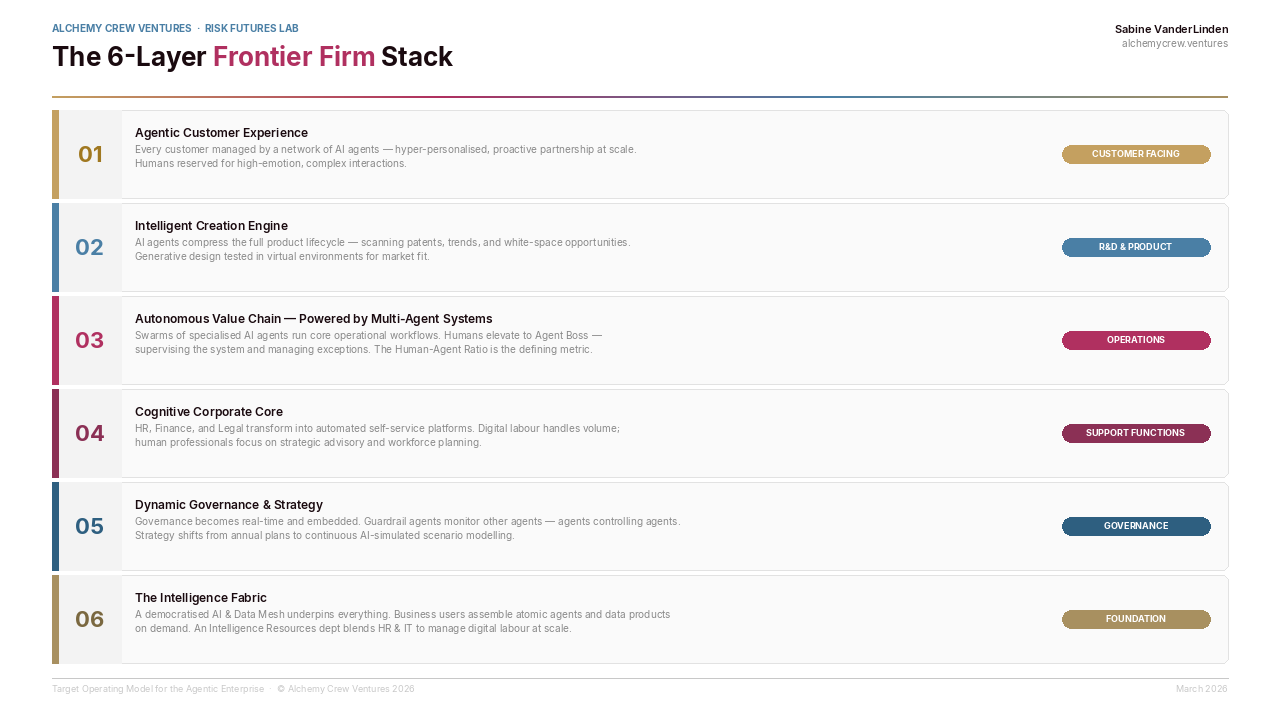
Becoming a Frontier Firm requires a fundamental redesign of the organisational blueprint. Not simply adding AI to an existing business model, but architecting a new operating model around intelligence that changes the very nature of the organisation. We’ve developed a six-layer Target Operating Model that transforms the enterprise into what we call the “Cognitive Corporate Core,” where humans set direction, and AI agents execute and automate at scale.
Layer 1: Agentic Customer Experience
Every customer is managed by a network of AI agents functioning as personal concierges, understanding historical preferences and predicting needs before they’re articulated. Human experts are reserved for the most complex, high-emotion interactions: the ultimate escalation points and empathy providers. The shift? From reactive service to proactive, hyper-personalised partnership.
Layer 2: Intelligent Creation Engine
The entire product lifecycle is compressed. AI agents scan patents, academic papers, and social media trends to identify white-space opportunities for R&D. Generative design agents create thousands of product variations, tested in virtual environments for market fit and sustainability. Speed without sacrificing rigour.
Layer 3: Autonomous Value Chain Powered by Multi-Agent Systems
This is the engine room, where core operational workflows are run by swarms of specialised AI agents. The human role elevates to Agent Boss: supervising the agentic system and managing exceptions rather than performing the tasks. A new metric, the Human-Agent Ratio, refines the balance of oversight and autonomy to maximise efficiency while managing systemic risk. Getting this ratio right is the defining operational challenge of the Agentic Frontier.
Layer 4: Cognitive Corporate Core
Traditional support functions — HR, Finance, Legal — transform into automated, self-service platforms. Intelligent Finance agents handle real-time budget forecasts and monitor transactions for anomalies. Agentic HR handles sourcing, screening, and onboarding. Human professionals focus on strategic advisory and workforce planning. Digital labor handles the volume; human judgment handles the exceptions.
Layer 5: Dynamic Governance and Strategy
Governance becomes real-time and embedded, not periodic and manual. “Guardrail agents” monitor the actions of other agents — agents controlling agents — ensuring compliance with ethical, legal, and financial boundaries. Strategy shifts from a static annual plan to continuous simulation, where AI models market scenarios and provide leaders with real-time strategic options.
Agents controlling agents. That’s what governance looks like in the Agentic Frontier.
Layer 6: The Intelligence Fabric
Underpinning everything is a democratised technology and data architecture: the “Intelligence Fabric.” A distributed Agentic AI Mesh allows business users to discover and assemble atomic agents and data products to create new workflows on demand. The organisation also establishes an Intelligence Resources department: blending HR and IT to manage the lifecycle of digital labor across the enterprise.
Workforce Transformation and the Emergence of Digital Colleagues
Let’s talk about the human side of this. Because the shift toward the Frontier Firm is driving a fundamental workforce transformation across every sector, the conversation requires both honesty and empathy.
Digital labor, AI agents purchased on demand to scale capacity, is becoming a standard component of workforce planning. By 2026, 40% of enterprise applications feature task-specific AI agents. Leaders expect that within five years, human workers will spend more time training (41%) and managing (36%) agents and AI systems than performing the work themselves. This isn’t a future prediction. It’s the current trajectory.
In this new model, teams form dynamically around specific outcomes rather than fixed functions, enabling organizations to be more flexible and outcome-oriented. Human workers are not replaced but take on evolving roles—leading, defining objectives, and guiding AI agents, as well as designing and managing interactions with various AI systems. The integration of AI in business operations can lead to 24/7 productivity without burnout, as digital labor complements human expertise and extends operational capacity.
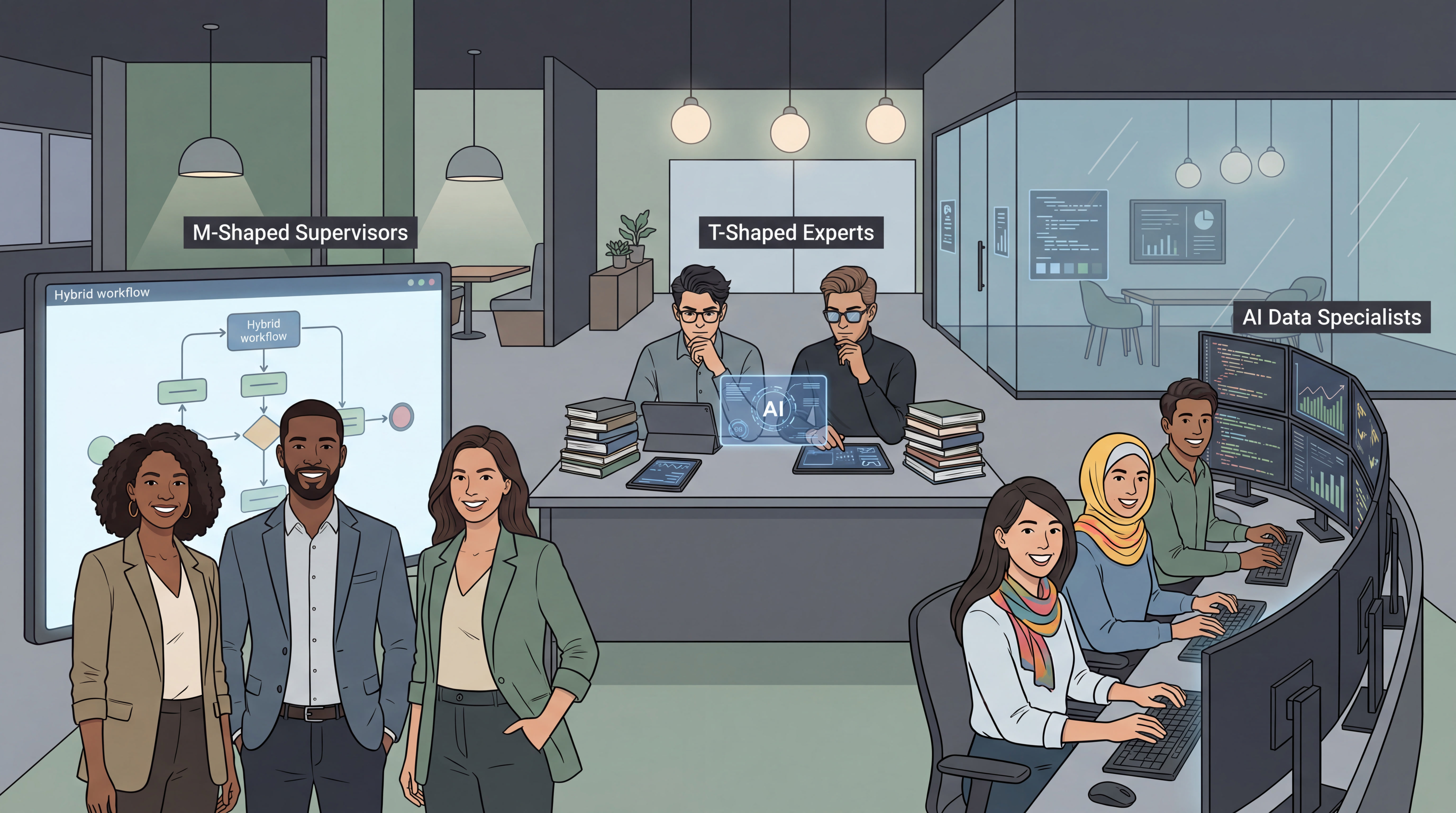
This requires entirely new roles:
-
M-Shaped Supervisors: general managers with broad, multi-domain understanding who orchestrate hybrid workflows and bridge the gap between business needs and AI capabilities.
-
T-Shaped Experts: deep specialists who handle complex exceptions, provide final quality assurance, and train AI agents within their domain.
-
AI Data Specialists: professionals dedicated to ensuring the data estate remains clean and “secure-by-design” for agentic tools.
|
Labor Type |
Mechanism |
Economic Value |
Strategic Impact |
|---|---|---|---|
|
Traditional Human Labor |
Manual execution of tasks |
Hourly/salary based on time |
Linear scalability |
|
Augmented Labor (Phase 1) |
Humans using AI tools (Copilots) |
Improved productivity per head |
Enhanced individual output |
|
Digital Labor (Phase 3) |
Autonomous agents executing workflows |
Outcome-based pricing; completion of jobs |
Exponential scalability and speed |
|
The Agent Boss |
Human oversight of digital labor swarms |
High-level judgment and strategy |
Strategic orchestration of intelligence |
The economic business model is shifting, too. Companies no longer buy “seats” for a CRM, they pay for invoices collected or fraud prevented. Outcome-based pricing compresses coordination overhead and allows firms to parallelise execution at machine-time decision cycles. The Human-Agent Ratio becomes the key metric for workforce planning, replacing traditional headcount models.
The question isn’t whether your workforce will change. It’s whether you’re leading that workforce transformation, or being led by it.
Digital Risk Intelligence and the Protection Gap
In a world where intelligence is “on tap,” the nature of risk changes, and so must our approach to protection.
The Protection Gap, the uninsured economic losses from natural disasters, cyber incidents, and supply chain failures, is widening at an alarming rate. In the US, uninsured disaster losses averaged $64 billion per year between 2021 and 2024. In the EU, the Protection Gap reached €59 billion. And while 86% of global companies suffered supply chain losses in 2025–2026, only one in three were fully covered. This is not a risk management problem. It’s a business model problem.
An uninsurable world demands a different kind of resilience.
For non-financial Frontier Firms like Telstra, Mercedes-Benz, and Nestlé, closing the Protection Gap requires more than buying insurance. It requires a Digital Risk Intelligence capability that embraces uncertainty and places data-driven decision-making at its core, aligning with broader efforts to close the $1.86 trillion global protection gap. In practice, this means building an Insurance Intelligence Layer — a data architecture that continuously feeds operational risk data into underwriting models, enabling agentic, AI-native underwriting and claims management, dynamic pricing, preventive interventions, and real-time exposure management.
Prevention as a Financial Stability Tool
Frontier Firms are adopting platforms like Recorded Future and Dataminr for 360-degree Digital Risk Intelligence, including automated mapping of the attack surface, monitoring for brand impersonation, and rapid remediation of exposed assets.
But the real shift is deeper: prevention as a financial stability tool. By investing in Nature-Based Solutions or AI-Managed Microgrids, companies reduce the root causes of risk. Healthy forests and wetlands function as natural buffers against extreme weather, reducing flooding risks by up to 700% in certain regions. In the CPG sector, Smart Contracts for Spoilage automatically trigger refunds when sensors detect a cold chain break, reducing litigation and administrative friction in global trade. Digital Risk Intelligence makes this prevention measurable, and insurable.
From Pilot Purgatory to Enterprise Activation: The DIVAAA™ Methodology
Digital transformation without a methodology is just expensive experimentation. The DIVAAA™ Transformation System provides a six-phase roadmap for moving from concept to scaled activation of the Frontier Firm operating model:
1. Discover (4–6 weeks): Use a Readiness Scorecard to evaluate your current data estate and organisational maturity.
2. Investigate (6–8 weeks): Build a Venture Client Unit Blueprint to identify external ecosystem partners that can solve specific business bottlenecks.
3. Validate (8–12 weeks): Run focused pilots with clear KPIs to prove the value of agentic workflows.
4. Adopt (4–8 weeks): Integrate successful AI agents into core production systems and workflows.
5. Activate (3–6 months): Scale the agentic model across the organisation and train employees in the Agent Boss role.
6. Amplify (Ongoing): Establish a continuous Innovation Engine that iterates on the Human-Agent Ratio and explores new intelligence layers.
Frontier Firms also leverage what we call the “Venture Client Model 2.0,” where the organisation acts as an early customer for innovative startups rather than just a financial investor. This model accelerates time-to-value from years to weeks, ensuring that technology is embedded in business units rather than siloed in innovation labs.
The Choice of Frontier Transformation Leaders
The year 2026 marks the end of the experimental era and the beginning of a period where digital labor and agentic intelligence define the competitive landscape. The Agentic Frontier is no longer an abstraction. It’s the operating reality for the organisations bold enough to cross the threshold.
For organisations like Telstra, Mercedes-Benz, and Nestlé, the transition to Phase 3 maturity isn’t merely about operational efficiency. It’s about building a more resilient, more proactive, and fundamentally more human-led enterprise. The technology is no longer the constraint. The constraint is the organisational courage to redesign the very fabric of value creation: the business model, the operating model, and the workforce itself.
The strategic imperatives? Invest in a robust Digital Intelligence Layer.
-
Build an Insurance Intelligence Layer to close the Protection Gap.
-
Foster a culture of Agent Bosses.
-
Calibrate your Human-Agent Ratio.
-
Lead your workforce transformation with honesty and ambition.
And do it now — because the gap between Frontier Firms and everyone else is widening every quarter.
The real question isn’t whether your organisation can transform. It’s who will lead that digital transformation.
Frontier Transformation Leaders recognise that in an uninsurable world, digital intelligence is the only durable anchor for financial stability and strategic growth. The choice isn’t whether to move. It’s how fast you’re willing to go.
Reach out if you want to know more -> here.
Frequently Asked Questions
What is a Frontier Firm?
A Frontier Firm is an organisation redesigned around autonomous intelligence, embedding a Digital Intelligence Layer into core workflows. It enables hybrid human-agent teams where humans set strategy and AI agents execute work. Defined by Microsoft’s 2025 Work Trend Index, these firms operate at Phase 3 maturity: human-led, agent-operated.
What is a Digital Intelligence Layer?
This foundational data and AI architecture acts as the central nervous system for an organisation’s value chain, connecting data sources, embedding AI agents into workflows, and delivering real-time intelligence for decision-making. In risk-intensive sectors, it functions as an Insurance Intelligence Layer, supporting underwriting and dynamic risk pricing.
What is the Insurance Intelligence Layer?
A specialised Digital Intelligence Layer for risk-heavy industries that feeds real-time operational data into underwriting models, enabling dynamic pricing, claims prevention, and exposure management. It is key to closing the Protection Gap and enhancing insurability.
What is Digital Risk Intelligence?
A data-driven approach to identifying and neutralising threats across an organisation’s digital ecosystem, including automated attack surface mapping and real-time threat detection. It is essential for closing the Protection Gap and building resilience.
What is the Protection Gap and why does it matter?
The Protection Gap represents uninsured economic losses from disasters and supply chain failures. With billions lost annually and many companies underinsured, it poses a systemic financial risk. Closing it requires combining Digital Risk Intelligence with an Insurance Intelligence Layer.
What is the Human-Agent Ratio?
A workforce metric measuring the balance between human oversight and AI agent autonomy. Unlike traditional headcount, it gauges how effectively human judgment and AI execution are calibrated to maximise efficiency and manage risk.
How does digital transformation differ in non-financial sectors?
Non-financial sectors like telecom, automotive, and consumer goods face unique challenges—complex supply chains, manufacturing constraints, and regulatory demands. The Frontier Firm model embeds intelligence into physical value chains, transforming operations beyond software upgrades.
What is digital labor and how does it change workforce planning?
Digital labor consists of AI agents deployed on demand to scale capacity. By 2026, 40% of enterprise applications will feature task-specific agents. Employees will spend more time managing and training agents than performing manual work, creating new roles and shifting economic models from seat-based to outcome-based pricing.
What is the DIVAAA™ Methodology?
Alchemy Crew Ventures’ six-phase system guiding organisations from pilot projects to enterprise-wide Frontier Firm activation. The phases—Discover, Investigate, Validate, Adopt, Activate, Amplify—offer a structured roadmap to assess readiness, run pilots, integrate workflows, and scale AI adoption.
How does the Frontier Firm operating model differ from traditional enterprise architecture?
The Frontier Firm Target Operating Model has six intelligent layers—Agentic Customer Experience, Intelligent Creation Engine, Autonomous Value Chain, Cognitive Corporate Core, Dynamic Governance and Strategy, and the Intelligence Fabric. Unlike traditional models that add digital capabilities piecemeal, this design centers intelligence, workforce metrics, and real-time governance as foundational elements.
References
1. Agentic AI Reshaping Automotive & Manufacturing | Globant Blog (accessed March 15, 2026)
3. Internal research on the top 5 agentic insurance enterprises — Alchemy Crew Ventures
4. How to Build a Frontier Firm: Defining Your Intelligence Core Blueprint (accessed March 15, 2026)
7. Internal research on the Frontier Firm Target Operating Model: Architecting the Agentic Enterprise — Alchemy Crew Ventures
8. The Frontier Firm Is Born — Microsoft Worklab (accessed March 15, 2026)
9. Telstra advanced autonomous networks ambition through breakthrough AI (accessed March 15, 2026)
10. Telstra pushes forward with agentic AI plans — iTnews (accessed March 15, 2026)
12. Mercedes-Benz Group 2026 China Update (accessed March 15, 2026)
15. How Mercedes-Benz is revamping its assembly concept (accessed March 15, 2026)
16. Nestlé selected to join the Frontier Firm AI Initiative — Nestlé Media (accessed March 15, 2026)
17. Generative AI Food: Complete Guide to AI Recipe & Culinary Innovation 2026 (accessed March 15, 2026)
18. How AI Is Transforming the CPG Industry — Bringoz (accessed March 15, 2026)
19. AI in Consumer Goods: How It’s Changing the Industry — Salesforce (accessed March 15, 2026)
20. Food Supply Chain AI: Saving Our Food System — Interconnected (accessed March 15, 2026)
21. Top 10 AI Trends for 2026: What Business Leaders Need to Know (accessed March 15, 2026)
23. Digital Risk Protection Market Size and Outlook 2030F — TechSci Research (accessed March 15, 2026)
24. Auto Sector: When Cyber Risk Becomes Credit Risk — S&P Global Ratings (accessed March 15, 2026)
26. Global Insurance Market Report (GIMAR) — IAIS (accessed March 15, 2026)
29. Tackling the Insurance Protection Gap — WWF Schweiz (accessed March 15, 2026)
30. Supply Chain Losses Hit 86% of Companies — Risk & Insurance (accessed March 15, 2026)
31. Digital Risk Management in 2026: 3 SAP-Integrated Steps — Nagarro (accessed March 15, 2026)
32. Solutions: Digital Risk Management — Dataminr (accessed March 15, 2026)
Editor in Chief

Rebuilding Risk Resilience