The Capacity Gap: Why Your Corporate Strategy is a Leaky Bucket (And How to Fix It)
Feb 07, 2026
Written by Sabine VanderLinden
-
What if your biggest strategic threat isn't the competition, but the growing chasm between ambition and delivery—so pervasive that research finds only about one in five organizations achieves 80% or more of its strategic targets (HBR).
-
Learn how "Frontier Firms" like Ping An and Nestlé are not just managing, but mastering this challenge. They're redesigning their work, turning capacity from a constraint into a competitive advantage.
-
Unlock a 5-step playbook to close your own Capacity Gap. Move from perpetual pilot projects to a powerful engine of execution, leveraging AI, strategic partnerships, and a new operating model for the digital age.
The Ghost in the Machine
What if the single greatest obstacle to your company’s future success isn’t a line item on your balance sheet? What if it’s an invisible force, a silent thief of momentum that lives in the space between your boardroom’s bold vision and your team’s daily reality? It’s the reason multi-year transformation roadmaps quietly wither, why “quick wins” never seem to scale, and why your best people are perpetually, heroically, exhaustingly busy, yet the needle barely moves on your most critical goals.
This is the Capacity Gap. It’s not a people problem. It’s a math problem. It’s the fundamental mismatch between the infinite demands of strategic ambition and the finite capacity of your organization to execute. It’s the canyon that opens when the C-suite declares, “We need to be an AI-first company,” while the IT department is still wrestling with a core system from 2004. For years, we’ve misdiagnosed this as a failure of strategy, leadership, or talent. But this is a structural failure to align what we want to do with what we can do. And in the age of AI, where speed is the new currency, this gap is a chasm threatening to swallow entire enterprises.
Breakdowns in information flows and knowledge loss often occur due to employee turnover, with departing employees taking valuable expertise with them. Inadequate documentation and information sharing can significantly hinder knowledge transfer within organizations, making it harder for remaining employees to maintain momentum and drive continuous improvement. The financial cost of replacing an employee can range from 50% to 200% of their annual salary, depending on their role and expertise—meaning that knowledge loss doesn’t just impact productivity, it also costs the business significant money.
Why Now? The Unbearable Weight of Ambition
The pressure has never been greater. A perfect storm of disruptive forces—generative AI, climate risk, shifting customer expectations, and relentless cyber threats—is forcing a level of ambition that legacy operating models cannot support. The insurance industry finds itself at the epicenter. A recent study found that while the sector shapes its AI adoption, a staggering 70% of the challenges in scaling these initiatives are not technological, but human and organizational. Indeed, McKinsey confirms that 70% of transformation initiatives fail. Another report reveals that only 7% of insurers have successfully scaled their AI systems across the enterprise, with two-thirds still stuck in "pilot purgatory."
We are entering a world where the word of the street is survival. The growing chasm between ambition and delivery—so pervasive that research finds only about one in five organizations achieves 80% or more of its strategic targets. Companies are pouring trillions into digital transformation—$3.7 trillion in 2026 (IDC) alone expected to reach $4 trillion in 2027 —yet 70% (two-thirds) of these initiatives still fail to meet their objectives (BCG). The culprit is rarely the technology itself. BCG’s research also breaks down the blockers: roughly 20% of scaling challenges are technological. It's the organizational friction, legacy systems, integration, data governance, and operational drag (BCG) that create a bottleneck between vision and value. The bulk sits in the operating model, incentives, and accountability. The winners of the next decade will not be the companies with the most visionary strategies, but those with the smallest capacity gaps.

The Frontier Firm Advantage: Turning Capacity into a Weapon
While many incumbents are drowning in the capacity gap, a new breed of “Frontier Firms” is emerging. These organizations, like Nestlé and Ping An, are not just managing capacity. They are weaponizing it. They treat capacity not as a fixed constraint, but as a dynamic asset to be designed, orchestrated, and multiplied. They have shifted their core question from “How do we build this ourselves?” to “How do we close the gap intelligently and deliver outcomes faster?” Rather than relying solely on in-house development, Frontier Firms leverage external partners to complement and extend their core business. By forming strategic business partnerships, they benefit from legal structures that clarify management responsibilities, profit sharing, and liability, while also gaining access to new markets and regulatory advantages.
These firms invest in operational elasticity: a combination of modular technology, rich partner ecosystems, and agile governance that allows them to expand and contract their delivery capabilities on demand. Let’s deconstruct their playbook.
Case Study: Ping An – The Ecosystem as an Engine
Ping An is the ultimate blueprint for a Frontier Firm. It transformed itself from a traditional insurer into a technology-driven ecosystem, famously stating its goal is to be a "technology company that happens to work in finance." With over 53,000 patent applications, 3,000 scientists, and 21,000 developers, Ping An has systematically dismantled the traditional constraints of the insurance industry.
Today's strategies are built on three "Intelligence Layers" that directly address the capacity gap:
|
Intelligence Layer |
Traditional Paradigm |
Ping An's Frontier Model |
|
Slow, manual, adversarial. A cost center. |
Automated, data-rich, customer-centric. A profit driver. |
|
|
Historical data, broad demographics. Guesswork. |
Dynamic, real-time AI-powered risk assessment. Precision. |
|
|
Monolithic, inflexible systems. An innovation blocker. |
Cloud-native, API-driven ecosystem. A venture creation engine. |
Ping An's AI-powered systems deliver staggering results. Their "111 Fast Claim" service allows for one-sentence reporting, one-click uploading, and one-minute validation, with an average claim processing time of just 7.4 minutes. An astonishing 93% of their life insurance policies are underwritten in seconds, and their AI-driven image recognition for auto damage assessment boasts 95% accuracy. By building an intelligent core, they spun off OneConnect, a Technology-as-a-Service platform now serving 99% of China's city commercial banks and 53% of its insurers, turning internal capacity into an external revenue stream.
Case Study: Nestlé – AI-Augmented Innovation Throughput
Nestlé, the world's largest food company, faced a different capacity challenge: the speed of innovation. To close the gap between aggressive product development goals and the plodding pace of traditional R&D, they invested heavily in AI. The company built a generative AI platform that analyzes consumer data to generate new product concepts, compressing a development process that once took months into weeks.
The impact has been profound. Nestlé built a GenAI tool, anchored in consumer insights, that can present a range of new product concepts in under a minute, drawing on inputs from more than 20 brands. In early efforts, Nestlé says it accelerated product ideation from 6 months to 6 weeks and trained about 100 members of its innovation team to use the tool. And this isn’t just my label—Microsoft’s 2025 Work Trend Index describes the rise of ‘Frontier Firms,’ organizations built around on‑demand intelligence and human‑agent teams. In that report, 71% of Frontier Firm leaders say their companies are thriving, compared with 39% globally.
By augmenting their human teams with AI, Nestlé can explore more ideas, test them faster, and bring more winning products to market. Nestlé's journey proves that technology, when applied strategically, is a powerful force-multiplier for organizational capacity.

Encouraging Cross-Functional Collaboration
In today’s hyper-competitive landscape, encouraging cross-functional collaboration is essential for any organization aiming to close the capacity gap and achieve long-term sustainability. The most successful corporate partnerships and business partnerships are built on a foundation of teams working closely together, sharing expertise, resources, and information to unlock new levels of internal and external innovation.
"Harvard Business Review Analytic Services, working with the Brightline Initiative, found that only about one in five organizations achieves 80% or more of its strategic targets. Put differently: four out of five strategic plans fall short in execution."
"And McKinsey notes that 70% of transformations fail—not because leaders lack vision, but because organizations lack the capacity to deliver.”
When companies break down silos and foster collaboration across departments and with external partners, they gain access to a broader pool of ideas, skills, and new technology. This approach is especially prevalent in developed countries, where leading organizations recognize that the ability to innovate and adapt quickly is a key driver of competitive advantage. For example, launching a pilot project with a strategic partner can serve as a low-risk way to test new solutions, gather data, and build confidence in the partnership’s potential for future success. Collaboration like this is a crucial component of commercialization at scale, enabling innovative methods and technologies to reach a wider market and amplifying success.
"Yet outcomes are elusive. Gartner reports that, on average, only 48% of digital initiatives enterprise-wide meet or exceed their business outcome targets."
Cross-functional collaboration exists in varying degrees—from informal knowledge sharing to fully integrated, formalized partnerships. Regardless of the structure, the main criteria for success remain the same: a shared vision, open communication, and a strong commitment to working together. By aligning on strategy and goals, companies and their partners can reduce risk, accelerate the adoption of innovation, and ensure that new ideas are not only developed but also successfully brought to market.
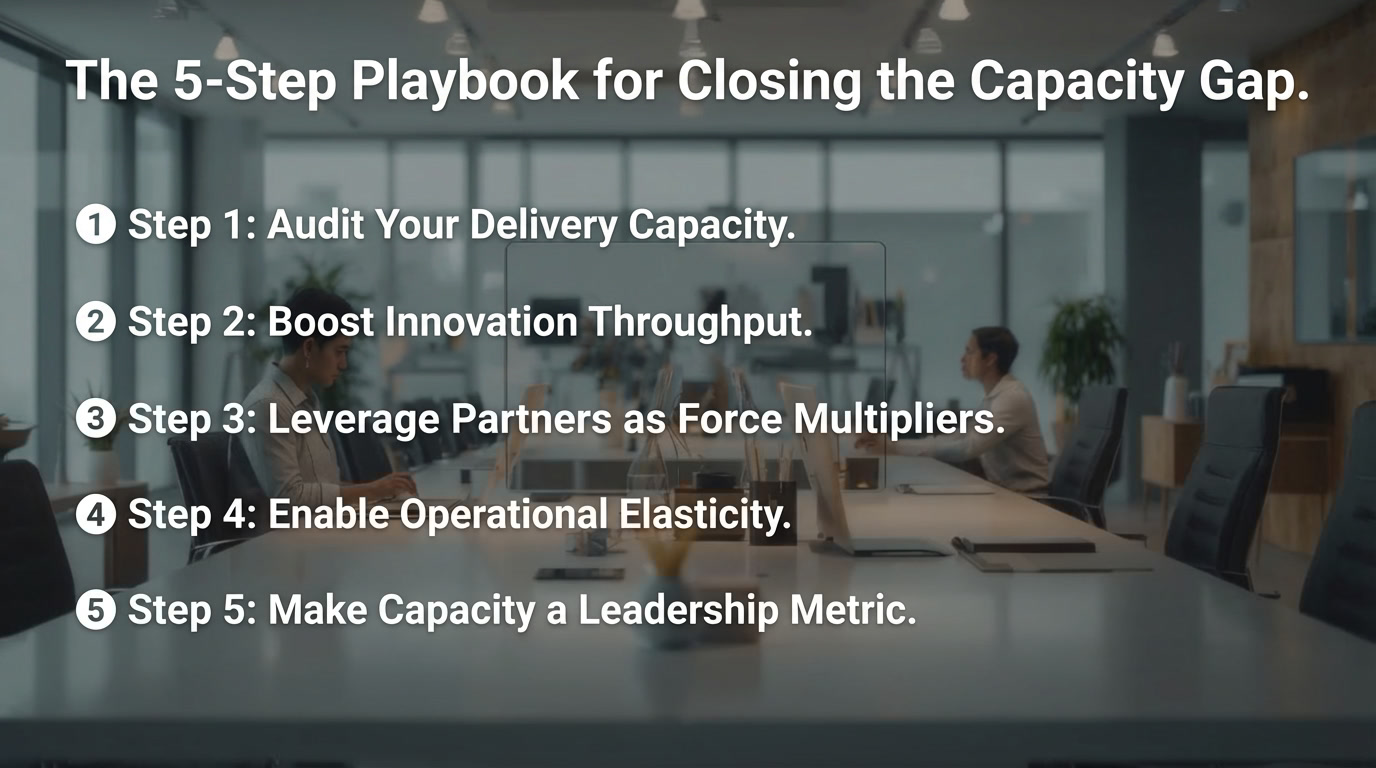
The 5-Step Playbook for Closing the Capacity Gap
To go back to the statement I heard at Microsoft Ignite, closing the capacity gap is not about asking your teams to work harder. It’s about reimaginging and redesigning the work itself. Frontier firms have already tested and written the playbook, and it’s available for any leader willing to make the shift.
-
Step 1: Audit Your Delivery Capacity. You cannot manage what you do not measure. Conduct a ruthless, honest audit of your organization’s true delivery capacity. Start by conducting a thorough gap analysis to define the current state of resources and the desired future state. Map your strategic ambitions against the finite resources—people, skills, technology, and time—available to achieve them. Leverage AI-powered tools and enterprise resource planning (ERP) systems for real-time visibility into capacity and demand. For instance, SAP has made some significant improvements to its platform with SAP Joule. To fill high-demand gaps, organizations should switch to skills-based hiring. This audit will create a “capacity vs. ambition” map, exposing mismatches and making the invisible gap visible and actionable.
-
Step 2: Boost Innovation Throughput. We all need to remember that "Innovation" is not one single event in time. It is a capacity system. The goal is not to generate more ideas, but to increase the flow of ideas to scaled outcomes. Limit work-in-progress. Implement ongoing training programs to close skill gaps and prepare employees for future needs—especially as 54% of employees require significant reskilling by 2026 to adapt to technological changes. Create dedicated, cross-functional “Digital Factory” teams, shielded from daily operations, and empower each team to drive high-priority projects from concept to launch.
-
Step 3: Leverage Partners as Force Multipliers. Frontier firms leverage external ecosystems not as simple vendors, but as strategic capacity multipliers. This is the essence of the Venture-Client Model, where a large corporation acts as a client to a startup, gaining access to cutting-edge technology and specialized skills without the overhead of internal development. Industries with complex technical challenges—manufacturing, healthcare, energy, and financial services—have embraced this approach. When you partner with a startup, you are not just buying software; you are buying capacity relief. The benefit of such collaborations includes access to new markets, resources, and technology that would take years to build internally. Startups' satisfaction rises significantly when they feel their corporate partner is highly committed, and working closely enhances both innovation and partnership outcomes. Establishing clear goals and KPIs is essential for successful corporate-startup collaborations, with performance tracked through AI-driven dashboards and predictive analytics to identify bottlenecks in real time. Review capacity plans regularly to ensure alignment with shifting business goals, and implement agile planning models to make rapid, iterative adjustments to changing market conditions.
-
Step 4: Enable Operational Elasticity. Operational elasticity is the ability to dynamically scale capacity up or down. Migrating to modular, cloud-based architectures provides the technical foundation. But elasticity is also about people: building a flexible workforce model and having framework agreements with trusted partners to bring in skilled teams on short notice. Utilizing technology to document processes helps organizations retain critical knowledge and improve efficiency. Cross-functional collaboration encourages teams to share specialized knowledge, strengthening the organization as a whole.
-
Step 5: Make Capacity a Leadership Metric. The focus on capacity must be embedded in governance and leadership accountability. Make capacity a board-level metric. Track key performance indicators (KPIs) such as utilization rates and employee engagement to measure capacity changes. Using performance management tools and data analytics can help monitor deficiencies that impede staff potential. Track “innovation throughput” and “delivery velocity” with the same rigor as you track revenue and profit. When leadership is measured on its ability to close the gap between strategy and delivery, the entire organization will shift its focus from admiring the problem to solving it.
Conclusion: Stop Admiring the Gap, Start Closing It
The capacity gap is the quiet crisis in the modern enterprise, but it is not insurmountable. It is a design problem, and it can be solved by design. The choice for leaders today is stark: continue to admire the gap, launching ambitious strategies destined to fail under their own weight, or begin the real work of building an organization that has the capacity to deliver on its promises. In the age of AI, the most valuable asset is not your strategy, but your ability to execute it. The playbook is clear. The examples of Frontier Firms like Ping An and Nestlé prove it's possible. The only remaining question is, do you have the capacity for change?
Frequently Asked Questions
Q1: Is the Capacity Gap just another term for a lack of resources?
Not exactly. The Capacity Gap is more structural—the mismatch between strategic goals and the organization's underlying ability to deliver, including skills, processes, technology, and governance. You can have a large budget but still have a massive capacity gap if your processes are slow and teams are siloed.
Q2: Our company is investing heavily in AI. Isn't that enough?
Investing in AI is critical, but not a silver bullet. Research shows that 70% of the challenges in scaling AI are organizational, not technological. Closing the gap requires technology paired with changes to culture, skills, partnerships, and governance.
Q3: How can the Venture-Client model help a risk-averse company?
The Venture-Client model is perfectly suited for risk-averse organizations. Instead of acquiring startups, you become their first strategic client. This provides a low-risk way to "rent" cutting-edge capabilities and learn from agile teams without the massive upfront investment of traditional M&A.
References
HBR, Testing Organizational Boundaries to Improve Strategy Execution
McKinsey, Perspective on Transformation
BCG, Insurance Leads in AI Adoption: It’s Time to Scale Up.
Algorithmic Underwriting 2.0 is revolutionizing risk assessment in insurance.
McKinsey Perspective on Transformation
Nestlé Unlocking New Opportunities With Gen AI
Earnix, "Data Modernization for Insurance: 74% Still Use Legacy...," February 2025. For further insight on digital transformation trends in insurance and finance, see 2024 Trends: Insurance & Finance in Digital Transformation.
Ping An Group, "Driving Innovation with Generative AI," March 2025. For further insights on recent developments in enterprise AI, see the podcast episode "AI Titans Double Down on Enterprise: Key Moves from April to June 2025".
Editor in Chief

Rebuilding Risk Resilience