The Intelligence Layer Is Now Sovereign Territory: Implications Ahead
Jul 03, 2026
Written by Sabine VanderLinden
KEY TAKEAWAYS
- Travelers just ended the build-vs-buy debate. By training TravelersLLM on decades of its own claims and underwriting judgment, and outperforming the frontier labs on its own tasks, it proved the Intelligence Layer is territory to be owned, not a service to be rented.
- The real choice isn't binary — it's a triangle. Build, rent, or venture-client: three doors to sovereign intelligence, and the right answer depends on whether the workload touches your pricing, your appetite, and your judgment, or just your paperwork.
- Sovereignty is a portfolio decision you can start this quarter. A practical playbook — inventory your AI estate, split commodity from core, and run your first venture-client sprint — with MSIG × fileAI as proof that the third door delivers at production depth.
Somewhere in Hartford this spring, a data science team watched a benchmark result come back that was not supposed to be possible. Their model — trained in-house, on millions of their company’s own documents — had just outperformed the best frontier models money can rent. Not once. Consistently, across tens of thousands of insurance questions, at lower cost and higher speed. And the company that did it was not a model lab. It was a Fortune 100 insurer.
On 30 June 2026, The Travelers Companies announced this publicly: TravelersLLM, a proprietary large language model built by its own engineers and data scientists, out-benchmarked the commercial frontier on the questions that matter most to its business. Read that again. An insurer beat the model labs. On insurance. With its own brain.
That is what it means to say the intelligence layer is now sovereign territory: for insurers, reinsurers, brokers, banks, and CIOs shaping AI strategy, the most valuable AI is increasingly the intelligence a firm owns outright: models, judgment, and workflows built on its own data, governance, and domain expertise, not rented capability. This piece looks at what that shift changes in practice: when to build proprietary models versus buy access, how venture-clienting can pull startup and scaleup solutions into the enterprise faster, how to govern and operationalize AI decisions, and what it takes to move from pilots to scaled adoption. The stakes are strategic. If your digital labor runs on the same rented intelligence as everyone else’s, differentiation erodes; if your intelligence layer compounds your institution’s knowledge, it becomes a moat.
Travelers just ended the build-vs-buy debate for sovereign AI
For two years, build-versus-buy was a slide in every AI strategy deck: debated, deferred, revisited next quarter. Travelers just ended the deferral. A Fortune 100 P&C carrier has demonstrated that decades of underwriting judgment, claims history, and institutional knowledge — the assets an insurer already owns — can be compounded into a model that beats the general-purpose alternatives on the questions that matter. It earned a CIO 100 Award for the work, and it is now the foundation for agentic applications across the enterprise. That is not an AI pilot. That is a strategic asset: a carrier deciding its intelligence is sovereign territory, worth owning the way it owns its actuarial tables.
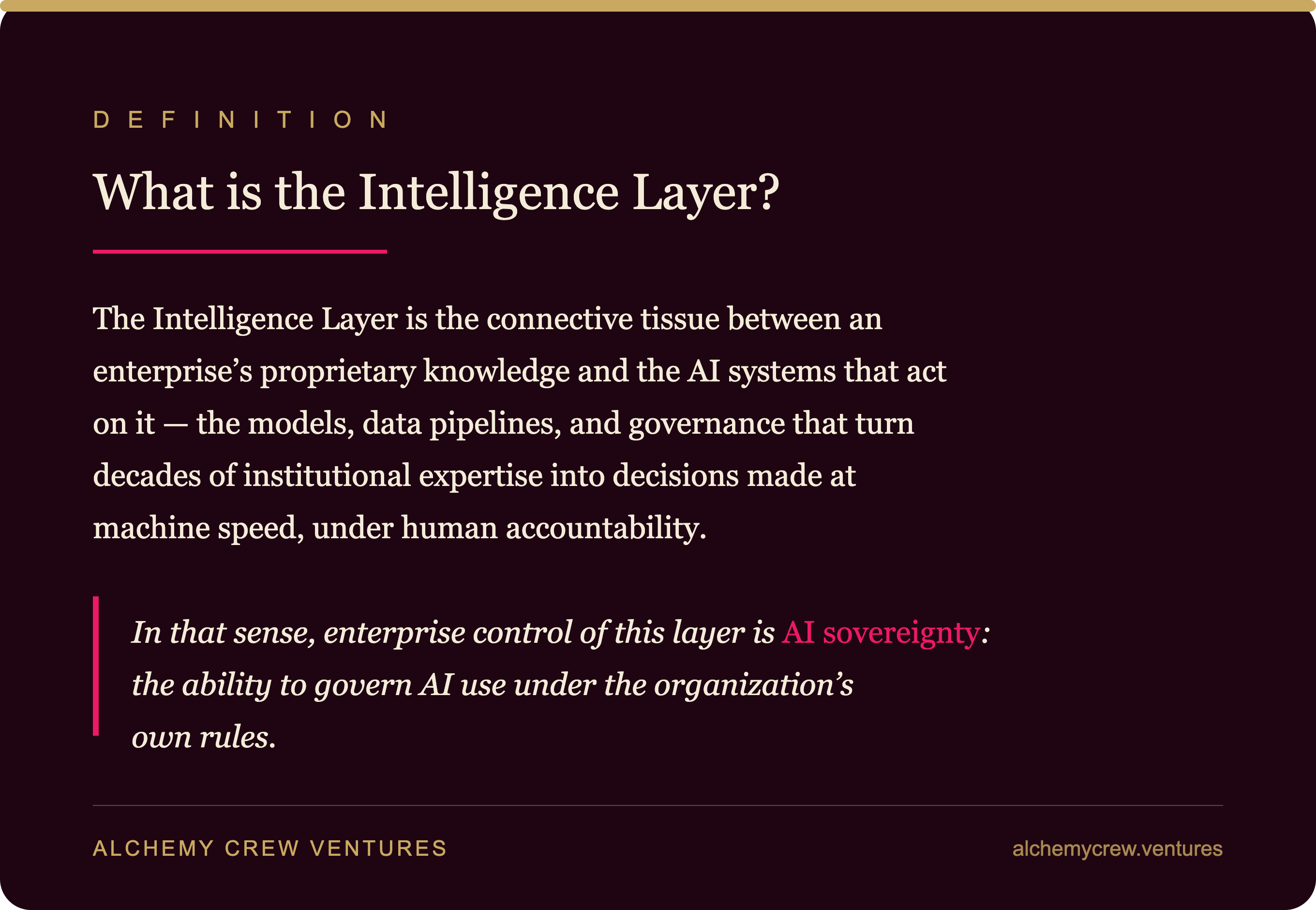
What is the Intelligence Layer? The Intelligence Layer is the connective tissue between an enterprise’s proprietary knowledge and the AI systems that act on it, the models, data pipelines, and governance that turn decades of institutional expertise into decisions made at machine speed, under human accountability. In that sense, enterprise control of this layer is AI sovereignty: the ability to govern AI use under the organization’s own rules.
Build: AI infrastructure knowledge that compounds instead of leaking
Here is what Travelers actually proved. The value of a carrier is not its policy admin system. It is the accumulated judgment inside millions of documents, submissions declined and why, claims disputed and how, risks priced and repriced through cycles. Route that corpus through a rented general-purpose model, and the judgment informs someone else’s roadmap. Embed it in a model you own, and it compounds while maintaining control over the intelligence supply chain: every underwriting analysis, every research query, every agentic workflow gets smarter on your data, your terms, your P&L.
That is the Agentic Frontier’s uncomfortable secret: agentic AI systems are only as differentiated as the knowledge they act on. Travelers now have a foundation nobody can subscribe to. Sovereign models are trained on local data or enterprise-native data so the intelligence reflects the context it is meant to serve.
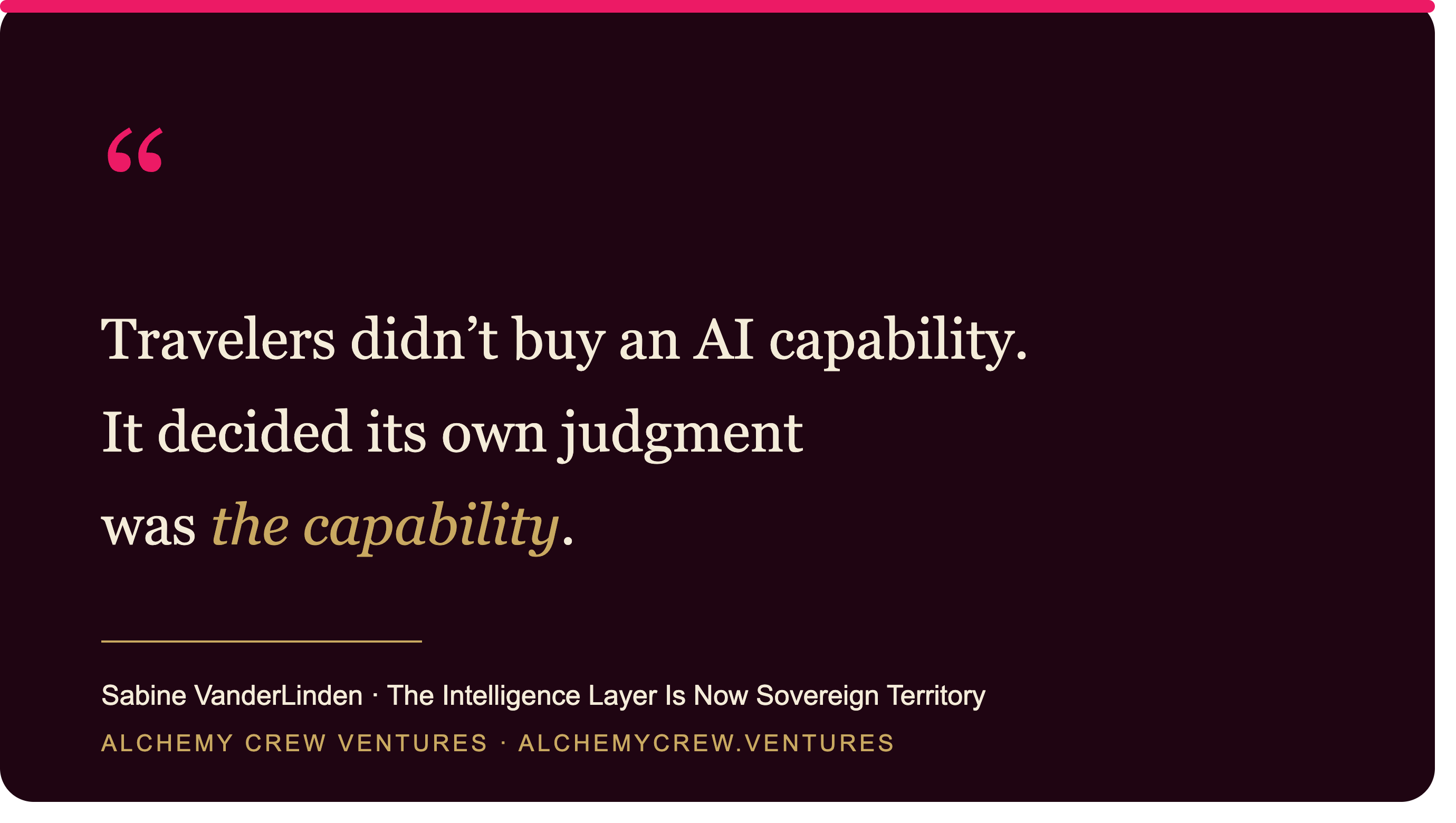
Travelers didn’t buy an AI capability. It made its own judgment about its capabilities and, with it, gained greater independence from foreign AI providers.
Rent: digital labor without digital sovereignty or a moat
Now the empathy note, because I have sat in these rooms. Most CIOs are squeezed between a board demanding an AI story and a procurement reality that offers exactly one: rent a frontier model, wrap it in guardrails, and ship a copilot. It works — and yet, somewhere around the third copilot demo, a quiet dread settles over the room, because everyone senses the ceiling. Renting a frontier model is like hiring a brilliant consultant who also works for your competitors: the same brain, the same advice, on every side of the table. Much of that rented intelligence is processed through a foreign technology stack in a data center beyond your national jurisdiction, which weakens legal authority, data residency, and real sovereignty. When your differentiation is prompt hygiene, your digital labor is a commodity wearing your logo.
Rented intelligence is the right answer for commodity workloads. Think about summarisation, drafting, and translation. It is the wrong answer for the decisions that define a carrier: what to write, what to pay, what to walk away from, especially as AI transforms core insurance underwriting decisions. In high-stakes settings, that dependence can raise data protection concerns and increase cross-border breach risk, while open source designs improve portability across providers and jurisdictions for firms trying to avoid vendor lock-in and preserve technical sovereignty and strategic autonomy.
Venture-client: the 3rd door for AI innovation and the other 95%
Travelers could build because it has Fortune 100 data volumes, engineering depth, and a nine-figure technology budget. Most carriers have none of those, and pretending otherwise is how innovation theatre starts.
But the same 8 July scan batch carried the counter-proof: MSIG Asia cut claims-processing time by 60% by adopting fileAI, a scaleup’s capability, straight into a production workflow. No model program, no research lab, no moonshot. A carrier bought outcomes from the frontier by becoming the startup’s client — and kept its sovereign decisions in-house.
That is the triangle nobody else is drawing: build, rent, or venture-client. More than 60 nations have now published formal AI strategies as of 2025, which is why this choice is showing up across markets and shaping AI sovereignty, echoing board-level debates on AI horizons and operating models to 2030.
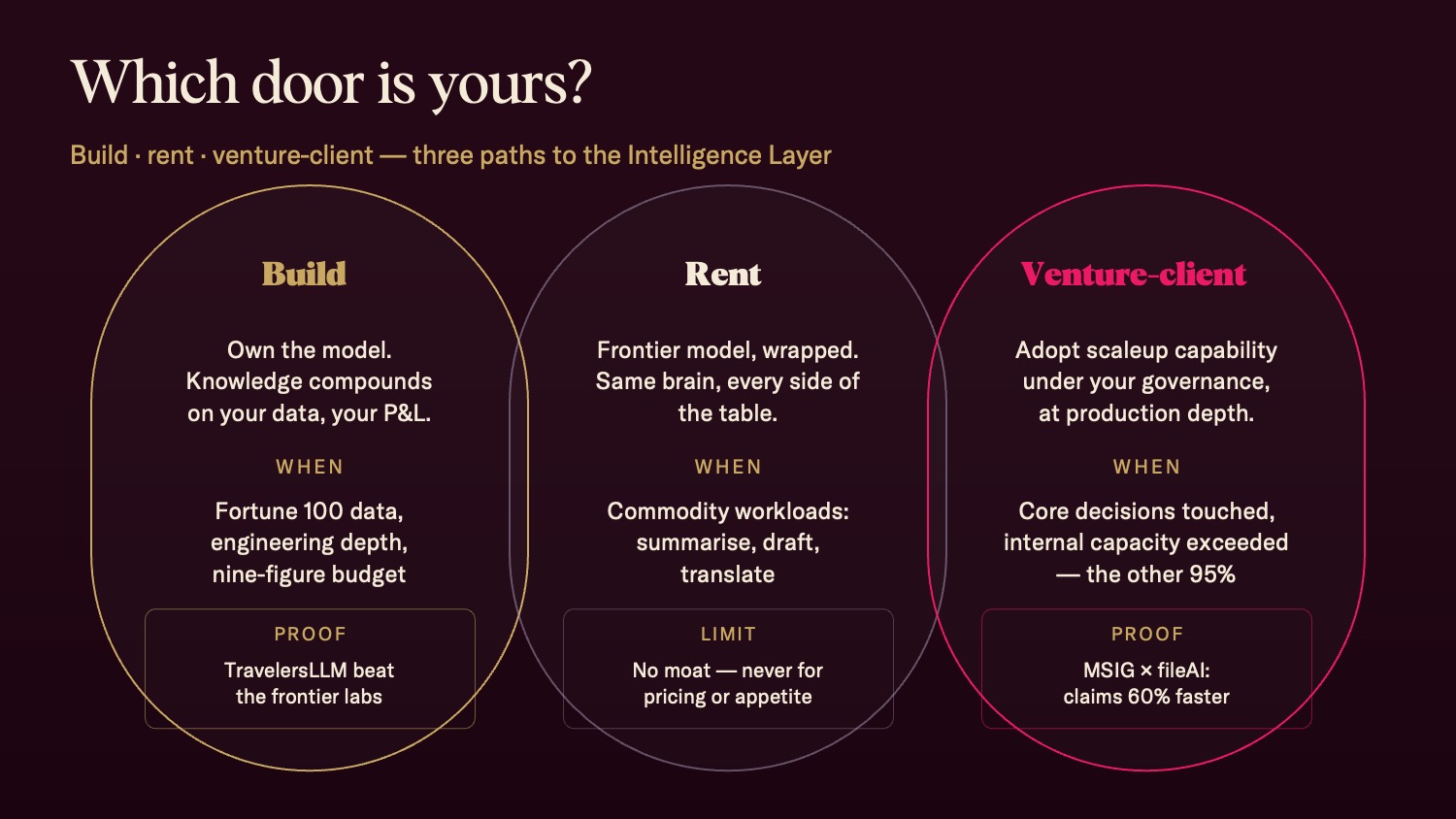
Build if your data and budget clear the Travelers bar. Rent for commodity work. And for the capabilities in between — the ones that touch core decisions but exceed internal capacity — venture-client them: adopt scaleup capability under your governance, at production depth, using venture-clienting frameworks that turn startups into production partners. In DIVAAA™ terms, that is the Adopt stage doing its job: pilots graduating into contracts. That gives firms a practical way to adopt AI without owning every layer of AI infrastructure, and the resulting landscape is becoming multipolar, with regional AI infrastructures rather than a single universal model supply chain, mirroring industry-wide shifts toward AI-powered insurance and corporate venturing.
In that sense, AI development is no longer just a lab question but a board-level operating choice, especially as AI applications move deeper into underwriting, claims, and service. And the economics are no longer hypothetical elsewhere either: Alan, newly funded at a €5.5 billion valuation, runs €800 million in ARR profitably, with one in ten members engaging with an AI agent every week. For a CFO, that changes the job: your AI investment case can now be benchmarked against a carrier that publishes frontier unit economics, and your board will do exactly that. It also changes how leaders read the AI market and pace AI innovation relative to peers in other countries, a theme running through strategic conversations about the future of insurance and technology. AI sovereignty also points to more fragmented global standards that affect cross-market operating models.
Your playbook for this quarter
-
Inventory the corpus. Count the documents that hold your underwriting and claims judgment. Then name which decisions they feed. That inventory is your Intelligence Layer balance sheet, and most carriers have never drawn it.
-
Split sovereign from commodity. Decide explicitly which decisions must never run on rented intelligence — pricing, appetite, reserving — and which can. Write it down; anchor it in your model-risk framework — the NAIC AI model bulletin and EIOPA’s AI governance opinion give you the scaffolding, while the EU AI Act and AI Act classify AI applications by risk level. For regulated decisions, data sovereignty, data residency, and domestic governance frameworks matter for compliance, especially in critical functions such as public sector government and healthcare, and in public services, carriers should treat them with the same care, where responsible, empathetic AI governance in claims and service becomes a competitive edge. Policy, not preference.
-
Run one venture-client sprint. Pick the workflow where a scaleup already has production proof — the MSIG × fileAI 60% benchmark is your reference class — and scope a ninety-day adoption with a named executive owner and a production contract as the finish line.
-
Set the Human-Agent Ratio before you scale. Agentic applications on top of any model — owned or adopted — need a governance answer to one question: which decisions do agents make, and which do humans sign, especially as autonomous agentic coworkers reshape underwriting and claims operations? Answer it before the volume arrives, not after. Governance is not just approval authority; it is operational sovereignty over AI systems in production, which is why the standard matters for national security-level resilience even when the immediate use case is commercial.
Two rooms made a decision
Back in Hartford, TravelersLLM is already the foundation for agentic applications across the enterprise; the benchmark was the beginning, not the trophy. In Singapore, MSIG’s claims teams are closing files 60% faster on a capability they adopted from a scaleup, under their own governance. Two rooms, two very different budgets, one thing in common: both made a decision.
The room that should worry you is the third one — the one still debating. Because the trajectory from here is not neutral: the builders compound, the venture-clients ship, and the renters converge — on the same models, the same capabilities, the same indistinguishable copilots. AI can both threaten and enhance national sovereignty depending on who owns the stack, exercises legal authority, and can maintain control of the systems and data. That is why digital sovereignty matters in regulated markets: it shapes national security, economic growth, and the institutional identity behind every decision. The market will not punish you for choosing the wrong door this quarter. It will punish you for standing in the doorway while your Intelligence Layer quietly becomes someone else’s training data, especially as algorithmic underwriting 2.0 rewires how risk is assessed and priced across the value chain.
Which door is yours? If you cannot answer in one sentence, that is the conversation to have this week — first with your board, then with me. I will bring the map of scaleups already proven behind each door. You bring the sentence about data sovereignty: keep sensitive data inside national borders to strengthen data protection, preserve legal authority over access and use, meet local laws and ethical standards, and build trust through local handling.
Frequently Asked Questions (FAQs)
1. What is the Intelligence Layer in insurance?
The Intelligence Layer is the connective tissue between an insurer's proprietary knowledge and the AI systems that act on it. The models, data pipelines, and governance that turn decades of institutional expertise into decisions made at machine speed, under human accountability. Control of this layer is AI sovereignty: the ability to govern AI use under your own rules.
2. Why does Travelers building its own LLM matter?
Because it proved the point in production. By training TravelersLLM on its own claims and underwriting judgment — and outperforming general-purpose frontier models on its own tasks — Travelers demonstrated that an insurer's edge doesn't live in the model it rents, but in the institutional knowledge it owns. The signal to the market: your judgment is the capability.
3. Should insurers build, rent, or venture-client their AI capabilities?
It depends on what the workload touches. Build when the capability sits on core judgment, and you have the data depth and budget to sustain it. Rent frontier models for commodity work — summarising, drafting, translating — where no moat exists anyway. Venture-client: when a capability touches core decisions but exceeds internal capacity, adopt a scaleup's production-grade technology under your governance, on your terms.
4. What is the venture client model, and how is it different from investing in startups?
A venture client buys and deploys a startup's solution as an early customer rather than taking an equity stake. The return is measured in operational impact, not portfolio marks, capability adopted at production depth, under the insurer's own governance and regulatory perimeter. MSIG's work with fileAI, cutting claims processing time by 60%, is the proof point: sovereignty gained without a nine-figure build.
5. How can an insurer start reclaiming AI sovereignty this quarter?
Three moves: inventory your AI estate to see where your judgment currently flows through rented systems; split commodity workloads from core-judgment workloads; and run your first venture-client sprint on one core capability. Sovereignty isn't a moonshot — it's a portfolio decision, made one workload at a time.
Editor in Chief

Rebuilding Risk Resilience