Human-Agent Ratio: The Number Your Board Isn't Tracking
Aug 08, 2026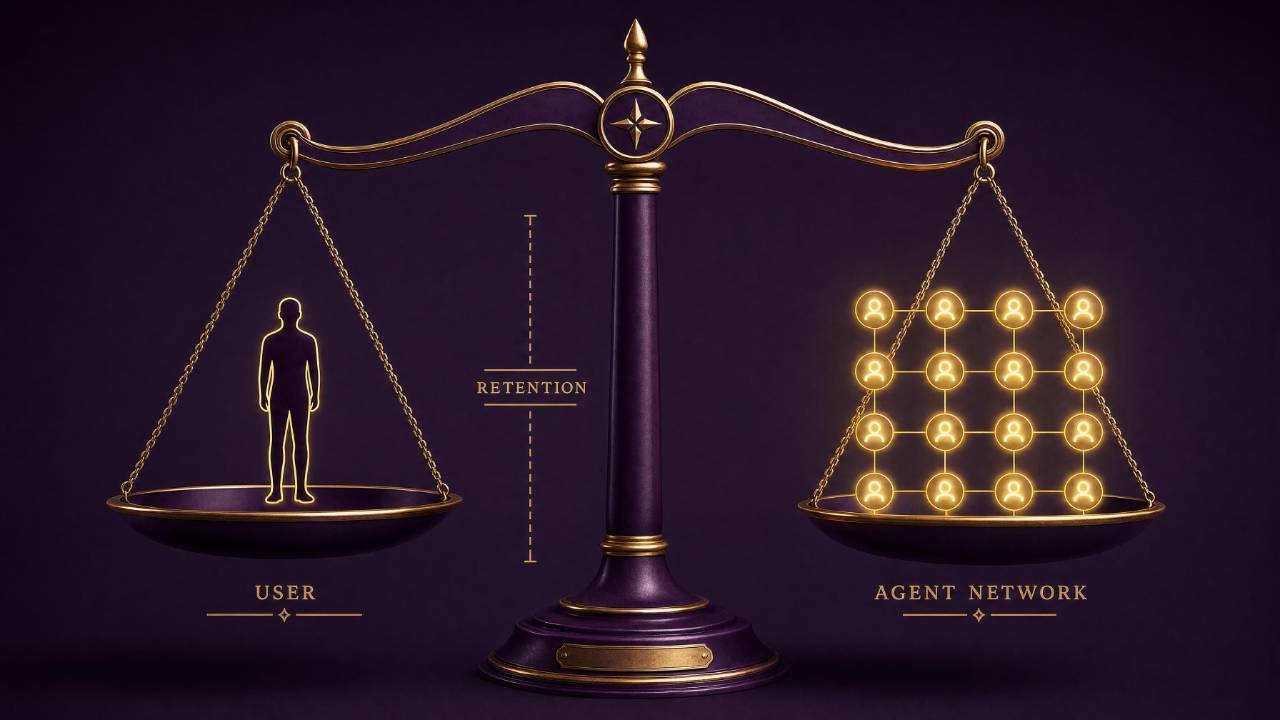
Written by Sabine VanderLinden
Why the Human-Agent Ratio, scored per function and rolled into the Agentic Maturity Index, is the new operating discipline.
At a glance
The three things a board needs from this article
- The Human-Agent Ratio (HAR) is the number of AI agents a function can safely run for every human accountable for their outputs. First named in Microsoft's 2025 Work Trend Index, it is scored per function, never enterprise-wide. The optimal ratio is not uniform: 2026 practitioner benchmarks range from hundreds of agents per human in logistics to roughly one agent per one to three humans in legal and underwriting.
- Over 40% of agentic AI projects may be canceled by 2027, according to Gartner projections cited in Munich Re and ERGO's Tech Trend Radar 2026. The dominant failure mode is not model quality. It is oversight design: automating the work without redesigning the accountability.
- The Agentic Maturity Index (AMI) turns that ratio into a benchmark. Alchemy Crew Ventures' composite instrument aggregates per-function HAR scores into one comparable firm-level rating across four dimensions (automation depth, role evolution, stack completeness, governance) and three tiers: Assisted, Augmented, Frontier.
Over 40% of agentic AI projects may be canceled by 2027. Gartner published that warning, carried into the insurance mainstream by Munich Re and ERGO's Tech Trend Radar 2026, in the same season Microsoft and AWS committed $3.5 billion to forward-deployed engineering inside enterprise operations and CNBC reported employers quietly reversing AI-led layoff decisions, echoing the AI titans’ enterprise push that has driven tens of billions into embedded, domain-specific AI.
Three signals. One diagnosis.
Enterprises are scaling digital labor faster than they are designing the oversight to govern it. The technology is not the bottleneck. The operating model is.
The number your board is not tracking is the Human-Agent Ratio: the number of AI agents a function can safely run for every human accountable for their outputs. For board members, C-suite leaders, and enterprise operators in insurance, financial services, and other complex functions, that ratio is becoming a control metric rather than a technical detail. When leadership does not set it deliberately, oversight breaks down, projects stall or get canceled, and firms miss the chance to scale AI with resilience.
This piece defines HAR, shows why the ratio varies by function, introduces Alchemy Crew Ventures’ Agentic Maturity Index (AMI), maps common failure modes in agentic AI adoption, and outlines practical benchmarks and steps for managing human-agent collaboration without losing accountability, separating AI facts from fiction so leaders can focus on realistic, governable deployment over hype.
What is the Human-Agent Ratio?
The Human-Agent Ratio is a new KPI for artificial intelligence adoption: a business metric that optimizes the balance between human oversight and agent efficiency on human-agent teams.
First introduced in Microsoft's 2025 Work Trend Index, it defines how many AI agents a function can safely run for every human accountable for their outputs, and is scored per workflow, function, or decision type as a tangible way to measure digital transformation across the organization.
Two questions sit underneath it, and Microsoft framed them precisely:
-
How many agents are needed for which roles and each task, and
-
How many humans are needed for a human employee to guide them?
Answer them well, and digital labor becomes a growth engine across functions as agentic AI transforms industries. Answer them badly, or not at all, and you inherit one of two failure modes: wasted capacity or unowned risk.
Why does digital labor break the old headcount math?
Because the constraint has moved. For a century, corporate growth was bound to human bandwidth: more output meant more people, more overhead, more coordination drag. Companies once tracked digital transformation through app adoption and cloud migration; HAR instead shows how embedded AI changes daily operations.
Intelligence on tap dissolves that constraint. In the 2025 Work Trend Index and at Microsoft Ignite 2026, 82% of leaders said they expect to use digital labor to expand operational capacity within 12 to 18 months, and 46% said their companies already use agents to fully automate workflows.
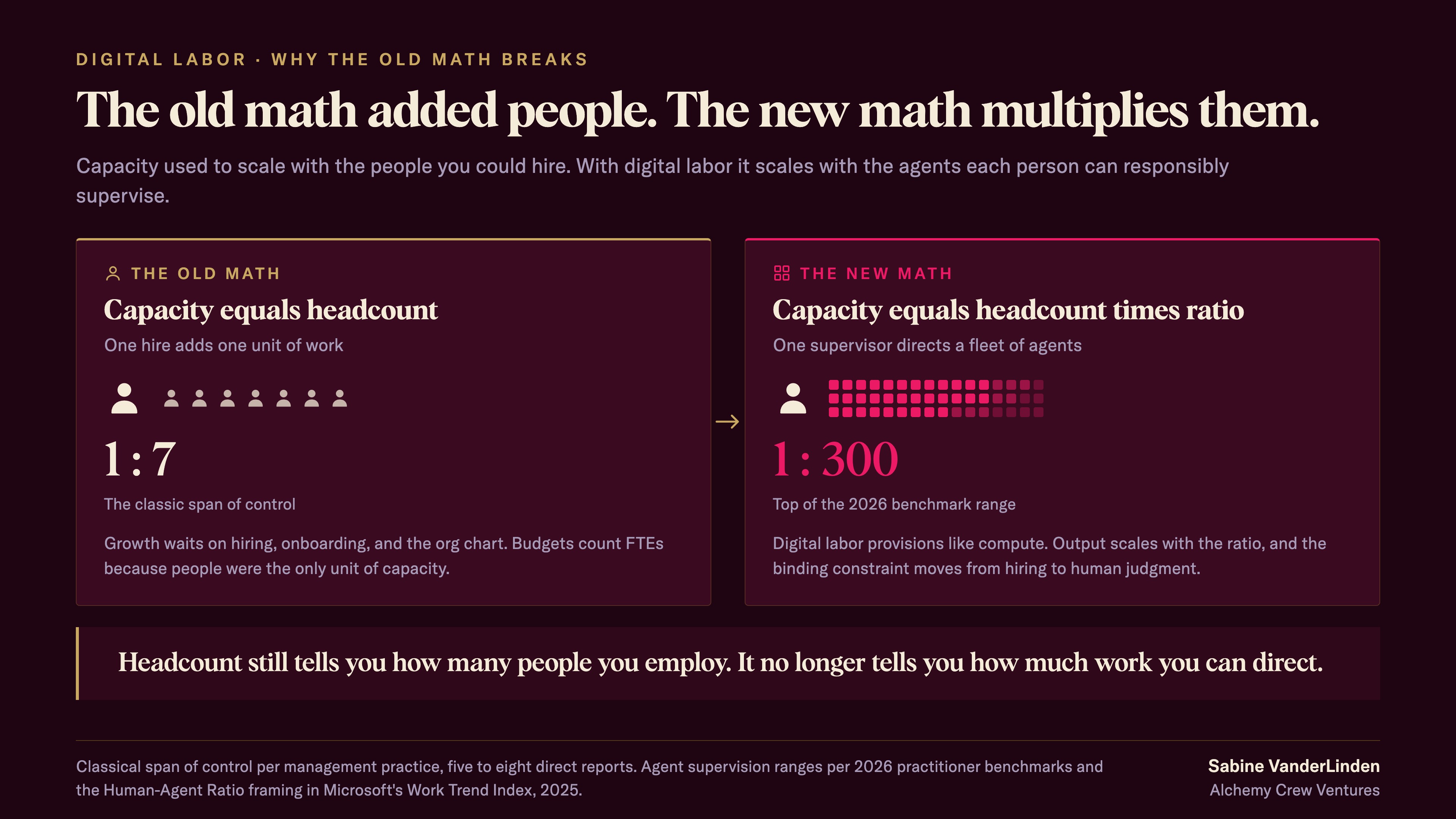
Meanwhile, the capacity gap grinds on: 53% of leaders say productivity must rise, while 80% of the global workforce says it lacks the time and energy to deliver. That is what happens when intelligent systems start carrying work that once required added headcount.
The early evidence is not theoretical.
-
Wells Fargo built an agent for 35,000 bankers across 4,000 branches; 75% of searches now run through it, and query response times fell from 10 minutes to 30 seconds.
-
Bayer's Crop Science researchers reclaim up to six hours a week each.
-
And Lemonade, profiled in Deloitte's work on the human-agentic workforce, embedded digital agents Maya and Jim into the core of its operating model from day one, scaling transactions without proportional growth in headcount because humans focus on exceptions while agents handle routine customer interactions, with people redeployed to quality and strategy.
Insurance leaders already own the mental model for this. The Human-Agent Ratio is a retention line. Every treaty you have ever signed answers the same question this metric asks: how much do you retain for your own judgment, and how much do you cede to capacity that is not yours? No underwriter cedes risk without limits, triggers, and a named decision owner. Your digital workforce deserves the same discipline, because the right ratio is the ideal balance between capacity ceded to agents and judgment retained by people.
The Human-Agent Ratio is a retention line for judgment. Decide what you retain, what you cede, and who signs.
What happens when the ratio runs too hot?
Review capacity collapses. When agents produce work at machine speed, the constraint shifts instantly from production to review, which becomes the binding constraint as output rises. Push the ratio past human oversight bandwidth, and adding more agents without increasing review capacity does not improve outcomes; instead, two failure modes appear: rubber-stamping, where overwhelmed reviewers approve outputs they never critically evaluated, and backlog, where agent output queues faster than humans can clear it. Unvetted errors, hallucinated commitments, and compliance drift then propagate at machine speed too.
Failure to monitor the ratio can also drive high employee burnout as reviewers absorb backlog, edge cases, and constant judgment calls.
This is the pattern behind the reversal of the layoffs. Organizations cut human capacity on the promise of automation, only to discover they had automated the work without redesigning accountability. As we argued in The Orphaned Decision, the biggest risk in agentic AI is not a bad answer. It is a consequential decision with no human owner.
The 2026 Work Trend Index, which surveyed 16,971 workers, shows how rare a balanced state still is. Only 19% of professionals operate in the Frontier zone, where individual AI capability and organizational readiness meet. Half sit in the emergent middle. And the blockers are managerial, not technical: only 26% of AI users say their executive leadership is aligned on AI strategy, and just 13% feel rewarded for redesigning how work gets done.
The same research found organizational AI culture is the strongest predictor of outcomes, with industry and company size contributing almost nothing. The ratio is a leadership choice, not an inheritance, and higher HAR drives increased efficiency only when oversight design keeps pace.
Nor is the optimal ratio uniform. Practitioner benchmarks compiled across 2026 deployments show logistics functions running hundreds of agents per human, customer operations dozens, while legal and underwriting hold near one agent for every one to three humans. High volume, structured, low stakes: run the ratio high. Low volume, unstructured, consequential: keep it low. Claims triage can run hot. Complex liability underwriting cannot.
What is the Agentic Maturity Index?
The Agentic Maturity Index (AMI) is Alchemy Crew's new performance metric for measuring how far an insurer is integrating intelligent agents as part of a shift from a human-run operating model toward a human-led, agent-operated one, and whether it is moving toward the Agentic Frontier rather than entrenching a legacy design. The Human-Agent Ratio, measured per function as the agent-led share of work, is the input. The AMI aggregates those scores into a single, comparable, reproducible firm-level rating.
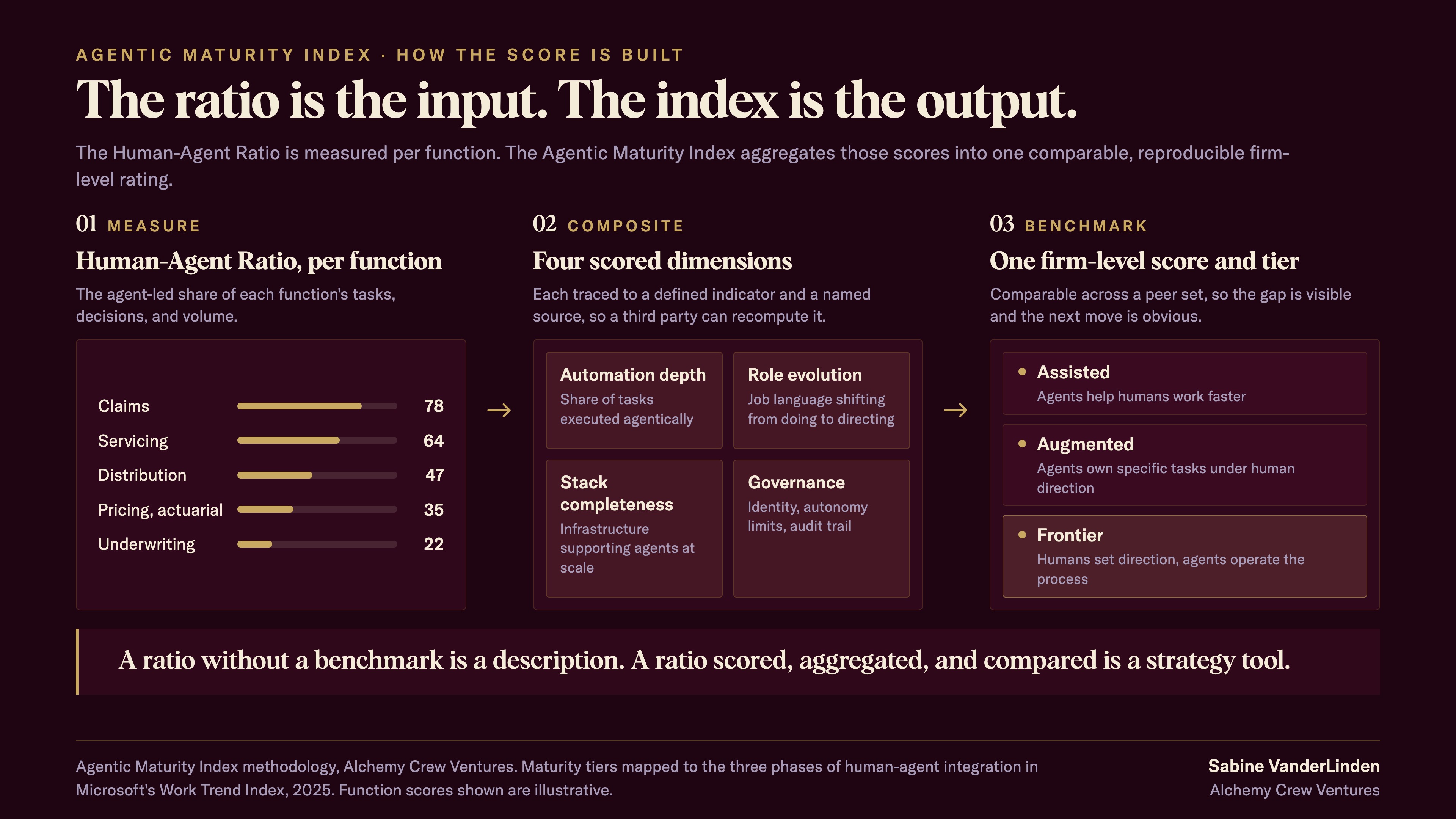
The index reads four dimensions:
-
automation depth
-
role evolution
-
stack completeness
-
and governance.
Each is scored from observable evidence, from disclosed automation rates to the shifting language of job postings, where "does the work" gives way to "directs the agents."
The composite then maps to three maturity tiers drawn from Microsoft's phases:
- Assisted, where agents help humans work faster;
- Augmented, where agents own specific tasks under human direction; and
- Frontier, where humans set direction and agents operate the process, with frontier firms designing teams around intelligent assistants rather than only counting deployments.
This is what turns the Human-Agent Ratio from a slogan into a performance metric. A ratio without a benchmark is a description. A ratio scored per function, alongside traditional KPIs, aggregated into an index, and compared across a peer set is a strategy tool that captures human-agent operating design: it tells you where you stand, where the gap is widening, which function to move next, and whether change is happening at a structural level rather than only in workflow automation, aligning with Alchemy Crew’s broader research on AI-powered insurers and digital transformation.
Agent counters vs ratio designers
Here is the contrast that will define the next 18 months of workforce transformation. Agent counters measure progress by the number of deployments launched. Like most enterprises, they start by deploying multiple agents and treat that as progress. They chase the highest possible automation number, celebrate pilot counts, and discover the oversight deficit in production, in front of a customer or a regulator. They are the raw material of Gartner's 40%.
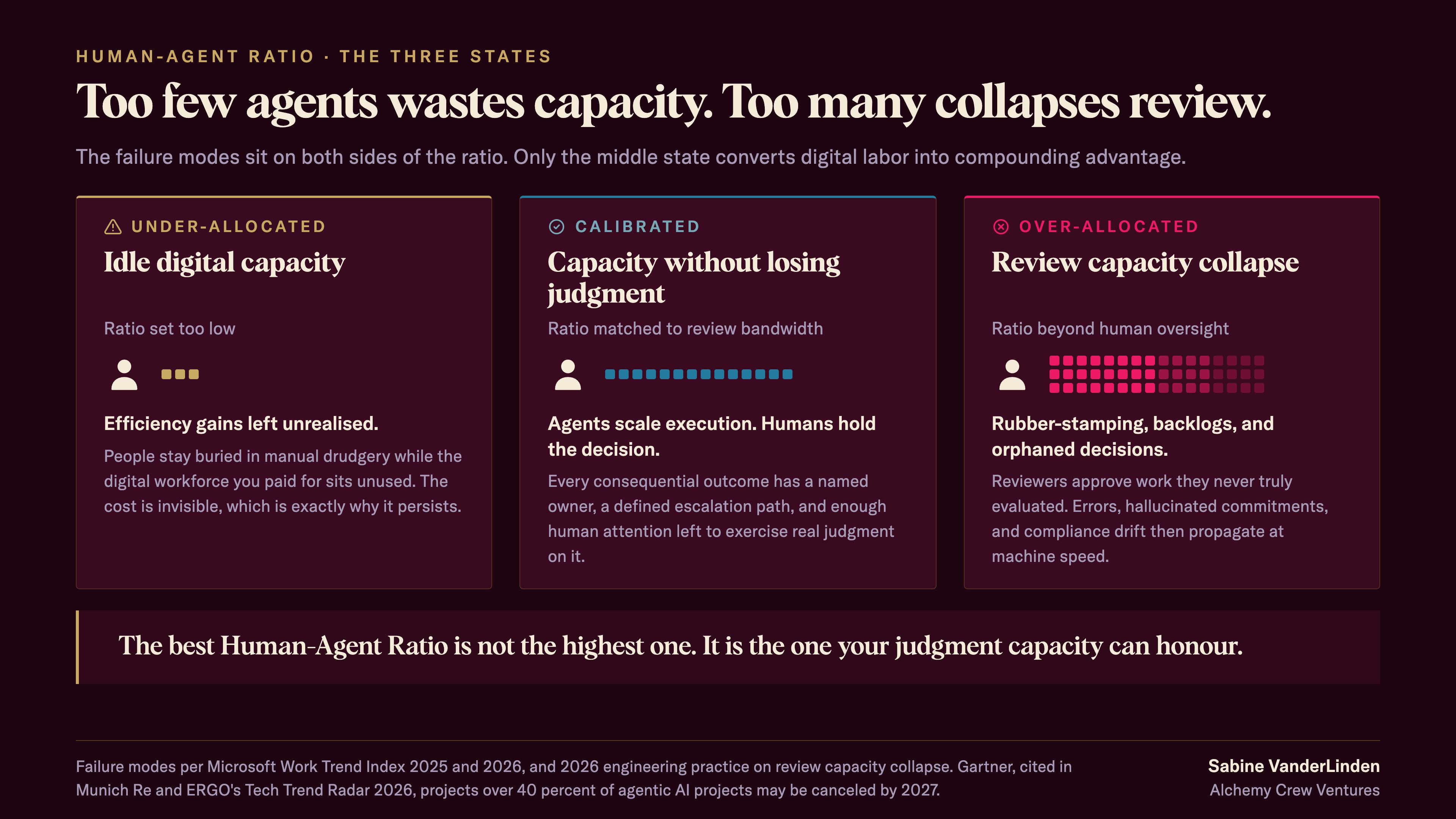
Ratio designers measure capacity and outcomes. They deliberately set the Human-Agent Ratio for each function, build review capacity before they build volume, and treat agents as governed operators with agent oversight, not just output engines, mirroring how Agentic Frontier firms in insurance are re-architecting underwriting and claims around autonomous systems. That includes controls around tool calls, especially when agents interact with external systems. Simply integrating multiple AI agents is not enough if operational capacity and human ownership are not designed first, just as an AI strategy will fail without workflow and governance redesign even when the technology and funding are in place.
- Deloitte calls this human-agent collaboration by design.
- Microsoft calls the emerging role the agent boss.
- We call it the difference between operating on the Agentic Frontier and performing innovation theatre at scale.
- The contrarian truth both converge on is that the best Human-Agent Ratio is not the highest. It is the one your judgment capacity can honor.
The best Human-Agent Ratio is not the highest one. It is the one your judgment capacity can honor.
The playbook: five moves this quarter
-
Baseline your ratio. For each core function, estimate the workload split: what share of tasks, decisions, and volume is executed by agents today, and what is your current agent capacity per function? That per-function score is your current Human-Agent Ratio. You cannot design what you have not measured.
-
Name the owner before you deploy the agent. Every consequential decision an agent touches gets a named human accountable for the outcome, with audit logging and audit trails in place for those actions. No owner, no launch.
-
Design the exception path before the happy path. Define what the agent owns, what it must escalate, who receives the escalation, and the incident response path when agents trigger errors or system changes, with the same rigor you apply to claims authority limits. Heavy reliance on AI can create data security and compliance risks without proper controls.
-
Build review capacity before volume. Add quality gates, automated checks, and agent-to-agent review before human sign-off, and include code review where relevant, so humans handle exceptions and final judgment calls. Protect against review collapse before it appears.
-
Score yourself on the maturity curve. Place each function on the Assisted, Augmented, Frontier arc, and measure progress in redeployed capacity and improved outcomes, never in agents launched.
The cost of not deciding
The Human-Agent Ratio is shaping your organization's future right now, whether leadership manages it or not. It is part of a new reality in which artificial intelligence continues to change workforce design; every ungoverned deployment sets it by accident, and every deferred decision cedes it to vendors, enthusiasts, and drift. 90 days from now you will either hold a function-by-function baseline your board can act on, or you will be reading your competitors' results wondering how they compounded so quickly by riding the enterprise AI moves of the major titans instead of watching from the sidelines. The most advanced frontier firms are not defined by how many agents they run. They are defined by how deliberately they decide who runs them.
Where does your Human-Agent Ratio stand today? That is a question we can answer together.
45 minutes. One conversation. A clear view of where you stand on the Agentic Maturity Index, and which function to move first, working with the Alchemy Crew team that specializes in AI-led operating model transformation.
Frequently Asked Questions (FAQs)
Human-Agent Ratio and Agentic Maturity Index, answered in brief.
What is the Human-Agent Ratio?
The Human-Agent Ratio (HAR) is a business metric, introduced in Microsoft's 2025 Work Trend Index, that balances human oversight against agent efficiency on human-agent teams. It answers two questions: how many generative AI agents are needed for which roles and tasks, and how many humans are needed to guide them. It is scored per function, never enterprise-wide.
What is a good Human-Agent Ratio?
There is no single good Human-Agent Ratio. The optimal ratio scales with decision volume and decision risk, and the right ratio depends on the function's operational capacity and judgment burden. High-volume, structured, low-stakes functions such as logistics can run hundreds of agents per human. Judgment-heavy, regulated functions such as legal and complex underwriting hold near one agent for every one to three humans. The best ratio is the one your review capacity can honor.
How do you measure the Human-Agent Ratio?
Measure it as a workload split per function: how many intelligent assistants or AI agents support each human employee within a function, and the share of that function's tasks, decisions, and volume executed by agents versus humans, expressed as a score from fully human to fully agent-operated. Span of oversight, meaning agents supervised per human, is a useful secondary lens where the data exists. Score each function separately. Claims triage and liability underwriting will never share a number.
What is review capacity collapse?
Review capacity collapse is what happens when AI agents produce work faster than humans can critically evaluate it. The binding constraint shifts from production to review, and two failure modes appear: rubber-stamping, where reviewers approve outputs they never truly assessed, and backlog, where agent output queues faster than it can be cleared. Errors, hallucinated commitments, and compliance drift then propagate at machine speed.
How does the Agentic Maturity Index relate to the Human-Agent Ratio?
The Human-Agent Ratio is the input; the Agentic Maturity Index is the output. HAR is scored per function, then the AMI aggregates those scores into a single, comparable, reproducible firm-level rating across four dimensions: automation depth, role evolution, stack completeness, and governance. The composite maps each insurer to one of three maturity tiers: Assisted, Augmented, or Frontier.
Why do agentic AI projects fail?
Most agentic AI projects fail because governance of intelligent systems is weak, not because the models alone are inadequate. The recurring patterns are orphaned decisions, where a consequential outcome has no named human owner, and review capacity collapse, where agents produce outputs faster than humans can critically evaluate them. Gartner's projection that over 40% of projects may be canceled by 2027 reflects this oversight deficit, which worsens when multiple AI agents operate without clear oversight or safe system design.
Sources
- Microsoft, 2025 Work Trend Index: The Year the Frontier Firm Is Born
- Microsoft, 2026 Work Trend Index Annual Report (n = 16,971)
- Deloitte, The Human-Agentic Workforce (Lemonade case study)
- ERGO, Deloitte and Google Cloud, From Tribal Knowledge to Self-Evolving Agents, July 2026
- Accenture and Wharton, The Age of Co-Intelligence, March 2026
- Munich Re and ERGO, Tech Trend Radar 2026 (citing Gartner)
- Dell'Acqua et al., The Cybernetic Teammate, Harvard Business School Working Paper 24-070
Editor in Chief

Rebuilding Risk Resilience