The Intelligence Layer Decision Has Landed: Build, Rent, or Venture Client
Jul 25, 2026
Written by Sabine VanderLinden ·
KEY TAKEAWAYS
- The Intelligence Layer is now sovereign territory. The connective tissue between an insurer's proprietary data, risk judgment, and automated execution can no longer be outsourced wholesale — carriers renting the same frontier models as their competitors produce near-identical risk assessments and commoditized underwriting.
- Build, rent, or partner is a portfolio decision, not a binary choice. Insurers should build sovereign cores only where proprietary data is the moat — a 70-billion-parameter domain model costs $1–5 million, not the $78–192 million of a frontier build — and rent frontier APIs solely for non-differentiating, high-volume work.
- The venture client model is the capital-efficient third path. Opex-funded pilots of under 12 weeks consume zero solvency capital and deliver production results fast — MSIG Asia cut claims processing time by 60% and claims operating costs by 18% within one month — ahead of the EU AI Act's high-risk enforcement on 2 August 2026.
In this article: Build · Rent · Venture Client · Theatre vs. Transformation · The Playbook · FAQ
On June 30, 2026, The Travelers Companies announced something most carriers had quietly assumed was beyond them: TravelersLLM, a proprietary large language model built entirely by in-house engineers, trained on more than 3 million internal documents and embedded with 170 years of accumulated risk expertise. Tested against tens of thousands of insurance-specific queries, it beat the commercial alternatives on quality, cost, and speed.
The announcement matters far beyond Hartford. It confirms that the Intelligence Layer — the connective tissue between a carrier's proprietary data, its risk judgment, and its automated execution — has become sovereign territory.
And it puts an uncomfortable question on every P&C leadership agenda:
Q: if the layer where your decisions are made is now strategic ground, who governs yours today?
For most insurers, the honest answer is: a vendor. Rented cognition feels efficient right up to the moment you realize your competitors are subscribing to the same engines, feeding in similar prompts, and receiving near-identical risk assessments. When everyone rents the same intelligence, underwriting stops being a moat and starts being a subscription.
This is not a technology choice. It is a capital allocation and risk management decision — one that determines how your AI spend interacts with solvency capital, how fast your organization learns, and how defensible your margins remain while Frontier Firms around you compound their advantage quarter after quarter.
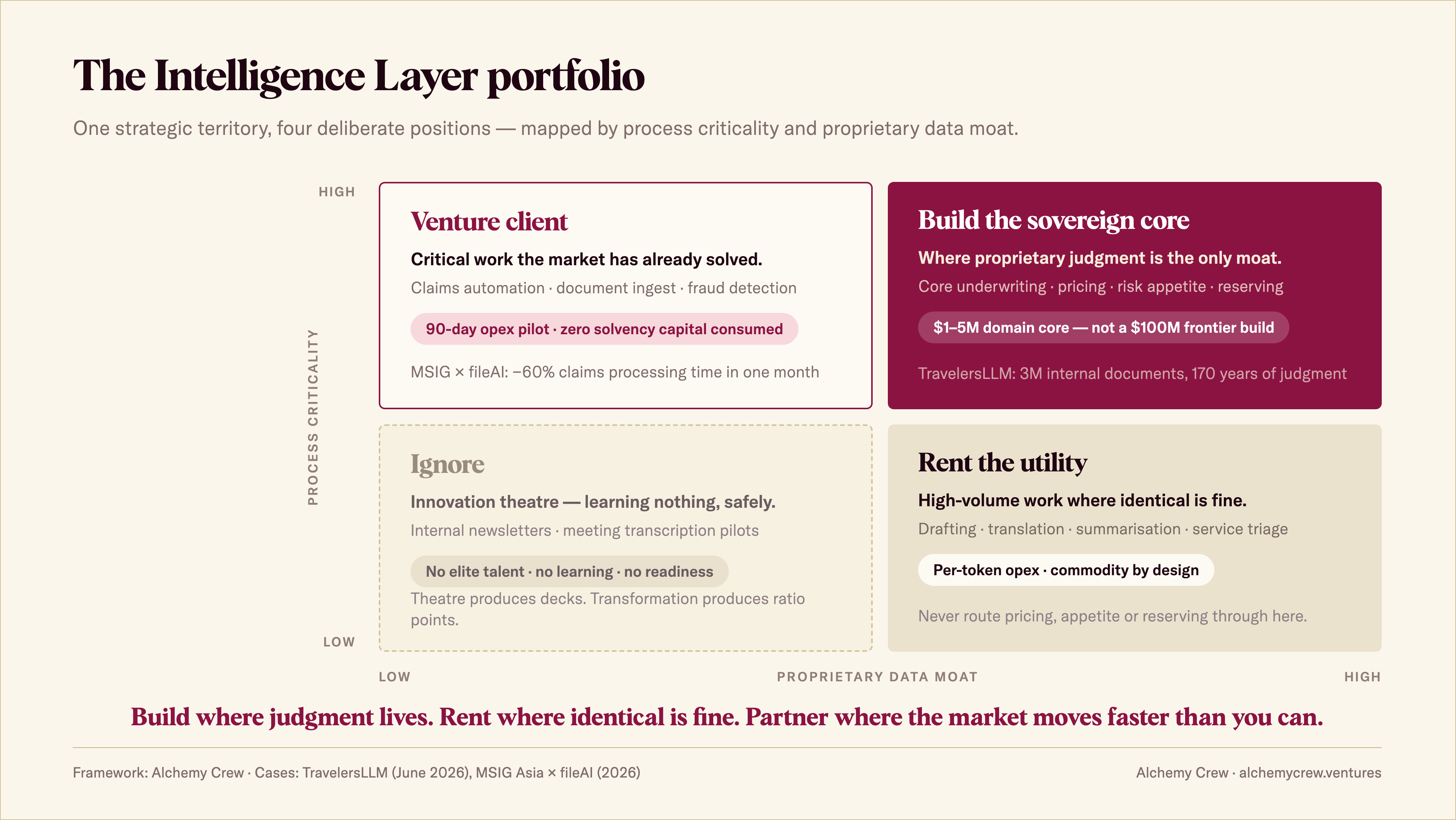
What is the Intelligence Layer? The Intelligence Layer is the connective tissue between an insurer's proprietary data, its risk judgment, and its automated execution. It is where risks are selected, priced, and defended. Whoever governs it — the carrier or its vendors — controls the carrier's margin, differentiation, and regulatory defensibility.
The good news: this is not a binary build-or-buy dilemma. It is a portfolio with three deliberate positions: build, rent, and partner through the venture client model. The discipline lies in knowing which process belongs where.
Build for AI Sovereignty — But Only Where Judgment Lives
Your competitive moat does not live in generic language capability. It lives in decades of accumulated judgment: risks declined, claims litigated, policies priced through hard and soft market cycles. That corpus is non-public, unreplicable, and — until recently — largely dormant. It is the raw material of your Intelligence Layer.
Off-the-shelf foundation models trained on the open web do not carry this expertise. On industry-specific benchmarks, they hallucinate at a documented rate of 28.6% (AIM Media House, 2026). Ground a model in your verified private corpus and hallucination rates fall by 70% to 90%, turning your archive into an asset no competitor can rent.
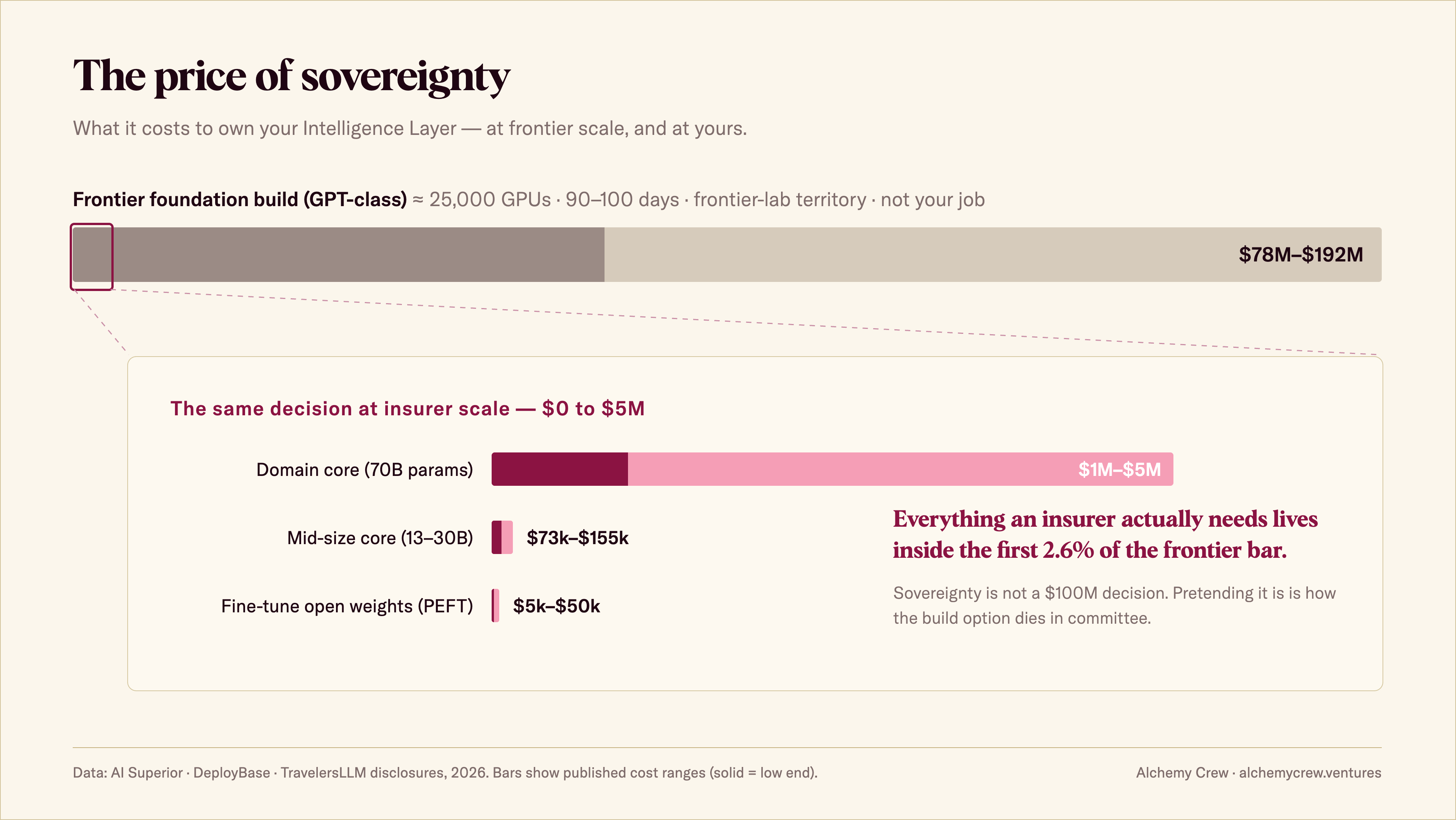
But sovereignty has a price list, and it rewards careful reading. Pre-training a frontier-class model demands roughly 25,000 GPUs running for 90 to 100 days and a budget between $78 million and $192 million (AI Superior, 2026). Almost no carrier needs that. A domain-optimized 70-billion-parameter core can be trained for $1 million to $5 million; a compact specialist model for a fraction of that. Because compute scales exponentially with parameter count, smaller architectures compress both cost and time — 15 to 25 days on a standard eight-GPU node.
Travelers understood the nuance. TravelersLLM holds the sovereign core: underwriting judgment, risk selection, the crown jewels. Around it, the carrier rents frontier capability where it holds no comparative advantage: Claude assistants for nearly 10,000 technical employees, and broader model access for more than 30,000 staff through TravAI, its secure internal platform. A dual-layer architecture, funded by the discipline of an 88.6% combined ratio.
"When everyone rents the same intelligence, underwriting stops being a moat and starts being a subscription."
The implication is precise: build — or deeply fine-tune open-weights models — for the narrow set of processes where your proprietary data is the only defensible moat. Nowhere else.
Rent the Utility, Not the Identity
For high-volume, non-differentiating work — drafting correspondence, translating policy text, summarising multi-page documents, routing service requests: renting frontier capability through secure APIs is the sensible path. It is fast, opex-funded, and priced by the token rather than by the balance sheet.
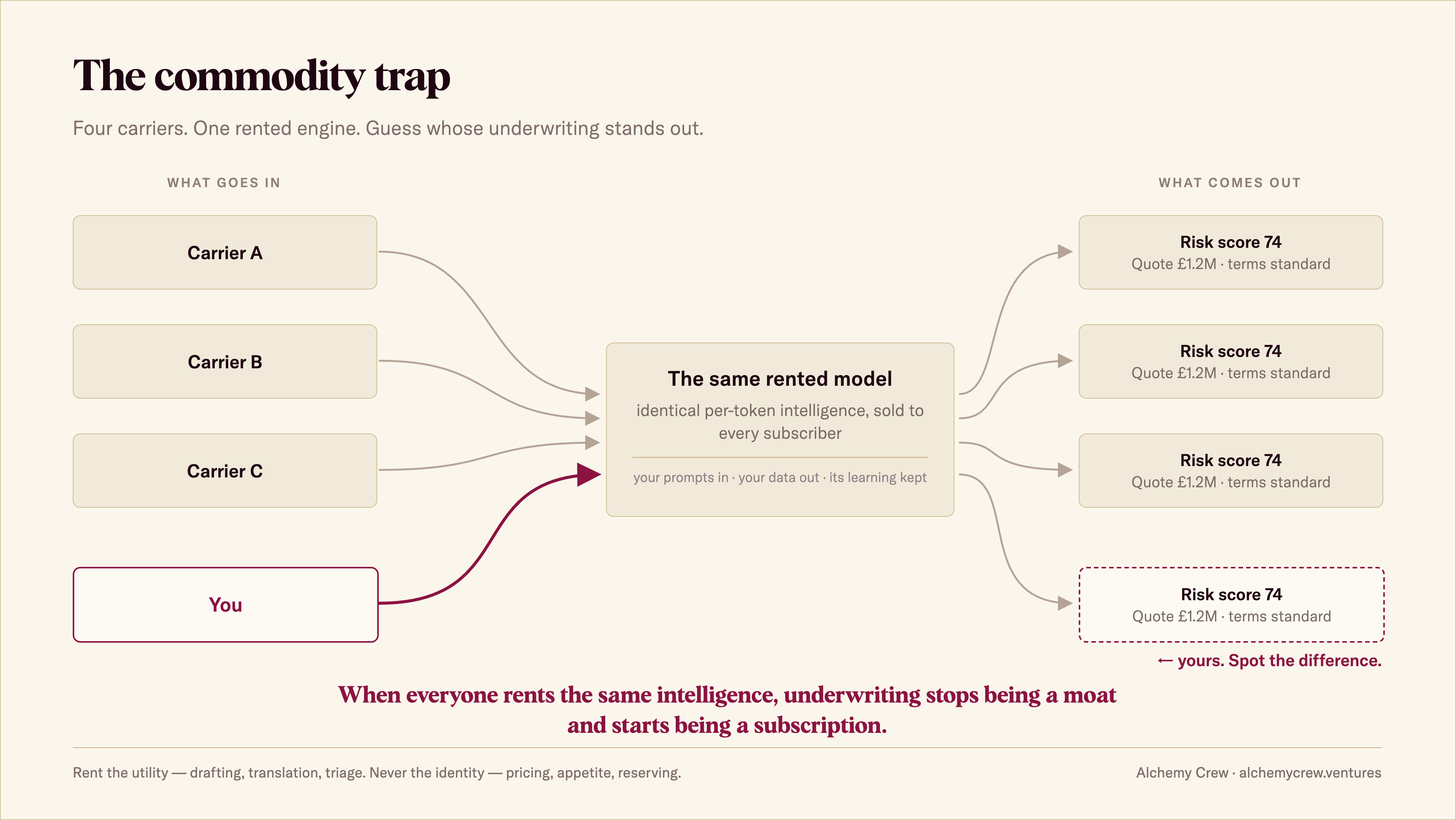
Think of it the way you would the market's most brilliant consultant. She is extraordinary. She is also, this same week, advising your three largest competitors. You would use her gladly, for the work where being identical to the market costs you nothing. You would never hand her your underwriting appetite.
Because that is the trap: if your digital labor runs on the same rented intelligence as everyone else's, your operations converge toward the market average, at machine speed.
The exposure is not only strategic. Under the EU AI Act, which reaches full enforcement on August 2, 2026, algorithms used for underwriting, pricing, and claims evaluation are classified as high-risk AI systems, with mandatory human oversight, documentation, and risk-management protocols. The NAIC Model Bulletin — adopted by nearly 25 U.S. states — demands that automated decisions be explainable, transparent, and non-discriminatory. Add China's GAI Measures and the volatility of commercial platforms' data terms, and renting your core becomes a compliance question as much as a competitive one.
Rent the utility. Keep the identity.
The Venture Client Model: The Third Path Most Carriers Miss
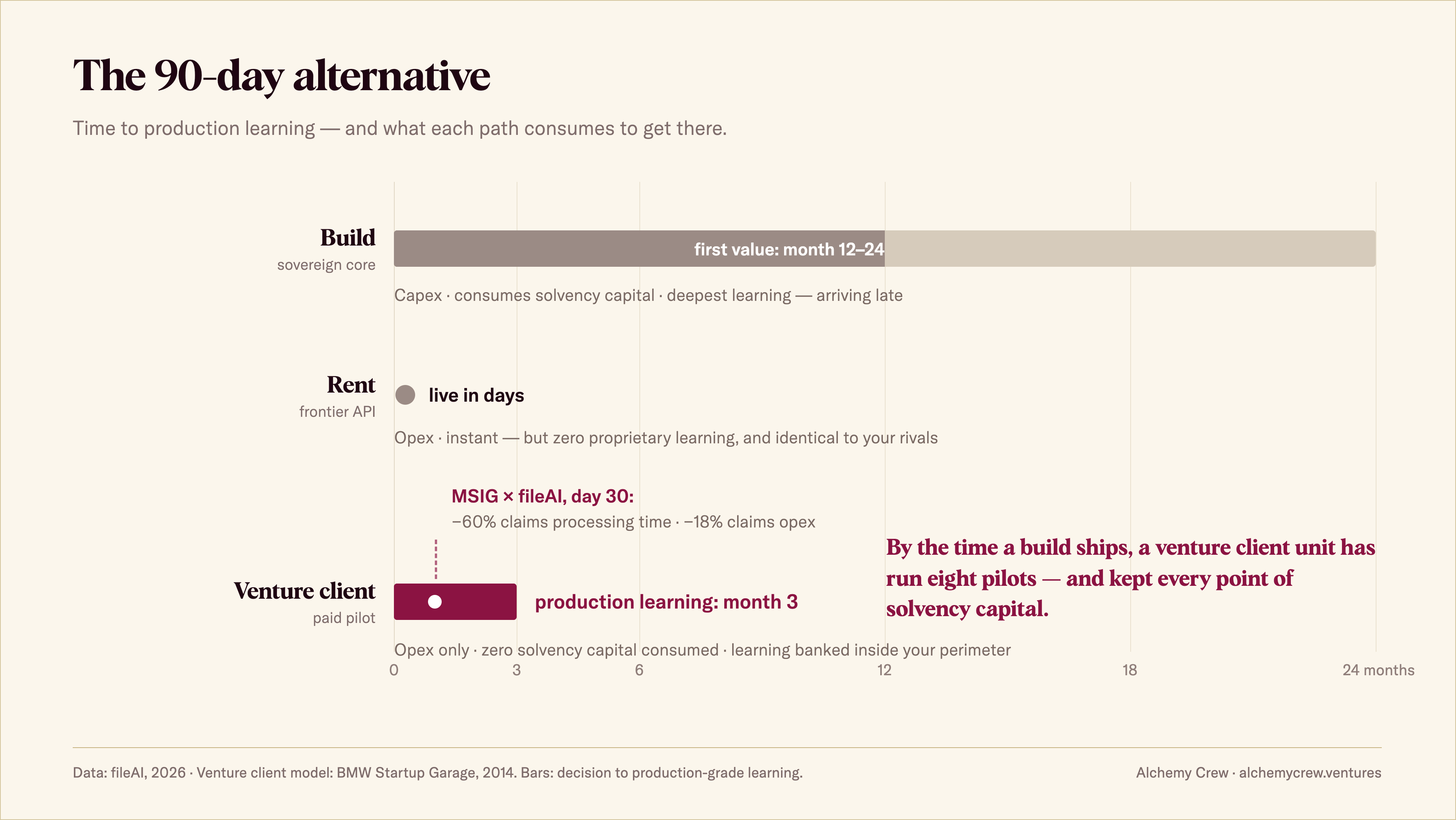
Between a nine-figure build and a commodity rental sits the option too few insurance leaders take seriously: the venture client model. Pioneered by Gregor Gimmy at the BMW Startup Garage in 2014, it is elegantly simple — become an early paying client of a scaleup, deploy its product against a real operational bottleneck, and measure the result inside 12 weeks. No equity. No capex. No solvency capital consumed.
The proof points are no longer theoretical.
MSIG Asia deployed fileAI's platform to automate complex, multilingual claims documentation. Within one month, the opex-funded pilot cut claims processing time by 60% and claims operating expenses by 18% (fileAI, 2026). Production-depth learning inside the carrier's own perimeter — the Intelligence Layer growing with every pilot, without a Fortune 100 technology budget.
Tawuniya, the MENA region's largest insurer, ran its InsurAI virtual accelerator with Plug and Play and Google: more than 1,000 startups screened, ten selected, and generative AI solutions for underwriting, claims, and fraud detection pitched directly to executives at its May 2025 Demo Day. A structured machine to find, test, and adopt what the market has already built.
For the startup, the model delivers revenue, validation, and a reference logo without dilution. For the insurer, it delivers speed, deep operational learning, and near-zero balance-sheet impact. If the pilot works, you scale. If it fails, you exit — capital intact, learning banked.
Innovation Theatre vs. Frontier Transformation
Here is where most strategies quietly fail. Leadership teams pilot AI on "safe" processes — the internal newsletter, meeting transcription — because the downside feels contained. It is innovation theatre. It attracts no elite talent, justifies no serious investment, and prepares nothing in the organization for agentic deployment.
The carriers pulling ahead do the opposite. They start where it hurts: commercial underwriting, where risk selection determines loss ratios and the data is the carrier's most valuable proprietary asset. Agentic AI in underwriting is already cutting quote preparation from hours to minutes and lifting quote capacity by 40% (Alchemy Crew, 2026). And by the end of 2026, roughly 22% of global insurers plan to run fully agentic systems in production.
"Pilot where it hurts. A safe pilot teaches you nothing your competitors don't already know."
The gap between the two postures compounds. Theatre produces decks. Transformation produces combined-ratio points.
The Intelligence Layer Playbook: Five Moves for This Quarter
- Inventory your proprietary corpus. Count and catalog every document that encodes decades of underwriting and claims judgment. This is your Intelligence Layer balance sheet: who owns the data, where it sits, and which external systems are currently learning from it.
- Segment sovereign decisions from rentable executions. Pricing, risk appetite, binding authority, and claims reserving stay inside sovereign, private architectures — fine-tuned open-weights models or local retrieval-augmented generation. Everything administrative routes to rented APIs.
- Match each workload to its position in the portfolio. Build deep where judgment lives. Rent wide where differentiation doesn't matter. Partner fast where the market has already solved your bottleneck.
- Stand up a venture client unit. Choose one measurable operational bottleneck, source three candidate scaleups, and run a 90-day paid pilot funded entirely from opex. MSIG's 60% result took one month.
- Set human-agent ratios and guardrails before you scale. A central agent registry, per-task permissioning, auditable logs. Your underwriters become agent bosses — accountable humans at defined judgment gates — ready with answers when the EU AI Act and NAIC examiners ask how a decision was made.
The Clock Is Not Neutral
August 2 is a few days away when this article was written. The EU AI Act's full enforcement will not wait for your architecture review, and neither will the carriers already running sovereign cores, rented utilities, and venture client pipelines in parallel. Ninety days from now, the insurers who moved will have pilots delivering measurable results, corpora cataloged, and guardrails in place. The insurers who didn't will have another quarter of theatre, and an Intelligence Layer quietly governed by someone else.
The real question isn't whether your organization will run on AI. It's whether the intelligence it runs on will be yours.
45 minutes. One conversation. A clear view of where your Intelligence Layer stands — and which of your decisions you are currently renting out. Email us at [email protected]
References
- The Intelligence Layer is Now Sovereign Territory — anchor from the "sovereign territory" line in the opening
- Understanding Venture Clienting — anchor from the first mention of the venture client model
- AI Horizon 2030: Agentic Insurance and the Readiness Problem — anchor from the 40% quote-capacity statistic
- Travelers Partners with Anthropic — press release — the 10,000-employee Claude deployment
- Travelers Builds Insurance-Specific LLM — Carrier Management — the TravelersLLM announcement, 3M files, 170 years
- Travelers Builds TravelersLLM to Protect Underwriting Data — InsuraBeat — the 88.6% combined ratio and dual-layer architecture
- Proprietary Data Is Becoming the Only AI Moat That Matters — AIM Media House — the 28.6% hallucination rate and 70–90% reduction
- Cost of Training an LLM From Scratch in 2026 — AI Superior — the $78M–$192M frontier build figure
- AI Training Cost — DeployBase — the $1M–$5M domain-core figure
- Venture Client Model — Bundl — BMW Startup Garage / Gimmy origin
- MSIG Asia × fileAI (formerly bluesheets) — Plug and Play APAC — the 60% / 18% pilot result
- Tawuniya's InsurAI Challenge — Arab News — the 1,000-startup accelerator and Demo Day
- Audit-Ready Before August 2026 — Notch — EU AI Act high-risk enforcement date
- NAIC Model Bulletin Best Practices — Fenwick — the ~25 states / explainability requirement
Frequently Asked Questions
1. What is the Intelligence Layer in insurance?
The Intelligence Layer is the connective tissue between an insurer's proprietary data, its risk judgment, and its automated execution — where risks are selected, priced, and defended. Whoever governs it, the carrier or its vendors, controls the carrier's margin, differentiation, and regulatory defensibility.
2. Should insurers build their own large language model or rent commercial AI?
Both — deliberately. Build or fine-tune sovereign models for judgment-heavy processes such as underwriting and pricing, where proprietary data is the only defensible moat. Rent frontier APIs for non-differentiating work such as drafting, translation, and triage. Treating this as a binary choice is the most common strategic error.
3. How much does it cost an insurer to build its own LLM?
Far less than frontier headlines suggest. A frontier-class model costs $78–192 million to pre-train, but a domain-optimized 70-billion-parameter core costs $1–5 million, and fine-tuning open-weights models runs $5,000–$50,000. Travelers built TravelersLLM in-house on more than 3 million internal documents.
4. What is the venture client model in insurance?
The venture client model, pioneered at BMW's Startup Garage in 2014, makes an insurer an early paying client of a scaleup — deploying its product against a real bottleneck in a paid pilot of under 12 weeks. Funded from opex, it consumes zero solvency capital and no equity.
5. How does the EU AI Act affect AI in underwriting?
From 2 August 2026, algorithms used for underwriting, pricing, and claims evaluation are classified as high-risk AI systems, requiring human oversight, documentation, and risk-management protocols. The NAIC Model Bulletin, adopted by nearly 25 U.S. states, adds explainability and non-discrimination requirements.
6. Why shouldn't insurers pilot AI on low-risk processes first?
"Safe" pilots — newsletters, meeting transcription — are innovation theatre: they attract no elite talent, justify no serious investment, and prepare nothing for agentic deployment. Starting with core processes like underwriting forces the structural and regulatory groundwork early, and is already lifting quote capacity by 40%.
Editor in Chief

Rebuilding Risk Resilience